Downtime can be a frequent issue amongst various PCs.
Many things require down time: Initiating, purchasing special equipment, gathering materials for talismongering or enchanting, actually enchanting, going to your day job, or even being captured will pull you out of the adventure.
Multiple characters can be a good way to get around this.
In this system, each player makes 2 characters. The characters all belong to the same team. The player decides who to play during each session, and the other character is considered "busy" and "unavailable" doing downtime activities.
This way a PC who gets captured need not sit out during his rescue, or if he has a time sensitive mission, another PC can get his down time to initiate while his alternate adventures. It is also a way to guarantee never to get a TPK as each PC will have a backup on hand.
Both characters will have to pay for their lifestyles seperately, and will gain mission money seperately (and should not share resources any more than other PCs do with each other). They may or may not gain karma equally depending on how your GM handles players who are not there that session.
This way, the game can continuously run, without being dragged out by excessive downtime. Just make sure each player earns enough to cover his lifestyle, or there may be trouble there.
Sunday, May 8, 2011

Friday, January 7, 2011
Magic Hazards
A few magic hazards for your mage to keep on the lookout for.
Langolier- An astral being, a kind of spirit that exists only to feed and to destroy- the langolier seeks out any astrally percieving or projecting being and attacks it with a singleminded ferver. They cannot manifest, however they do have the perception ability that they can use. They roll their force opposed by the target's willpower. If successful they force the target to astrally percieve for a number of turns equal to the langolier's net successes. (Complex action). This does not work on things incapable of astral perception. They have no interest in the unawakened.
Disenchanter- An awakened creature similar to a camel with a face like an anteater, the disenchanter feeds off of magical auras. On an attack it can make a dispelling check, lowering the force of foci, active spells (including quickened ones!) or even the magic rating of mages (temporarily). It has ranks of dispelling and uses them automatically on a successful attack. Foci and active spells are permanently drained, mages gain their magic back at 1 point per day, and must check for magic loss if dropped to 0. They have little interest in the non-awakened, unless they are affected by spells.
Astral Flare- An astral "weather" event, that can sometimes happen in areas where large amounts of magic were thrown about. Most magic combats are not enough to trigger this, though extended battles with multiple magic users using magic could suffice. Typically it's seen in areas with high magical experimentation. This provides astral obscurement, giving anywhere from a +1 to a +5 visibility modifier to anyone percieving astrally. It typicaly fades a point every day or so, though cleansing can help hurry this up. In some ways it's similar to a background count, except that it doesn't directly interfere with spells or checks.
Astral Portal- A tear in space-time found only on the astral (though mundanes might feel a sense of deja-vu when they pass by). This happens due to intense magic, perhaps the death of a grand dragon, dimensional or temporal travel, or could happen naturally. This looks like a black hole or wormhole in the astral- people looking into it (Quickness TN 6 chance to avoid) risk taking willpower damage and going insane. Those astrally projecting individuals who get too close to it risk getting pulled in completely, severing the ties to their body and existing in some alternate dimension (where insanity will likely result), unable to return to their body in any way. These are rediculously rare.
Ejector- How these come about is a mystery- it's suspected that a special metamagic technique is used to create them- this astral phenomenon attempts to eject spirits and astral travellers back to their home(or body)- almost like an astral trap. Dual-Natured creatures just get nauseated near it, but possessing influences, astral projection, and spirits need watch out for these astral phenomon.
As my Magic and the Mundane posts shows, there's little reason to play a non-awakened character. Hopefully this will provide more reason.
Langolier- An astral being, a kind of spirit that exists only to feed and to destroy- the langolier seeks out any astrally percieving or projecting being and attacks it with a singleminded ferver. They cannot manifest, however they do have the perception ability that they can use. They roll their force opposed by the target's willpower. If successful they force the target to astrally percieve for a number of turns equal to the langolier's net successes. (Complex action). This does not work on things incapable of astral perception. They have no interest in the unawakened.
Disenchanter- An awakened creature similar to a camel with a face like an anteater, the disenchanter feeds off of magical auras. On an attack it can make a dispelling check, lowering the force of foci, active spells (including quickened ones!) or even the magic rating of mages (temporarily). It has ranks of dispelling and uses them automatically on a successful attack. Foci and active spells are permanently drained, mages gain their magic back at 1 point per day, and must check for magic loss if dropped to 0. They have little interest in the non-awakened, unless they are affected by spells.
Astral Flare- An astral "weather" event, that can sometimes happen in areas where large amounts of magic were thrown about. Most magic combats are not enough to trigger this, though extended battles with multiple magic users using magic could suffice. Typically it's seen in areas with high magical experimentation. This provides astral obscurement, giving anywhere from a +1 to a +5 visibility modifier to anyone percieving astrally. It typicaly fades a point every day or so, though cleansing can help hurry this up. In some ways it's similar to a background count, except that it doesn't directly interfere with spells or checks.
Astral Portal- A tear in space-time found only on the astral (though mundanes might feel a sense of deja-vu when they pass by). This happens due to intense magic, perhaps the death of a grand dragon, dimensional or temporal travel, or could happen naturally. This looks like a black hole or wormhole in the astral- people looking into it (Quickness TN 6 chance to avoid) risk taking willpower damage and going insane. Those astrally projecting individuals who get too close to it risk getting pulled in completely, severing the ties to their body and existing in some alternate dimension (where insanity will likely result), unable to return to their body in any way. These are rediculously rare.
Ejector- How these come about is a mystery- it's suspected that a special metamagic technique is used to create them- this astral phenomenon attempts to eject spirits and astral travellers back to their home(or body)- almost like an astral trap. Dual-Natured creatures just get nauseated near it, but possessing influences, astral projection, and spirits need watch out for these astral phenomon.
As my Magic and the Mundane posts shows, there's little reason to play a non-awakened character. Hopefully this will provide more reason.
Health and Personal Fitness Services
The concept was stolen from Paul's Health and Wellness page, but the overall treatments are mine.
There are certain spas, mechanics, doctors, and other professionals who can provide people temporary boosts or optimizations.
Renraku Rigger Realignment:
Renraku can update the latest software, provide special programming, and "tune-up" a rigger's VCR. This process involves the sedation of the rigger, opening the headware, and tinkering with it. Once completed, the rigger gains a bonus to his control pool equal to 2x his VCR's rating (from 1-3). This effect lasts until the rigger suffers a deadly stun or physical wound, or until 28 days have elapsed. Such a treatment costs $5000 per level of the VCR.
Decker Update:
This involves turning in your cyberware to a local "geek squad" to have it updated with the latest software, and protections against the latest malware. Each level of the treatment gives you +1 die to each of your hacking, digital perception, and digital stealth checks when splitting dice between them. The treatment is available in 3 levels. The cost is $5000, $10,000, or $20,000 respectively, and the treatment only lasts for 7 days (when the new programs are developed and the old ones are obsolete again).
Crash Study:
This involves finding a private tutor to instruct you in a specific skill. This is available in 8 levels, representing the skill level of the instructor, and takes 2 days of study. This is useless if you have the skill at rank 8+. Afterwards, make an intelligence check, TN 4+level. If you have the skill to be taught already, roll it as a suppliment. If successful, you gain the skill at the level (overlapping the skill if you already have it). However, the information doesn't stick in your mind as it is not formal training, and you only keep the skill for a number of days equal to your successes. Successful or not, the training costs $1000 per level. If you decide to learn the skill with good karma during this time, it costs you 1 less point of good karma per success you got, but you cannot use this benefit to improve the skill beyond 8.
Spa Treatment:
Avalon has perfected a spa treatment based on purifying the body and soul. It's a one day appointment that involves a special laxative and colonoscopy, meals of organically grown foods and specially purified water, and involves exercise routines, deep tissue massage, special grooming, and sleeping in a special container where you breathe purified air and absorb slight sunlight beams. This gives you a boost to your essence equal to 1/6 your current essence score(use no rounding just like when calculating cyberware loss)- which does not improve magic, but can provide better TNs for health spells, allow for a higher "safe" bio index, or improved mutant powers. It also provides a 1 point boost to all attributes (S,Q,B,I,W,Ch). This effect lasts for a number of days equal to your increased essence. The one-day treatment costs $20,000. Some wealthy people do this once or twice a week to keep the benefits at all times.
Cyberware Nanite Optomization
Developed independantly by Ares and by Nova Robotics, the Nanite Optomization involves the injection of special nanites that head for the cyberware and miniaturize it while it is already in the body. The user makes a test using the rating of the service against double the total essence lost from cyberware in the user(round up). (So if you have 3.5 cyberware loss the TN is 8). Each success on this test decreases the essence cost of your existing cyberware by 5%, with a maximum decrease of 50%. This does not decrease essence lost, but allows for the difference to be used on new cyberware, or for the user to benfit from some kind of essence restoration treatment. This has no effect on bioware. The cost for this is Level^2*$5000, so for a Level 10 treatment (which is the max), it will cost $500,000. Of course, it could potential cut your cyberware essence cost in half.
Cyberware cannot benefit from further treatments (once decreased it is decreased), but cyberware already optomized still affects the TN the nanites use to repair your system. Unused essence lost (such as the difference between the essence lost and the new cyberware cost) does not contribute to the TN. This effect does not fade.
So you have 3 points of essence taken by cyberware and get a R5 treatment. You roll 5 dice against a TN of 6. You get 4 successes, so you decrease the essence lost by 20%. You're still down 3 points of essence, but only 2.4 is taken up by cyberware. You can add .6 worth of cyberware without further essence loss. If you only add .4, you're at 2.8 lost from cyberware (still TN 6) even though you are still down 3 essence, and can only decrease the cost of that extra .4.
Brainwave Stimulation
By going into Aztechnology, you can get special experimental shocks done to your brain, altering your brainwaves. Each level boosts your intelligence score by 1 point and provides you a task pool of 1 die, as well as giving you +1 die to knowledge and language checks (but not when defaulting). It is available in 3 levels. This effect lasts for 1d6+4 days (the d6 can explode). The treatment costs $15000 per level.
Mental Training
Avalon corp (as well as Shinra) offers this magical service to people who are worried about pesky mages stealing their secrets. They bombard the user with mind reading and control spells, while trying to train the user to defeat them. Each level of the treatment adds +2 to your effective willpower score, which only affects the number of dice you have and the target number for resisting spells and other willpower targeting effects. It does not help you resist drug addiction or nonmagical acts of will. This is available in 3 ratings. Your willpower can not be increased to more than double it's beginning rating and this does not stack with magical enhancements (such as a quickend improve willpower spell). When this is complete, roll a willpower check against a TN of 4 using your increased willpower. Each success increases the duration of this treatment by 1 day, with a base time of 2 days. This takes 1 day to perform the treatment, and costs $5000 per level. Some runners are hesitant to use this service as the person performing the service gains access to their memories and actions during this time, though the people performing the service are usually quite professional. As such, it has a street index of 2 for those who also need to hide special secrets that might come out.
Patches O'Houllihan's Quickness Exercises
Developed by Patches O'Houllihan as training for the sport of dodgeball, this 1 week training program involves having wrenches thrown at you, dodging cars on the street, being shot at, and is an overall dangerous and reckless means for improving reflexes and reaction time. When the 1 week session is complete the person gains +1 iniative dice, +4 to reaction, +1 to quickness, and lowers his TN on dodge tests by 1, and can make dodge tests for attacks he is not aware of. If he has the combat paralysis flaw, he ignores it for the duration. However, he takes a penalty of (1d6/2, round up) to strength, body, and willpower due to the stress (and injuries) he suffers during the training. (Roll once and use the same number against all) The effect lasts for one month and costs $15000. It stacks with any magical, cyberware, bioware, perk, or edge boost to these stats. Strength, Body, or Willpower brought below 1 involves failure and injury, and the person must spend the month "healing up".
Mental Tune-Up
This use of brainwave altering chemicals and electroshock helps to "tune up" the brain and combat the mental effects of aging, including Alzhimer's disease and dementia. Any mental stat bonuses due to age are doubled. This process costs $30,o00 and lasts 1 year.
There are certain spas, mechanics, doctors, and other professionals who can provide people temporary boosts or optimizations.
Renraku Rigger Realignment:
Renraku can update the latest software, provide special programming, and "tune-up" a rigger's VCR. This process involves the sedation of the rigger, opening the headware, and tinkering with it. Once completed, the rigger gains a bonus to his control pool equal to 2x his VCR's rating (from 1-3). This effect lasts until the rigger suffers a deadly stun or physical wound, or until 28 days have elapsed. Such a treatment costs $5000 per level of the VCR.
Decker Update:
This involves turning in your cyberware to a local "geek squad" to have it updated with the latest software, and protections against the latest malware. Each level of the treatment gives you +1 die to each of your hacking, digital perception, and digital stealth checks when splitting dice between them. The treatment is available in 3 levels. The cost is $5000, $10,000, or $20,000 respectively, and the treatment only lasts for 7 days (when the new programs are developed and the old ones are obsolete again).
Crash Study:
This involves finding a private tutor to instruct you in a specific skill. This is available in 8 levels, representing the skill level of the instructor, and takes 2 days of study. This is useless if you have the skill at rank 8+. Afterwards, make an intelligence check, TN 4+level. If you have the skill to be taught already, roll it as a suppliment. If successful, you gain the skill at the level (overlapping the skill if you already have it). However, the information doesn't stick in your mind as it is not formal training, and you only keep the skill for a number of days equal to your successes. Successful or not, the training costs $1000 per level. If you decide to learn the skill with good karma during this time, it costs you 1 less point of good karma per success you got, but you cannot use this benefit to improve the skill beyond 8.
Spa Treatment:
Avalon has perfected a spa treatment based on purifying the body and soul. It's a one day appointment that involves a special laxative and colonoscopy, meals of organically grown foods and specially purified water, and involves exercise routines, deep tissue massage, special grooming, and sleeping in a special container where you breathe purified air and absorb slight sunlight beams. This gives you a boost to your essence equal to 1/6 your current essence score(use no rounding just like when calculating cyberware loss)- which does not improve magic, but can provide better TNs for health spells, allow for a higher "safe" bio index, or improved mutant powers. It also provides a 1 point boost to all attributes (S,Q,B,I,W,Ch). This effect lasts for a number of days equal to your increased essence. The one-day treatment costs $20,000. Some wealthy people do this once or twice a week to keep the benefits at all times.
Cyberware Nanite Optomization
Developed independantly by Ares and by Nova Robotics, the Nanite Optomization involves the injection of special nanites that head for the cyberware and miniaturize it while it is already in the body. The user makes a test using the rating of the service against double the total essence lost from cyberware in the user(round up). (So if you have 3.5 cyberware loss the TN is 8). Each success on this test decreases the essence cost of your existing cyberware by 5%, with a maximum decrease of 50%. This does not decrease essence lost, but allows for the difference to be used on new cyberware, or for the user to benfit from some kind of essence restoration treatment. This has no effect on bioware. The cost for this is Level^2*$5000, so for a Level 10 treatment (which is the max), it will cost $500,000. Of course, it could potential cut your cyberware essence cost in half.
Cyberware cannot benefit from further treatments (once decreased it is decreased), but cyberware already optomized still affects the TN the nanites use to repair your system. Unused essence lost (such as the difference between the essence lost and the new cyberware cost) does not contribute to the TN. This effect does not fade.
So you have 3 points of essence taken by cyberware and get a R5 treatment. You roll 5 dice against a TN of 6. You get 4 successes, so you decrease the essence lost by 20%. You're still down 3 points of essence, but only 2.4 is taken up by cyberware. You can add .6 worth of cyberware without further essence loss. If you only add .4, you're at 2.8 lost from cyberware (still TN 6) even though you are still down 3 essence, and can only decrease the cost of that extra .4.
Brainwave Stimulation
By going into Aztechnology, you can get special experimental shocks done to your brain, altering your brainwaves. Each level boosts your intelligence score by 1 point and provides you a task pool of 1 die, as well as giving you +1 die to knowledge and language checks (but not when defaulting). It is available in 3 levels. This effect lasts for 1d6+4 days (the d6 can explode). The treatment costs $15000 per level.
Mental Training
Avalon corp (as well as Shinra) offers this magical service to people who are worried about pesky mages stealing their secrets. They bombard the user with mind reading and control spells, while trying to train the user to defeat them. Each level of the treatment adds +2 to your effective willpower score, which only affects the number of dice you have and the target number for resisting spells and other willpower targeting effects. It does not help you resist drug addiction or nonmagical acts of will. This is available in 3 ratings. Your willpower can not be increased to more than double it's beginning rating and this does not stack with magical enhancements (such as a quickend improve willpower spell). When this is complete, roll a willpower check against a TN of 4 using your increased willpower. Each success increases the duration of this treatment by 1 day, with a base time of 2 days. This takes 1 day to perform the treatment, and costs $5000 per level. Some runners are hesitant to use this service as the person performing the service gains access to their memories and actions during this time, though the people performing the service are usually quite professional. As such, it has a street index of 2 for those who also need to hide special secrets that might come out.
Patches O'Houllihan's Quickness Exercises
Developed by Patches O'Houllihan as training for the sport of dodgeball, this 1 week training program involves having wrenches thrown at you, dodging cars on the street, being shot at, and is an overall dangerous and reckless means for improving reflexes and reaction time. When the 1 week session is complete the person gains +1 iniative dice, +4 to reaction, +1 to quickness, and lowers his TN on dodge tests by 1, and can make dodge tests for attacks he is not aware of. If he has the combat paralysis flaw, he ignores it for the duration. However, he takes a penalty of (1d6/2, round up) to strength, body, and willpower due to the stress (and injuries) he suffers during the training. (Roll once and use the same number against all) The effect lasts for one month and costs $15000. It stacks with any magical, cyberware, bioware, perk, or edge boost to these stats. Strength, Body, or Willpower brought below 1 involves failure and injury, and the person must spend the month "healing up".
Mental Tune-Up
This use of brainwave altering chemicals and electroshock helps to "tune up" the brain and combat the mental effects of aging, including Alzhimer's disease and dementia. Any mental stat bonuses due to age are doubled. This process costs $30,o00 and lasts 1 year.
Harmony Points (HP)
Not to be confused with Hit Points, HP is a system to encourage a bit of cooperation between the GM and the player.
When creating a character, a GM can award HP for providing certain things which assist in the campaign:
1) Providing a detailed backstory
2) Providing runner motivation.
3) Creating a character consistant with the campaign world.
4) Having the character be workable in the world.
5) Having the character be friends (or at least friendly) with other PCs.
6) Taking skills(instruction/leadership) or powers(like karma sharing) that can help foster teamwork between characters.
Some points might be awarded for good "character conduct" during games as well:
1) Accepting a GM ruling without argument.
2) Active participation in missions (which may not mean being the leader, but at least offering suggestions or telling other PCs what resources you have to offer).
3) "Playing along"- if the group is supposed to work for Aztechnology, you aren't playing an anti-aztech super-secretive character or avoiding missions because you're "part time".
4) Non-Metagaming- this isn't about killing other PCs so much as not actively seeking out info your character couldn't know or having characters suddenly get suspicious when the player knows something is going on. It also means not quibbling over wording when you're dominated and told to "fight them", by dropping all guns and trying to box them or something.
5) Don't do silly things like shoot major "good" NPCs or other players or police or whatever.
6) As a reward for GM fiat perhaps.
HP would be expendable, probably working as bonus Karma Pool points that don't refresh, or using 5+ at once might be the same as burning a karma point. This helps keep characters alive who advance the story. The GM might allow them to be cashed in to get higher availability for items or to discount the price of items (or just gain cash).
You might think this effectively "punishes" people who don't do these things.
Reward: Something given or received in recompense for worthy behavior.
Punishment: suffering, pain, or loss that serves as retribution.
Emphasis is added: A reward is something given, a Punishment is a loss. We can argue relativistic terms, but just as Good Karma is a "reward" for completing missions, you can't say you are "punished" for not completing missions by not recieving good karma, any more than you are punished by every company you don't work for when you don't recieve a paycheck.
When creating a character, a GM can award HP for providing certain things which assist in the campaign:
1) Providing a detailed backstory
2) Providing runner motivation.
3) Creating a character consistant with the campaign world.
4) Having the character be workable in the world.
5) Having the character be friends (or at least friendly) with other PCs.
6) Taking skills(instruction/leadership) or powers(like karma sharing) that can help foster teamwork between characters.
Some points might be awarded for good "character conduct" during games as well:
1) Accepting a GM ruling without argument.
2) Active participation in missions (which may not mean being the leader, but at least offering suggestions or telling other PCs what resources you have to offer).
3) "Playing along"- if the group is supposed to work for Aztechnology, you aren't playing an anti-aztech super-secretive character or avoiding missions because you're "part time".
4) Non-Metagaming- this isn't about killing other PCs so much as not actively seeking out info your character couldn't know or having characters suddenly get suspicious when the player knows something is going on. It also means not quibbling over wording when you're dominated and told to "fight them", by dropping all guns and trying to box them or something.
5) Don't do silly things like shoot major "good" NPCs or other players or police or whatever.
6) As a reward for GM fiat perhaps.
HP would be expendable, probably working as bonus Karma Pool points that don't refresh, or using 5+ at once might be the same as burning a karma point. This helps keep characters alive who advance the story. The GM might allow them to be cashed in to get higher availability for items or to discount the price of items (or just gain cash).
You might think this effectively "punishes" people who don't do these things.
Reward: Something given or received in recompense for worthy behavior.
Punishment: suffering, pain, or loss that serves as retribution.
Emphasis is added: A reward is something given, a Punishment is a loss. We can argue relativistic terms, but just as Good Karma is a "reward" for completing missions, you can't say you are "punished" for not completing missions by not recieving good karma, any more than you are punished by every company you don't work for when you don't recieve a paycheck.
Thursday, January 6, 2011
How to avoid being Traced
Well all the deckers out there, beware- for here is advise on how to avoid being traced by a decker!
First of all, you need to get rid of your cell phone, your comp, your car, and any equipment that might have a GPS attached, including anything that sends or recieves signals. You can carry a CB radio, but you may never transmit over it.
Next, you must never go outside (at least if you do you must always be in disguise). There are cameras everywhere and they can trace you from there.
Next, pay cash for everything, never buy anything expensive, and ditch your cred sticks, bank accounts, and lifestyles. Be a squatter.
This should destroy "direct" tracing. Next you need to worry about indirect tracing. (This is the NUMB3RS style tracing where they see where and when you were places and they figure out based on that where you most likely live or operate out of). So you must never go anywhere and do anything where you can be traced. If you must travel, travel on foot or in the back seat of friends' cars. (And mind wipe the friends!).
And NEVER meet with Johnsons!
For extra points, live in the woods and hunt your food.
If you follow these simple steps, you can never be traced, nor will you ever interact in any shadowrun missions.
First of all, you need to get rid of your cell phone, your comp, your car, and any equipment that might have a GPS attached, including anything that sends or recieves signals. You can carry a CB radio, but you may never transmit over it.
Next, you must never go outside (at least if you do you must always be in disguise). There are cameras everywhere and they can trace you from there.
Next, pay cash for everything, never buy anything expensive, and ditch your cred sticks, bank accounts, and lifestyles. Be a squatter.
This should destroy "direct" tracing. Next you need to worry about indirect tracing. (This is the NUMB3RS style tracing where they see where and when you were places and they figure out based on that where you most likely live or operate out of). So you must never go anywhere and do anything where you can be traced. If you must travel, travel on foot or in the back seat of friends' cars. (And mind wipe the friends!).
And NEVER meet with Johnsons!
For extra points, live in the woods and hunt your food.
If you follow these simple steps, you can never be traced, nor will you ever interact in any shadowrun missions.
Magic and the Mundane
Magic costs 18-30 build points (or less with one of my alternates.) That 30 build points could be used for 30 skill points, 15 attribute points, edges, etc. However, it soon becomes apparant during the course of the campaign that the mage trumps the mundane in every way.
Karma:
Yes, mages must spend a lot of karma initiating, learning spells, and bonding to foci. This may seem to give them a disadvantage. But remember that the quickening metamagic technique makes mages the cheapest characters to level up.
A mage basically pays 2 karma points per ability score increase. (1 to learn the spell, 1 to quicken it). They can go from 6 willpower to 12 willpower for 12 karma. Your standard human character (who cannot gain 12 willpower at all) must pay seperately for each stat increase a point at a time.
Because a mage can have higher stats cheaper, he can also have higher skills cheaper. Using a max skill rating of 12, a mage can ensure that any given stat is at least 12, causing him to pay a cheaper cost to raise a skill than a mundane would. This easily makes up for the karma costs.
Skills:
While a mage does spend a lot of karma initiating, he also finds that he needs less skills. (Sorcery and or Conjuration usually do it). A mage can lose stealth and cast invisibility. He can lose weapon skills and cast combat spels. He can forget vehicle skills and fly. And since the spell is far less expensive than the skill, the mage wins out against the mundane here also.
An adept can gain bonus dice to any skill via his powers, then also take the skill ranks. Checkmate, mundane!
Money:
Spells and foci are expensive. But then, while a mage is boosting his own willpower, he might as well sell the service to other party members and boost their stats as well. This can easily make up cost differences.
Cyberware:
While a mage is usually looked at as "non-cybered", a mage can easily take cyberware and take gaesa (which can be dropped during initiation if the wish). Some gaesa might be hardly noticable, allowing for a mage to have almost as much cyberware as someone else without trouble.
Bioware:
Finally, something that helps the mundane! There is no real way for a mage to get over his bio index except by increasing his magic (which still leaves him at a net loss). Of course, there's very little bioware can do that magic can't suppliment- the mnemonic enhancer comes to mind. Other than that... well, what bioware does the mage really need anyway?
Utility:
The ability to astrally percieve, assense, project, summon, spellcast, astrally track, use metamagic (such as divining and psychometry), banish and dispel magic and use spell defense dice are exclusive to mages. What's more, some spirits are immune to natural weapons. This means that in many cases it takes a mage to defeat a mage.
Equipment:
A mage need not carry guns (having attack spells), and might still have use of B&E equipment (which he can physically mask as something else), so a mage has no trouble walking past a security detail. (He might even look like their boss!). The mundane trying to pull his sniper rifle and 100 kilos of C12 however...
Rigging/Decking:
Well, a mage can use cyberware and can take skills. There's really nothing stopping the mage from being a decker or a rigger. Sure they load up on gaesa or something, but they can still do it with minimal problems.
Drugs:
Okay, you got me. Mages who abuse drugs must check for magic loss. (A check that becomes near impossible to fail at higher magic ratings) Of course, magic loss can also be offset by gaesa. What drugs are useful again? The stim patch? Totally not better than the healing spells.
Race:
While some races (elves, gnomes, dwarves) might seem better suited to mages due to their willpower or charisma bonuses, and some (trolls, orks) might seem ill suited, it really doesn't matter. They can boost up their stats very quickly, and still benefit from all their racial stuff. The charisma penalty means very little, and the willpower penalty doesn't really hurt them.
Astral Perception:
Oh yeah, only astrally percieving creatures risk being possessed or attacked on the astral plane! Good thing mages can just turn it off.
Defensive:
Who else can attack just fine using a mirror, or through an invisible wall? Not gunners! Who can counter ruthenium with well placed illusion spells? Who else can go unseen by cameras and ultrasound detectors?
Secrets:
What's more likely to work- the intimidation check or the mind reading? You can even read thoughts he's not aware he has! And detect spells? Come on!
So what's the benefit in playing a non caster? A few more skill ranks to start out with. That's pretty much it. The ability to take bioware without fear perhaps. That's why my campaigns tend to have special anti-magic security measures, to tip the scales back to balanced. Maybe you don't play your character to be powerful... but you probably do.
Karma:
Yes, mages must spend a lot of karma initiating, learning spells, and bonding to foci. This may seem to give them a disadvantage. But remember that the quickening metamagic technique makes mages the cheapest characters to level up.
A mage basically pays 2 karma points per ability score increase. (1 to learn the spell, 1 to quicken it). They can go from 6 willpower to 12 willpower for 12 karma. Your standard human character (who cannot gain 12 willpower at all) must pay seperately for each stat increase a point at a time.
Because a mage can have higher stats cheaper, he can also have higher skills cheaper. Using a max skill rating of 12, a mage can ensure that any given stat is at least 12, causing him to pay a cheaper cost to raise a skill than a mundane would. This easily makes up for the karma costs.
Skills:
While a mage does spend a lot of karma initiating, he also finds that he needs less skills. (Sorcery and or Conjuration usually do it). A mage can lose stealth and cast invisibility. He can lose weapon skills and cast combat spels. He can forget vehicle skills and fly. And since the spell is far less expensive than the skill, the mage wins out against the mundane here also.
An adept can gain bonus dice to any skill via his powers, then also take the skill ranks. Checkmate, mundane!
Money:
Spells and foci are expensive. But then, while a mage is boosting his own willpower, he might as well sell the service to other party members and boost their stats as well. This can easily make up cost differences.
Cyberware:
While a mage is usually looked at as "non-cybered", a mage can easily take cyberware and take gaesa (which can be dropped during initiation if the wish). Some gaesa might be hardly noticable, allowing for a mage to have almost as much cyberware as someone else without trouble.
Bioware:
Finally, something that helps the mundane! There is no real way for a mage to get over his bio index except by increasing his magic (which still leaves him at a net loss). Of course, there's very little bioware can do that magic can't suppliment- the mnemonic enhancer comes to mind. Other than that... well, what bioware does the mage really need anyway?
Utility:
The ability to astrally percieve, assense, project, summon, spellcast, astrally track, use metamagic (such as divining and psychometry), banish and dispel magic and use spell defense dice are exclusive to mages. What's more, some spirits are immune to natural weapons. This means that in many cases it takes a mage to defeat a mage.
Equipment:
A mage need not carry guns (having attack spells), and might still have use of B&E equipment (which he can physically mask as something else), so a mage has no trouble walking past a security detail. (He might even look like their boss!). The mundane trying to pull his sniper rifle and 100 kilos of C12 however...
Rigging/Decking:
Well, a mage can use cyberware and can take skills. There's really nothing stopping the mage from being a decker or a rigger. Sure they load up on gaesa or something, but they can still do it with minimal problems.
Drugs:
Okay, you got me. Mages who abuse drugs must check for magic loss. (A check that becomes near impossible to fail at higher magic ratings) Of course, magic loss can also be offset by gaesa. What drugs are useful again? The stim patch? Totally not better than the healing spells.
Race:
While some races (elves, gnomes, dwarves) might seem better suited to mages due to their willpower or charisma bonuses, and some (trolls, orks) might seem ill suited, it really doesn't matter. They can boost up their stats very quickly, and still benefit from all their racial stuff. The charisma penalty means very little, and the willpower penalty doesn't really hurt them.
Astral Perception:
Oh yeah, only astrally percieving creatures risk being possessed or attacked on the astral plane! Good thing mages can just turn it off.
Defensive:
Who else can attack just fine using a mirror, or through an invisible wall? Not gunners! Who can counter ruthenium with well placed illusion spells? Who else can go unseen by cameras and ultrasound detectors?
Secrets:
What's more likely to work- the intimidation check or the mind reading? You can even read thoughts he's not aware he has! And detect spells? Come on!
So what's the benefit in playing a non caster? A few more skill ranks to start out with. That's pretty much it. The ability to take bioware without fear perhaps. That's why my campaigns tend to have special anti-magic security measures, to tip the scales back to balanced. Maybe you don't play your character to be powerful... but you probably do.
Friday, December 31, 2010
Cameras
Everything digital nowadays. But sometimes- just sometimes, the old way is better.
Just like when sometimes bows are better than guns, sometimes old school film cameras (including movie cameras) are better than their digital equivelants? And why is that? Because they're optical!
A film camera makes a flash of light and an image is burned into the photographic negative, which must then be manually developed in a lab (or via polaroid). What this means is that the image is as optical as a mirror. While this doesn't help most video cameras (especially as far as displaying things on a monitor), it means that film based cameras record things as people do, and are not auto-tricked by trid phantasm.
They have no intelligence or willpower, so any illusion will affect them, unless it's specifically designated to hit machines and not people. (Most spells like that are used as counter-rutheneum measures). In any case, this may be something to keep in mind when dealing with the invisible to machines.
Granted- a mage can't target through the picture (though he could target through the optical zoom on a regular video camera), and cyberware recorders perform the same function. But just sometimes it might help to have some optical pics.
Just like when sometimes bows are better than guns, sometimes old school film cameras (including movie cameras) are better than their digital equivelants? And why is that? Because they're optical!
A film camera makes a flash of light and an image is burned into the photographic negative, which must then be manually developed in a lab (or via polaroid). What this means is that the image is as optical as a mirror. While this doesn't help most video cameras (especially as far as displaying things on a monitor), it means that film based cameras record things as people do, and are not auto-tricked by trid phantasm.
They have no intelligence or willpower, so any illusion will affect them, unless it's specifically designated to hit machines and not people. (Most spells like that are used as counter-rutheneum measures). In any case, this may be something to keep in mind when dealing with the invisible to machines.
Granted- a mage can't target through the picture (though he could target through the optical zoom on a regular video camera), and cyberware recorders perform the same function. But just sometimes it might help to have some optical pics.
B&E Equipment
Glass Cutter:
A suction cup with an extendable claw that can circle around and create a small circular opening in most glass windows, usually very quietly. Often times you need only create a hole small enough for your arm to reach in and unlock the window before climbing in normally. Highly concealable (8). Does not work on bullet proof glass.
Suction Climbers:
These devices attach to your hands, feet, and knees to aid in climbing. Using these a person gains a +2 bonus to any dice to climb, and by making an athletics (12) test, they can even climb across a completely horizontal surface (like a ceiling). (The bonus does not apply to the ceiling climbing). Some walls and ceilings may be treated to prevent this, but outdoor ones never are because weather effects remove all treatments.
Lockpicks:
The lockpick gun is known, but regular lockpicks are small and easily concealed (10). They can be used to pick mechanical locks with a B/R mechanical test, base time 5 minutes with every success (use rating of the lock) reducing by 1/2. Basically a B/R locks kit.
Stethoscope:
Used to "pick" combination locks and dials. Certain cyberware may grant similar bonuses, but allows you to roll a perception test against the lock's rating to pick the lock, base time 10 minutes with extra successes decreasing time. With digital methods of locking doors, these are not quite as common anymore.
Bolt Cutters:
Already in SR3- but these are great for getting past padlocks or chain link fences.
Bag of Dust / Aerosol Spray
Useful for finding laser beams and (to a lesser extent) trip wires, as well as secret doors (provided they're not air-tight) and wind currents. Somewhat obsolete with thermographic vision and special cyber vision.
Grapple Gun/Stealth Rope
Already in SR3- great for climbing to rooftops.
Polaroid
With digital cameras being all the rage and all sorts of electrical setups to avoid tampering, sometimes you can just put a polaroid picture of a hallway in front of a (immobile) camera and trick the person watching it. Of course, a polaroid is needed for instant printing.
A suction cup with an extendable claw that can circle around and create a small circular opening in most glass windows, usually very quietly. Often times you need only create a hole small enough for your arm to reach in and unlock the window before climbing in normally. Highly concealable (8). Does not work on bullet proof glass.
Suction Climbers:
These devices attach to your hands, feet, and knees to aid in climbing. Using these a person gains a +2 bonus to any dice to climb, and by making an athletics (12) test, they can even climb across a completely horizontal surface (like a ceiling). (The bonus does not apply to the ceiling climbing). Some walls and ceilings may be treated to prevent this, but outdoor ones never are because weather effects remove all treatments.
Lockpicks:
The lockpick gun is known, but regular lockpicks are small and easily concealed (10). They can be used to pick mechanical locks with a B/R mechanical test, base time 5 minutes with every success (use rating of the lock) reducing by 1/2. Basically a B/R locks kit.
Stethoscope:
Used to "pick" combination locks and dials. Certain cyberware may grant similar bonuses, but allows you to roll a perception test against the lock's rating to pick the lock, base time 10 minutes with extra successes decreasing time. With digital methods of locking doors, these are not quite as common anymore.
Bolt Cutters:
Already in SR3- but these are great for getting past padlocks or chain link fences.
Bag of Dust / Aerosol Spray
Useful for finding laser beams and (to a lesser extent) trip wires, as well as secret doors (provided they're not air-tight) and wind currents. Somewhat obsolete with thermographic vision and special cyber vision.
Grapple Gun/Stealth Rope
Already in SR3- great for climbing to rooftops.
Polaroid
With digital cameras being all the rage and all sorts of electrical setups to avoid tampering, sometimes you can just put a polaroid picture of a hallway in front of a (immobile) camera and trick the person watching it. Of course, a polaroid is needed for instant printing.
Personal Vehicles
Roller Skates (Ice Skates)
The basic model that fits on your feet- available in regular or inline varieties. (Ice skates are all the same of course). This allows you to travel at 2x your quickenss normally or 5x when running. This is "driven" usnig the athletics skill, and you may have to make athletics checks involving handling these at high speeds or during hazards, jumps, etc.
Scooters/Skateboards
A skateboard requires an athletics test to use, but allows you to go at 3x your quickness normally or 6x when "running". You must make an athletics (4) test to use regularly, (6) to "run" and may have to make extra checks to avoid hazards. The scooter works the same way except that you need not make athletics checks to keep your balance like you do on the skateboard.
Bicycle
Bicycle includes unicycles, tricicyles, two-person bicycles, etc. They are all used with the athletics (biking) skill. At normal usage "walking" it allows you to go 3x quickness, at full speed you can go at 10x your quickness (athletics tests may be used to increase this just as when running). Unicycles and tandem bikes mayhave more specalized tests. Nice in that they have no fuel, are usually able to be carried, are silent, and easily stowed, and don't require licensing (so its hard to trace to an owner).
Wheelchair
These allow "walking" movement at 1/2 quickness and running at 2x quickness (though hills can increase this). Athletics tests can compensate. Most buildings by law must accomodate these chairs.
Pogo-Stick
Requires athletics (6) tests to use, but these allow a walking speed of 2x quickness, are very light and easy to use. The test must be made every round or you fall off it.
Motorized Personal Vehicles (Requires the new skill Pilot: Personal Vehicles)
Motorized Scooters: Usually go between 20-30 MPH and have handlings of 6. Sometimes can fold down for easy stowing and has excellent gas milage.
Go-Kart: Small vehicle not allowed on most city roads and certainly not on expressways, but can hit speeds up to 40-50mph, usually fairly loud due to 2 cylendar engine, but can fit in the trunk of most full size vehicles. Defaulting to drive is only a +1 Modifier.
Segway: A small vehicle you stand on and lean on to pilot- requires both hands and has no storage space of any kind, and allows for speed up to 15 mph. Fairly manuverable (handling 3). It's easily stowed and hidden and fairly quiet. Some areas ban these on the streets.
Motorized Wheelchair: With top speeds of 10mph and some slight storage capacity, these are the way for the paraplegic to travel in style. Thanks to rigger upgrades some can even go as fast as cars (though the handling sucks) and even quadrapalegics can operate them with datalinks.
Rocket Skates: Able to hit speeds of 20mph, though piloting checks must be made for every turn (handling 6). Very difficult to stop in a hurry (without crashing), but very easy to take off and put on and very small.
The basic model that fits on your feet- available in regular or inline varieties. (Ice skates are all the same of course). This allows you to travel at 2x your quickenss normally or 5x when running. This is "driven" usnig the athletics skill, and you may have to make athletics checks involving handling these at high speeds or during hazards, jumps, etc.
Scooters/Skateboards
A skateboard requires an athletics test to use, but allows you to go at 3x your quickness normally or 6x when "running". You must make an athletics (4) test to use regularly, (6) to "run" and may have to make extra checks to avoid hazards. The scooter works the same way except that you need not make athletics checks to keep your balance like you do on the skateboard.
Bicycle
Bicycle includes unicycles, tricicyles, two-person bicycles, etc. They are all used with the athletics (biking) skill. At normal usage "walking" it allows you to go 3x quickness, at full speed you can go at 10x your quickness (athletics tests may be used to increase this just as when running). Unicycles and tandem bikes mayhave more specalized tests. Nice in that they have no fuel, are usually able to be carried, are silent, and easily stowed, and don't require licensing (so its hard to trace to an owner).
Wheelchair
These allow "walking" movement at 1/2 quickness and running at 2x quickness (though hills can increase this). Athletics tests can compensate. Most buildings by law must accomodate these chairs.
Pogo-Stick
Requires athletics (6) tests to use, but these allow a walking speed of 2x quickness, are very light and easy to use. The test must be made every round or you fall off it.
Motorized Personal Vehicles (Requires the new skill Pilot: Personal Vehicles)
Motorized Scooters: Usually go between 20-30 MPH and have handlings of 6. Sometimes can fold down for easy stowing and has excellent gas milage.
Go-Kart: Small vehicle not allowed on most city roads and certainly not on expressways, but can hit speeds up to 40-50mph, usually fairly loud due to 2 cylendar engine, but can fit in the trunk of most full size vehicles. Defaulting to drive is only a +1 Modifier.
Segway: A small vehicle you stand on and lean on to pilot- requires both hands and has no storage space of any kind, and allows for speed up to 15 mph. Fairly manuverable (handling 3). It's easily stowed and hidden and fairly quiet. Some areas ban these on the streets.
Motorized Wheelchair: With top speeds of 10mph and some slight storage capacity, these are the way for the paraplegic to travel in style. Thanks to rigger upgrades some can even go as fast as cars (though the handling sucks) and even quadrapalegics can operate them with datalinks.
Rocket Skates: Able to hit speeds of 20mph, though piloting checks must be made for every turn (handling 6). Very difficult to stop in a hurry (without crashing), but very easy to take off and put on and very small.
Thursday, December 30, 2010
Who's Game is it Anyway?
Part of creating a character is knowing the style of the campaign before you go into it. Some GM's favor non-standard missions, some may present you with apocalypse scenarios, some might focus on your basic smash & grab missions, some on espionage, some on NPC interaction, some on stealth, while some might force you to make your own missions.
When creating a character, it's very important to think about who the GM is, and his particular play style, to make sure that your character doesn't end up sitting out all the time.
A GM that focuses on "do the right thing" saintly missions may not have as much for a ninja assassin who specalized on harvesting the body parts of his victims to do.
On the other hand, a GM who does a high paranoia kill-or-be-killed campaign is going to have the total pacifist literally sitting out all the time when his teammates are murdering everyone who gives them an awkward eye.
In the existing system, Riggers can pose a big problem, especially if they focus only on driving the car, without any special skills to actually complete missions, you're going to have an awesome driver with nothing to do.
Likewise, even the most detailed aquatic secret-base-building water sprite is going to look pretty foolish when most of the campaign takes place above water. (Or all of it!)
And the ugly cybertroll from hell is going to be sitting around bored every time a mission can be solved by stealth, negotiation, or planning. He may even get bored and start shooting policemen with his sniper rifle for no reason.
When in doubt- make a character that can do anything. That's the best way to get by. If he can stealth when he must, fight when he needs to, talk when it comes up, and break though a door, this guy will always have something to do. The cost of generalization is average rolls. The cost of specialization is almost never being able to make a roll because it doesn't come up.
I've seen campaigns where the best thief in the world with maxed out skills was of little use because it was a Mutants and Masterminds campaign where teleportation trumped opening doors and stealing things every time. I've also seen master merchants waste their potential in a combat-oriented D&D game.
You know who your GM is- you know if he favors magic or melee, combat or concepts, stealth or cynicism... you can build your character to match and have a lot of fun and have plenty of the spotlight, or you can build the character who gets along with no one, fights with the johnsons, and wonders why he's never included in side missions.
The game is there for everyone to have fun. The GM should definately try to accomodate each player. While PvP can be fun too, team cohesion is what makes survival in a game like shadowrun: the dystopian corporate evil game, possible.
Just think about it.
When creating a character, it's very important to think about who the GM is, and his particular play style, to make sure that your character doesn't end up sitting out all the time.
A GM that focuses on "do the right thing" saintly missions may not have as much for a ninja assassin who specalized on harvesting the body parts of his victims to do.
On the other hand, a GM who does a high paranoia kill-or-be-killed campaign is going to have the total pacifist literally sitting out all the time when his teammates are murdering everyone who gives them an awkward eye.
In the existing system, Riggers can pose a big problem, especially if they focus only on driving the car, without any special skills to actually complete missions, you're going to have an awesome driver with nothing to do.
Likewise, even the most detailed aquatic secret-base-building water sprite is going to look pretty foolish when most of the campaign takes place above water. (Or all of it!)
And the ugly cybertroll from hell is going to be sitting around bored every time a mission can be solved by stealth, negotiation, or planning. He may even get bored and start shooting policemen with his sniper rifle for no reason.
When in doubt- make a character that can do anything. That's the best way to get by. If he can stealth when he must, fight when he needs to, talk when it comes up, and break though a door, this guy will always have something to do. The cost of generalization is average rolls. The cost of specialization is almost never being able to make a roll because it doesn't come up.
I've seen campaigns where the best thief in the world with maxed out skills was of little use because it was a Mutants and Masterminds campaign where teleportation trumped opening doors and stealing things every time. I've also seen master merchants waste their potential in a combat-oriented D&D game.
You know who your GM is- you know if he favors magic or melee, combat or concepts, stealth or cynicism... you can build your character to match and have a lot of fun and have plenty of the spotlight, or you can build the character who gets along with no one, fights with the johnsons, and wonders why he's never included in side missions.
The game is there for everyone to have fun. The GM should definately try to accomodate each player. While PvP can be fun too, team cohesion is what makes survival in a game like shadowrun: the dystopian corporate evil game, possible.
Just think about it.
The Best Flaws
I did a post on the worst flaws, now how about the best?
Favors (-1): Someone has done you some favors in the past and now you owe them. Hooray for backstory! Now you have a contact that's not quite a contact, but is likely to be a source for missions!
Day Job (-1 to -3): This should be an edge! You mean I get money to put in some hours somewhere. This should probably be restricted to individuals with SINs or something because you get cash AND build points, and can quit whenever you want!
Hunted/Background Trouble/Enemies/Dark Secret: What a motivation! You need to hide out, you need to do missions to defeat the evil enemy that's been huting you, or every day is a fight to stay alive. Holy mission supply, Batman, the GMs should LOVE these flaws.
Inaptitude (-2): You have to spend 1 of the points you get back buying the actual skill I suppose, but otherwise it's free points so long as you apply it to a skill you're never going to really use anyway. Cheese!
Allergy (Phobia/Intolerance/etc): A GM can spice up any mission just by adding in the thing you're allergic to! It brings depth to missions now that it's sunny out. Of course, if you just cheese it out and take allergy to gold it's kind of weak, but then some critters with the wealth power pay in gold, so maybe even that will come up...
Weirdness/Trouble Magnet (-1/-2): The mission is going too well? They've walked past all your security features with their improved invisibility spells and rutheneum and are about to walk out unschathed? But wait! Someone else is breaking in to steal the same item, and they tripped the alarms! Need a mission hook? The johnson just happens to be the ex-girlfriend who never forgave you for the abortion you made her get. (Weird, huh?) These add tons of fun to any mission. (For more details see the post about this in particular).
Sensitive System (-3, -2 for mages): Double the essence cost of cyberware. The important thing is that it's the exact same cost for mages as bio-rejection. Why ever choose bio rejection? And how much cyberware is your mage going to have anyway? (Whether or not it affects bioware is a GM call)
Dependant (variable): You have someone who shows up and wasters your time, takes your money, and needs your constant care! It's a motivation! It's a mission source! It's a target for your enemies! (It's a chance to use Limit Break!) GMs should love this also!
Astral Impressions (-2): It makes you easier to track astrally. Of course, that will be quite the benefit when you get captured and the other mage has to find you! Everybody wins!
Pacifist/Soft Hearted/Lifesaver: For the GMs who prefer non-evil campaigns, this is just a way of fitting into the campaign world and doing what your team and job will probably prefer anyway.
Amnesia (less than 5), Flashbacks (-4): Great way for a GM to reveal your backstory over time! (If you wrote the backstory yourself that is!)
For those of you who did take special backstory flaws (hunted, enemies, amnesia, etc), the GM should award something special for finally overcoming the flaw through play- perhaps extra karma, or some special RP award. It's not everyday you can finally clear your tarnsihed name!
Favors (-1): Someone has done you some favors in the past and now you owe them. Hooray for backstory! Now you have a contact that's not quite a contact, but is likely to be a source for missions!
Day Job (-1 to -3): This should be an edge! You mean I get money to put in some hours somewhere. This should probably be restricted to individuals with SINs or something because you get cash AND build points, and can quit whenever you want!
Hunted/Background Trouble/Enemies/Dark Secret: What a motivation! You need to hide out, you need to do missions to defeat the evil enemy that's been huting you, or every day is a fight to stay alive. Holy mission supply, Batman, the GMs should LOVE these flaws.
Inaptitude (-2): You have to spend 1 of the points you get back buying the actual skill I suppose, but otherwise it's free points so long as you apply it to a skill you're never going to really use anyway. Cheese!
Allergy (Phobia/Intolerance/etc): A GM can spice up any mission just by adding in the thing you're allergic to! It brings depth to missions now that it's sunny out. Of course, if you just cheese it out and take allergy to gold it's kind of weak, but then some critters with the wealth power pay in gold, so maybe even that will come up...
Weirdness/Trouble Magnet (-1/-2): The mission is going too well? They've walked past all your security features with their improved invisibility spells and rutheneum and are about to walk out unschathed? But wait! Someone else is breaking in to steal the same item, and they tripped the alarms! Need a mission hook? The johnson just happens to be the ex-girlfriend who never forgave you for the abortion you made her get. (Weird, huh?) These add tons of fun to any mission. (For more details see the post about this in particular).
Sensitive System (-3, -2 for mages): Double the essence cost of cyberware. The important thing is that it's the exact same cost for mages as bio-rejection. Why ever choose bio rejection? And how much cyberware is your mage going to have anyway? (Whether or not it affects bioware is a GM call)
Dependant (variable): You have someone who shows up and wasters your time, takes your money, and needs your constant care! It's a motivation! It's a mission source! It's a target for your enemies! (It's a chance to use Limit Break!) GMs should love this also!
Astral Impressions (-2): It makes you easier to track astrally. Of course, that will be quite the benefit when you get captured and the other mage has to find you! Everybody wins!
Pacifist/Soft Hearted/Lifesaver: For the GMs who prefer non-evil campaigns, this is just a way of fitting into the campaign world and doing what your team and job will probably prefer anyway.
Amnesia (less than 5), Flashbacks (-4): Great way for a GM to reveal your backstory over time! (If you wrote the backstory yourself that is!)
For those of you who did take special backstory flaws (hunted, enemies, amnesia, etc), the GM should award something special for finally overcoming the flaw through play- perhaps extra karma, or some special RP award. It's not everyday you can finally clear your tarnsihed name!
Powered Armors
 Power Armor
The lighest and most useful of the ridable mechs, powered armor links to your own muscles and does the moving for you, replacing your strength score with it's and providing heavy armor bonuses to you.
The rating of a power armor determines it's STR and QUICK scores (but it still uses your own natural reaction). It can hold cyberware-like weapon mounts and jet packs, optical systems, and similar designs at extra cost.
Your typical power armor is like hardened heavy secuirty armor, takes 20 minutes to take off or put on, and has a battery that lasts 6 hours before recharging. They usually have strength and quickness scores of 10. They are bulky and not-concealable, though they carry their own weight, and can use their strength score for tasks (like carrying thins or wielding melee weapons). They are mostly smartlink 2 equipped when using weapons. Some are rutheneum covered.
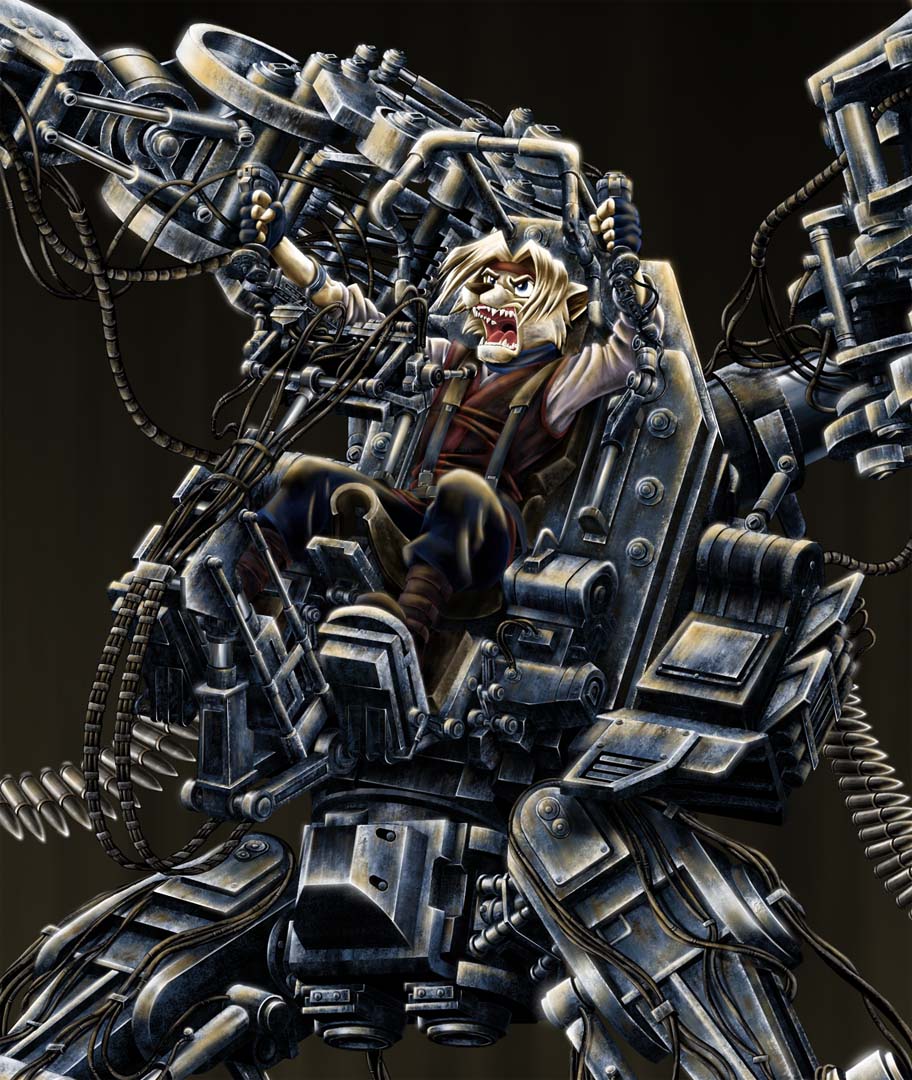 Power Mechs
Mainly used by military, these mechs act as powered armors but provide no actual bonus to ballistic ratings (though provide 8 impact and alleviate all falling damage).
Such devices are typically used to wield heavy weapons like rail guns or miniguns by one person, and often have effective strength ratings of 14 or more. These mechs can lift most cars (but not outrun them).
The availability of these are extremely high, and the user suffers perception modifiers from the front and side (though included huds usually show movement in 360 degrees).
These things way 2-3 tons and can fit in the back of a semi truck (by laying or folding) but not in most moving trucks. They make reduclous noise. Certainly not for your average shadowrunner. This is used with the Pilot: Mech skill.
 Bot Suit
 These limited power suits are used for heavy lifting and mechanical work. They are not combat-specific, and generally have a strength score equal to their rating (normally from 6-12) and are self powered, but use the user's quickness (giving -2 to the quickness score). They are not fast, but instead strong, used to pull cars (in neutral) or lift heavy boxes.
Some provide ballisting and impact armor ratings, usually between 2 and 4.
Special Techniques
Consequence Reading: (Requires Common Sense Edge)
A character can suggest to the GM a specific course of action and make an Intelligence (4) test. The GM should tell the player what a probable outcome of that action will be. Extra successes equal more detailed info.
Example: The player says "I want to set off a smoke bomb, escape using the fire escape slide, using my knife to cut it behind me so people can't follow me away". He rolls 3 successes on his intelligence test, so the GM says "People may assume there's a fire and try to escape using the slide, be unable to see that it's damaged and fall to their injury or death."
Conversation Trick:
Daffy: It's rabbit season
Bugs: Duck season
Daffy: Rabbit season
Bugs: Rabbit season
Daffy: Duck season!
A conversation trick can trick someone into either revealing something, changing their stated belief, or thinking or taling about a special topic. The player makes an etiquette test opposed by the targets intelligence. If the player is successful, the ploy succeeds, with multiple successes meaning greater success. If the player fails, the ploy fails. If the target gets more than 3 net successes, he detects the attempted ploy and may be bothered by it.
This can be used during mind reading to attempt to trick people into thinking about a given topic.
Example: The party wants to know the location of the target's diary. The player says "So I hear your brother was going through your diary." he makes the opposed test. If successful, the target's eyes dart to her bed quickly. Multiple successes may have her go check the bed immediately to see if the diary is disturbed, thus revealing the diary's location. 3 net successes from the target make her realize the player is trying to trick her into revealing the diary's location.
Cold Reading
This is used to determine things about a person and being able to predict things about them. After a few rounds of conversation with a person, make a knowledge:psychology check opposed by the target's intelligence. You gain can get from a -3 to +3 modifier on the roll depending on how familiar you already are with the target, and how familiar the target is with you. (If you've been spying on him for a week and he just met you, you gain +3 to your roll).
If successful, you can divine things about the target that were not explicitly revealed. (Hey, I bet he uses his daughter's name as his password!) Multiple successes reveal more detailed and relevant items. This can be combined with Holmsing (below)
Holmsing
This is the Sherlock Holmes technique of looking at someone and gaining rediculously detailed information about them. Make a perception test against a TN of 4 and an investigation roll. The perception roll is modified by a person's direct attempts to conceal things. The investigation TN is set by the GM based on the nature of the information gained.
Each success reveals something about the target, which may or may not be relevant. This can aid in cold reading (above).
Example: The player succeeds his perception test and thus gets to make his investigation roll. The GM sets the TN at 6 and the player gets 3 successes. He deduces that the grey dirt on the target's knees indicates he was recently on his knees in a dusty place- most likely Hope Church's graveyard, which has lots of gravel about and has had a poor time growing plants. This means he was likely kneeling at a grave. His left ring finger shows a small indentation which means he was recetly wearing a wedding ring. Perhaps he was kneeling at the grave of a deceased wife. His suit is new and shows little wear, meaning the death may be recent, or he may have recently come into some extra funds.
Grappling
Make an unarmed combat check against a target. If he doesn't dodge, he resists you with strength instead of body. If you have more successes you have grappled him and he is unable to move, draw weapons, etc. While grappling he must succeed at an opposed strength check to draw weapons, or aim firearms (even at you).
Tripping
Make an unarmed combat check against the target. If he doesn't dodge he can resist you with reaction. If he fails he drops prone.
Disarm
Make a melee weapon combat roll against the target, taking the penalty for called shot. If successful, the target resists you with strength. If you get more successes he drops something he was holding. If you are using unarmed combat and you get more than 2 net successes you may choose to be holding the item yourself.
Optic Advantage
You can attempt to make a perception test (TN set by GM) to attempt to use a window, glasses, cybereye, mirror, etc to see what's going on somewhere outside your direct field of view. (For example, reading a person's computer screen off the reflecton on his glasses). Such things should have very high TNs.
Do it Now!
You can attempt to use a negotiation test supplimented by intimidate (or etiquette) to convince someone to do something by creating a special scenario. Intimidate is used if the scenario is bullying, while etiquette is used if the scenario is just annoying. You might try to get past a guard by saying you need to go the bathroom really bad, or lure a guard from his post by telling him that you've run out of toilet paper.
Example: You attempt to get the border guard to stop from checking your ID by pulling out your purse and dropping it, causing all sorts of papers and card to go all over the floor of your car. You act all worried as you start trying to sort through the papers to find your ID. The guard, seeing all the cars piled up behind you, just sends you through, since you look like you're probably fine. In this case, you can use etiquette to suppliment your negotiations.
Example: You attempt to get into a club by demanding that you are the personal assistant to a celebrity who is supposed to appear at the club next week. You are overly demanding and want to make sure everything is perfect, because pop star divas like your client throw fits over everything. As the guard asks for ID and such, you throw fits, get on the phone and pretend to have a conversation, ask the guard for his name, until he starts to get worried and decides to let you pass. In this case, use intimidation to suppliment your negotiate.
Taunt/Distract
The player makes a charisma check opposed by the target's willpower, by shouting things at the target. The player can force the target to take a penalty to his willpower roll if he has specific information to shout at the target (such as if he knows the target's sister is a whore and he shouts about how he was the one who gaver her syphilus, etc).
If the player is successful, the target becomes enraged and "attacks" the player. In regular combat this means targeting the player. Outside of combat it may mean unarmed attacks, arresting the player, or throwing him out of the club, distracting him from other people. Each round (or until the target gets his point across) the target must re-make the willpower roll (with a +1 cumulative bonus each round) to break off of the player, though he may get further bonuses if he notices that this was a ruse. (During a distraction he may get penalties to his perception checks, however).
A character can suggest to the GM a specific course of action and make an Intelligence (4) test. The GM should tell the player what a probable outcome of that action will be. Extra successes equal more detailed info.
Example: The player says "I want to set off a smoke bomb, escape using the fire escape slide, using my knife to cut it behind me so people can't follow me away". He rolls 3 successes on his intelligence test, so the GM says "People may assume there's a fire and try to escape using the slide, be unable to see that it's damaged and fall to their injury or death."
Conversation Trick:
Daffy: It's rabbit season
Bugs: Duck season
Daffy: Rabbit season
Bugs: Rabbit season
Daffy: Duck season!
A conversation trick can trick someone into either revealing something, changing their stated belief, or thinking or taling about a special topic. The player makes an etiquette test opposed by the targets intelligence. If the player is successful, the ploy succeeds, with multiple successes meaning greater success. If the player fails, the ploy fails. If the target gets more than 3 net successes, he detects the attempted ploy and may be bothered by it.
This can be used during mind reading to attempt to trick people into thinking about a given topic.
Example: The party wants to know the location of the target's diary. The player says "So I hear your brother was going through your diary." he makes the opposed test. If successful, the target's eyes dart to her bed quickly. Multiple successes may have her go check the bed immediately to see if the diary is disturbed, thus revealing the diary's location. 3 net successes from the target make her realize the player is trying to trick her into revealing the diary's location.
Cold Reading
This is used to determine things about a person and being able to predict things about them. After a few rounds of conversation with a person, make a knowledge:psychology check opposed by the target's intelligence. You gain can get from a -3 to +3 modifier on the roll depending on how familiar you already are with the target, and how familiar the target is with you. (If you've been spying on him for a week and he just met you, you gain +3 to your roll).
If successful, you can divine things about the target that were not explicitly revealed. (Hey, I bet he uses his daughter's name as his password!) Multiple successes reveal more detailed and relevant items. This can be combined with Holmsing (below)
Holmsing
This is the Sherlock Holmes technique of looking at someone and gaining rediculously detailed information about them. Make a perception test against a TN of 4 and an investigation roll. The perception roll is modified by a person's direct attempts to conceal things. The investigation TN is set by the GM based on the nature of the information gained.
Each success reveals something about the target, which may or may not be relevant. This can aid in cold reading (above).
Example: The player succeeds his perception test and thus gets to make his investigation roll. The GM sets the TN at 6 and the player gets 3 successes. He deduces that the grey dirt on the target's knees indicates he was recently on his knees in a dusty place- most likely Hope Church's graveyard, which has lots of gravel about and has had a poor time growing plants. This means he was likely kneeling at a grave. His left ring finger shows a small indentation which means he was recetly wearing a wedding ring. Perhaps he was kneeling at the grave of a deceased wife. His suit is new and shows little wear, meaning the death may be recent, or he may have recently come into some extra funds.
Grappling
Make an unarmed combat check against a target. If he doesn't dodge, he resists you with strength instead of body. If you have more successes you have grappled him and he is unable to move, draw weapons, etc. While grappling he must succeed at an opposed strength check to draw weapons, or aim firearms (even at you).
Tripping
Make an unarmed combat check against the target. If he doesn't dodge he can resist you with reaction. If he fails he drops prone.
Disarm
Make a melee weapon combat roll against the target, taking the penalty for called shot. If successful, the target resists you with strength. If you get more successes he drops something he was holding. If you are using unarmed combat and you get more than 2 net successes you may choose to be holding the item yourself.
Optic Advantage
You can attempt to make a perception test (TN set by GM) to attempt to use a window, glasses, cybereye, mirror, etc to see what's going on somewhere outside your direct field of view. (For example, reading a person's computer screen off the reflecton on his glasses). Such things should have very high TNs.
Do it Now!
You can attempt to use a negotiation test supplimented by intimidate (or etiquette) to convince someone to do something by creating a special scenario. Intimidate is used if the scenario is bullying, while etiquette is used if the scenario is just annoying. You might try to get past a guard by saying you need to go the bathroom really bad, or lure a guard from his post by telling him that you've run out of toilet paper.
Example: You attempt to get the border guard to stop from checking your ID by pulling out your purse and dropping it, causing all sorts of papers and card to go all over the floor of your car. You act all worried as you start trying to sort through the papers to find your ID. The guard, seeing all the cars piled up behind you, just sends you through, since you look like you're probably fine. In this case, you can use etiquette to suppliment your negotiations.
Example: You attempt to get into a club by demanding that you are the personal assistant to a celebrity who is supposed to appear at the club next week. You are overly demanding and want to make sure everything is perfect, because pop star divas like your client throw fits over everything. As the guard asks for ID and such, you throw fits, get on the phone and pretend to have a conversation, ask the guard for his name, until he starts to get worried and decides to let you pass. In this case, use intimidation to suppliment your negotiate.
Taunt/Distract
The player makes a charisma check opposed by the target's willpower, by shouting things at the target. The player can force the target to take a penalty to his willpower roll if he has specific information to shout at the target (such as if he knows the target's sister is a whore and he shouts about how he was the one who gaver her syphilus, etc).
If the player is successful, the target becomes enraged and "attacks" the player. In regular combat this means targeting the player. Outside of combat it may mean unarmed attacks, arresting the player, or throwing him out of the club, distracting him from other people. Each round (or until the target gets his point across) the target must re-make the willpower roll (with a +1 cumulative bonus each round) to break off of the player, though he may get further bonuses if he notices that this was a ruse. (During a distraction he may get penalties to his perception checks, however).
Leadership
Another one of those skills with limited (if any) direct use is leadership. So let's clean it up.
A character with leadership may take the "commanding" roll in battle. At least once per turn he spends a complex action shouting out orders to his team. "Dave- shoot that guy", "Mark- unlock that door!" etc. He may shoult commands to all his teammates in one complex action.
During this action he may make a leadership test TN 4. For every success he gets on this test, his teammates get +1 die on any check to complete that action, as well as +1 die of combat pool (or tech pool, astral combat pool, or spell pool- reciever's choice) for the rest of the turn- however they only get these bonuses if they are attempting the action that he shouted out to them. (If he says unlock the door, they get no bonus if they instead shoot someone). They need not succeed in the action to get the bonus, but they must spend at least one relevant action attempting it.
This is only useful in combat scenarios, and the orders must be specific. ("Shoot THAT guy" is fine, but not "Start Shooting". "Cover fire" is fine but not "Run Around". "Summon a spirit" is fine but not "cast a spell" (you would need to specify a spell and a target, thoug spirits are specific enough- how many sprits can you summon from where you are anyway?).
The leader may instead attempt to command just one of his allies instead of the ally group as a complex action. He then makes a leadership (8) test. For ever success he lowers the TN of the proposed action by 1. (So if he says "Dave, summon a spirit!" and makes 3 successes, Dave can get a -3 bonus to his TN to summon a spirit!). The player is not aware how many successes the leader has until he makes the test (and thus cannot plan what spirit to summon based on what bonus he has).
This wastes an action for the leader, but allows him to effectively command his troops in battle. A leader can spend all his actions commanding troops and provide tons of bonuses, though individual bonuses overlap and do not stack (he can't benefit from spending more than one phase telling everyone to do the same thing).
A character with leadership may take the "commanding" roll in battle. At least once per turn he spends a complex action shouting out orders to his team. "Dave- shoot that guy", "Mark- unlock that door!" etc. He may shoult commands to all his teammates in one complex action.
During this action he may make a leadership test TN 4. For every success he gets on this test, his teammates get +1 die on any check to complete that action, as well as +1 die of combat pool (or tech pool, astral combat pool, or spell pool- reciever's choice) for the rest of the turn- however they only get these bonuses if they are attempting the action that he shouted out to them. (If he says unlock the door, they get no bonus if they instead shoot someone). They need not succeed in the action to get the bonus, but they must spend at least one relevant action attempting it.
This is only useful in combat scenarios, and the orders must be specific. ("Shoot THAT guy" is fine, but not "Start Shooting". "Cover fire" is fine but not "Run Around". "Summon a spirit" is fine but not "cast a spell" (you would need to specify a spell and a target, thoug spirits are specific enough- how many sprits can you summon from where you are anyway?).
The leader may instead attempt to command just one of his allies instead of the ally group as a complex action. He then makes a leadership (8) test. For ever success he lowers the TN of the proposed action by 1. (So if he says "Dave, summon a spirit!" and makes 3 successes, Dave can get a -3 bonus to his TN to summon a spirit!). The player is not aware how many successes the leader has until he makes the test (and thus cannot plan what spirit to summon based on what bonus he has).
This wastes an action for the leader, but allows him to effectively command his troops in battle. A leader can spend all his actions commanding troops and provide tons of bonuses, though individual bonuses overlap and do not stack (he can't benefit from spending more than one phase telling everyone to do the same thing).
Limit Break!
"This isn't anger... isn't hatred..."- Galuf Halm Baldseion
"Well... my time is almost up. Time to die, everyone!" - Trance Kuja
"I... I can fight! ... I realize we must fight for the future of the children." - Terra Branford
Limit Breaks are a final desperation move for a character who is near death or in a highly emotionally charged state. Such states include direct and real threats against a loved one ("MJ and I, we'll have a hell of a time!"- The Green Goblin) or against something which the character has previously proven to be something of deep emotional connection to the character (the dependant flaw could work, or someone who threatens to destroy the entire world, etc). This can also be used by a character who is at 10 boxes of physical damage.
To use Limit Break!, the character must have at least 3 points of karma pool available. He permanently burns those three points of good karma, and enters Trance Mode
During trance mode, the character can use 1 karma pool for free on EVERY roll. (Basically letting him reroll failures on every roll!) He gains immunity to natural weapons (at double his essence), and gets a -3 bonus to all TNs. He also ignores all wound penalties. He continues this carnage even as he takes overflow boxes of damage. The character cannot be healed during this time, nor can he break off combat.
Naturally this makes the character into a combat monster. He also goes into a berserker style rage, where he must fight to destroy the offending enemy (or all visible enemies), which lasts until the encounter ends (which may be dragged out sligtly in extended foot chase scenes). During any time which the emotional state ends or the encounter ends, the trance ends. (so the trance state cannot be used to chase the enemy in your helicoptor, unless you're crashing the copter into the villain!, nor can it be used to sneak through a facility or disable maglocks- only to recklessly destroy!).
When trance ends: the character collapses from exhaustion (and this is reliant on other PCs to carry them out). If the character had 10+ boxes of physical damage he dies. (If he had a cranial bomb, it detonates!). The character cannot be awakened for 24 hours after collapsing.
Trance can be used in place of hand of god for special way for a charcter to die to save the team or to kill the big bad guy. Since the PC can't break off combat (and can't die!) he affortds the rest of the team a chance to escape (at least), and may do considerable damage on his way out. (Might be better than a TPK!)
"Well... my time is almost up. Time to die, everyone!" - Trance Kuja
"I... I can fight! ... I realize we must fight for the future of the children." - Terra Branford
Limit Breaks are a final desperation move for a character who is near death or in a highly emotionally charged state. Such states include direct and real threats against a loved one ("MJ and I, we'll have a hell of a time!"- The Green Goblin) or against something which the character has previously proven to be something of deep emotional connection to the character (the dependant flaw could work, or someone who threatens to destroy the entire world, etc). This can also be used by a character who is at 10 boxes of physical damage.
To use Limit Break!, the character must have at least 3 points of karma pool available. He permanently burns those three points of good karma, and enters Trance Mode
During trance mode, the character can use 1 karma pool for free on EVERY roll. (Basically letting him reroll failures on every roll!) He gains immunity to natural weapons (at double his essence), and gets a -3 bonus to all TNs. He also ignores all wound penalties. He continues this carnage even as he takes overflow boxes of damage. The character cannot be healed during this time, nor can he break off combat.
Naturally this makes the character into a combat monster. He also goes into a berserker style rage, where he must fight to destroy the offending enemy (or all visible enemies), which lasts until the encounter ends (which may be dragged out sligtly in extended foot chase scenes). During any time which the emotional state ends or the encounter ends, the trance ends. (so the trance state cannot be used to chase the enemy in your helicoptor, unless you're crashing the copter into the villain!, nor can it be used to sneak through a facility or disable maglocks- only to recklessly destroy!).
When trance ends: the character collapses from exhaustion (and this is reliant on other PCs to carry them out). If the character had 10+ boxes of physical damage he dies. (If he had a cranial bomb, it detonates!). The character cannot be awakened for 24 hours after collapsing.
Trance can be used in place of hand of god for special way for a charcter to die to save the team or to kill the big bad guy. Since the PC can't break off combat (and can't die!) he affortds the rest of the team a chance to escape (at least), and may do considerable damage on his way out. (Might be better than a TPK!)
Magical Technology
Mana-Masker
A new development by Avalon corp, the Mana-Masker is a device about the size of Darth Vader's chest plate, which contains microscopic bacterial organisms which are nurtured inside and given various electrical impusles that allow them to simulate emotions.
In game terms, this helps mask an astral signature of an individual or his foci. This device can fool any mechanical way of detecting astral signatures (such as the Shinra PKE but not mages using astral vision). The rating of the device rolls against the rating of the one looking for signatures, and if successful it hides the auras of foci and individuals (but not sustained or quickened spells) on the person. The mana masker must be worn on the outside of the body, and may be apparant to others.
Aura-Bomb
A special kind of grenade by Avalon corp, this sends out sprays of microorganisms into the air in the form of smoke or mist when it detonates. While this does nothing to normal people, anyone astrally perciving (or any machine doing so) will be overloaded with the auras, and be unable to distinguish one aura from another (being effectively blind). What's more, astrally projecting creatures and unmanifested spirits will be unable to move through the effective area due to the life forms everywhere. This is sometimes used to set false alarms with PKE readers, or to hide mages (amongst the mess).
M-Death
This is a special drug which, when injected, temporarily removes all magic from the subject. The subject becomes unable to summon spirits or use magic (though ones already in the field still owe their survices). Their aura is completely surpressed during this time. It takes 6 successes on an assenssing test to realize that the aura viewed is being concealed by drugs, but they cannot tell the true aura or essence/magic scores. This prevents critters from using regeneration and other abilities, but helps them sneak past any form of astral viewing, mechanical or otherwise.
This drug is in very high demand due to its possible weapon use, but Avalon has been very protective in its production, specifically using a method which requires awakened plants so that the drug cannot be easily replicated. It is not really addictive (2, day). This even conceales magical auras on the target (such as active spells and foci).
Ranged Weapon Foci
Avalon finally "perfected" the ranged weapon foci. A projectile weapon (such as a slingshot or bow, but not a firearm or laser weapon) can be imbued as a ranged weapon focus. (Treat it as a weapon with reach +3!). Whenever the weapon is to be fired as a focus, the user's magic is reduced by 1 (meaning that your standard starting mage has 6 shots at best, including misses). When the magic reaches 0, the mage must check for magic loss and all sustained spells and abilities (like astral projection) are lost. The lost magic points restore at 1 per hour. When using this in astral combat, the weapon need not fire "actual" projectiles. The mage may choose to use the weapon without expending magic but it does not act as a weapon focus (for damaging creatures or overcoming regeneration from death) when this is done.
Metamagic: Ranged Focus Expert
With the creation of the Ranged Weapon Focus, Avalon mages developed a metamagic technique which would allow magic only to be lost on a successful hit, not when the shot misses.
Metamagic Ranged Focus Master (requires ranged focus expert)
The most advanced mages have learned how to channel their magic so that only enemies who suffer a wound from the ranged weapon foci cause magic loss to the mage, those who resist the damage completely cause no ill effects to the mage.
Avanlon Emancipator
This taser weapon fires a ray of electrical discharge at a target, doing 5L stun damage. It can hold 20 shots before needing a recharge and is the size of Han's Blaster. Spirits and astrally active creatures take no damage from this specially charged beam. This is not the main use of the device, however. When fired at a device which houses a trapped spirit (such as a mako battery or a spirit trap) the device must make an rating test TN 8. If it has more successes then the person firing the weapon got, it is fine. Otherwise it explodes, causing everyone within 10 meters to resist 10S damage, and the spirt(s) within are freed instantly, who usually flee, but sometimes may attack their prior captors.
Large reactor devices (such as Mako reactors or giant Spirit Trap containment units) usually have special shielding devices rendering them immune or resistant to such handheld devices.
A new development by Avalon corp, the Mana-Masker is a device about the size of Darth Vader's chest plate, which contains microscopic bacterial organisms which are nurtured inside and given various electrical impusles that allow them to simulate emotions.
In game terms, this helps mask an astral signature of an individual or his foci. This device can fool any mechanical way of detecting astral signatures (such as the Shinra PKE but not mages using astral vision). The rating of the device rolls against the rating of the one looking for signatures, and if successful it hides the auras of foci and individuals (but not sustained or quickened spells) on the person. The mana masker must be worn on the outside of the body, and may be apparant to others.
Aura-Bomb
A special kind of grenade by Avalon corp, this sends out sprays of microorganisms into the air in the form of smoke or mist when it detonates. While this does nothing to normal people, anyone astrally perciving (or any machine doing so) will be overloaded with the auras, and be unable to distinguish one aura from another (being effectively blind). What's more, astrally projecting creatures and unmanifested spirits will be unable to move through the effective area due to the life forms everywhere. This is sometimes used to set false alarms with PKE readers, or to hide mages (amongst the mess).
M-Death
This is a special drug which, when injected, temporarily removes all magic from the subject. The subject becomes unable to summon spirits or use magic (though ones already in the field still owe their survices). Their aura is completely surpressed during this time. It takes 6 successes on an assenssing test to realize that the aura viewed is being concealed by drugs, but they cannot tell the true aura or essence/magic scores. This prevents critters from using regeneration and other abilities, but helps them sneak past any form of astral viewing, mechanical or otherwise.
This drug is in very high demand due to its possible weapon use, but Avalon has been very protective in its production, specifically using a method which requires awakened plants so that the drug cannot be easily replicated. It is not really addictive (2, day). This even conceales magical auras on the target (such as active spells and foci).
Ranged Weapon Foci
Avalon finally "perfected" the ranged weapon foci. A projectile weapon (such as a slingshot or bow, but not a firearm or laser weapon) can be imbued as a ranged weapon focus. (Treat it as a weapon with reach +3!). Whenever the weapon is to be fired as a focus, the user's magic is reduced by 1 (meaning that your standard starting mage has 6 shots at best, including misses). When the magic reaches 0, the mage must check for magic loss and all sustained spells and abilities (like astral projection) are lost. The lost magic points restore at 1 per hour. When using this in astral combat, the weapon need not fire "actual" projectiles. The mage may choose to use the weapon without expending magic but it does not act as a weapon focus (for damaging creatures or overcoming regeneration from death) when this is done.
Metamagic: Ranged Focus Expert
With the creation of the Ranged Weapon Focus, Avalon mages developed a metamagic technique which would allow magic only to be lost on a successful hit, not when the shot misses.
Metamagic Ranged Focus Master (requires ranged focus expert)
The most advanced mages have learned how to channel their magic so that only enemies who suffer a wound from the ranged weapon foci cause magic loss to the mage, those who resist the damage completely cause no ill effects to the mage.
Avanlon Emancipator
This taser weapon fires a ray of electrical discharge at a target, doing 5L stun damage. It can hold 20 shots before needing a recharge and is the size of Han's Blaster. Spirits and astrally active creatures take no damage from this specially charged beam. This is not the main use of the device, however. When fired at a device which houses a trapped spirit (such as a mako battery or a spirit trap) the device must make an rating test TN 8. If it has more successes then the person firing the weapon got, it is fine. Otherwise it explodes, causing everyone within 10 meters to resist 10S damage, and the spirt(s) within are freed instantly, who usually flee, but sometimes may attack their prior captors.
Large reactor devices (such as Mako reactors or giant Spirit Trap containment units) usually have special shielding devices rendering them immune or resistant to such handheld devices.
Wednesday, December 29, 2010
Mako Energy
Energy from spiritual sources or "souls", Mako energy has been quite contraversial since its discovery by Shinra Corp. It provides energy which is clean, reliable, portable, and long-lasting, but it is powered by "souls" (and it's status as renewable energy is debateable).
Many Mako battery reactors are powered by captured free spirits, ghosts and spectres, or even live critters (who die during the process).
In game terms, Mako batteries usually cost double or triple what normal batteries do, with an extremely high availability. They generate a small aura (as if a sustained spell), and the batteries will last 10-20 times as long, making them ideal for rutheneum suites or energy weapons. Once the batteries drain, they can only be recharged by replacing the spirit trapped within, either by catching one and using a spirit trap, or by going to a designated Shinra facility and purchasing one. Some free spirits have been known to be powerful enough to have charged batteries which still have not run out!
A few small mako reactors have been created, usually on site to help power Shinra's own corporate buildings. Rumors about them using the "earth's soul" abound, though their spirit fighting equipment and reputation implies that they could easily be powered by strong captured spirits. The effect of draining the earth's soul (if it exists) leads to debates as heated and varied as the global warming debates of the late 20th century. So far, no ill effects have been observed (or at least reported).
Anyone seen with a mako battery seems to be treated as if they had the spirit bane flaw for all spirit types. There has been some debate as to whether this is an evil practice or not, particularly in relation to blood spirits, toxic spirits, and insect spirits.
Many Mako battery reactors are powered by captured free spirits, ghosts and spectres, or even live critters (who die during the process).
In game terms, Mako batteries usually cost double or triple what normal batteries do, with an extremely high availability. They generate a small aura (as if a sustained spell), and the batteries will last 10-20 times as long, making them ideal for rutheneum suites or energy weapons. Once the batteries drain, they can only be recharged by replacing the spirit trapped within, either by catching one and using a spirit trap, or by going to a designated Shinra facility and purchasing one. Some free spirits have been known to be powerful enough to have charged batteries which still have not run out!
A few small mako reactors have been created, usually on site to help power Shinra's own corporate buildings. Rumors about them using the "earth's soul" abound, though their spirit fighting equipment and reputation implies that they could easily be powered by strong captured spirits. The effect of draining the earth's soul (if it exists) leads to debates as heated and varied as the global warming debates of the late 20th century. So far, no ill effects have been observed (or at least reported).
Anyone seen with a mako battery seems to be treated as if they had the spirit bane flaw for all spirit types. There has been some debate as to whether this is an evil practice or not, particularly in relation to blood spirits, toxic spirits, and insect spirits.
Relics of the Faithful
Some objects seem to have taken an almost "awakened" style, based on the beliefs of people and the constant legends surrounding such object. Scholars have wondered if it was some kind of magical placebo effect, something the user is doing instead of the item itself, which seems to be justified when some items don't work for active disbelievers, but then sometimes people are able to manipulate objects without being aware of their history, so the debate rages on.
In shadowrun campaigns, some kind of relic might be the focus of a mission, or a mission may take place near a museum where they can go to ask for a blessing (such as a mission in Jerusalem where they can go to the site of Jesus' birth).
Example Relics:
Jesus Toast: It could be jesus, it could be Mary, it could be toast, it could be wood, but when people flock around a naturally occuring religious icon, it seems like their own prayers are infusing it with the semblance of power. Some people have claimed that the relic has cast the heal spell on them as if it were an anchoring focus using its own skill.
Saint's Remains: The remains of a saint, their burial shroud, their thigh bone, or whatever is sometimes worshipped in its own right, and people have claimed to have diseases cured by touching such a vessel, or by praying before it.
Legendary Weapons: Some legendary weapons (such as Masamune or Excalibur) have been said to act as a weapon focus without the user needing to bond with it, being able to overcome natural weapon immunity and slay regenerators with ease. Of course, with all the frauds out there (and the ability to create your own weapon foci) such claims are hard to verify.
God's Own Items: Whether it be the Holy Grail, the Tablets of Joseph Smith, a thorn from jesus' crown, or a splinter of Noah's Ark, some holy relics have demonstrated magical ability to those who come and touch them or pray to them. Sometimes this comes in the form of a boost or detection magic on behalf of the worshipper. The Catholic Pope's orb is said to act as a sustaining focus, for example, and none of the popes ever needed to bond with it.
Holy Sites: Some locations themselves seem to act as power sites, despite no actual mana lines going through or converging there. The site of Jesus' birth, Stonehenge, the Easter Island Heads, Old Faithful, or the top of Mt. Olympus may be examples of some power sites, empowered by the mysteries and faith of those around them more so than by "measureable" sources.
In shadowrun campaigns, some kind of relic might be the focus of a mission, or a mission may take place near a museum where they can go to ask for a blessing (such as a mission in Jerusalem where they can go to the site of Jesus' birth).
Example Relics:
Jesus Toast: It could be jesus, it could be Mary, it could be toast, it could be wood, but when people flock around a naturally occuring religious icon, it seems like their own prayers are infusing it with the semblance of power. Some people have claimed that the relic has cast the heal spell on them as if it were an anchoring focus using its own skill.
Saint's Remains: The remains of a saint, their burial shroud, their thigh bone, or whatever is sometimes worshipped in its own right, and people have claimed to have diseases cured by touching such a vessel, or by praying before it.
Legendary Weapons: Some legendary weapons (such as Masamune or Excalibur) have been said to act as a weapon focus without the user needing to bond with it, being able to overcome natural weapon immunity and slay regenerators with ease. Of course, with all the frauds out there (and the ability to create your own weapon foci) such claims are hard to verify.
God's Own Items: Whether it be the Holy Grail, the Tablets of Joseph Smith, a thorn from jesus' crown, or a splinter of Noah's Ark, some holy relics have demonstrated magical ability to those who come and touch them or pray to them. Sometimes this comes in the form of a boost or detection magic on behalf of the worshipper. The Catholic Pope's orb is said to act as a sustaining focus, for example, and none of the popes ever needed to bond with it.
Holy Sites: Some locations themselves seem to act as power sites, despite no actual mana lines going through or converging there. The site of Jesus' birth, Stonehenge, the Easter Island Heads, Old Faithful, or the top of Mt. Olympus may be examples of some power sites, empowered by the mysteries and faith of those around them more so than by "measureable" sources.
Improvised Weapons
Sometimes you don't have a weapon. Sometimes you need to deal with the crap you find. Enter the improvised weapons!
Improvised weapons generally deal damage using either unarmed combat skill or whatever is closest to the weapon. Weapons that fit in the palm of the hand (large rocks or broken bottles) used for melee should be unarmed combat. Larger items (pool cues, chairs, etc) should go towards other items (polearms for pool cues). Thrown weapons tend to use the thrown weapon skill.
An improvised item generally uses ballistic armor to resist it. If sharp (broken bottle) it does physical damage, if blunt (big rock) it does stun damage. Going from stun>physical is fine, but it reduces the power of the attack by 1/2.
Most improvised weapons do 1 or 2 points less power than normal (so a chair leg might do [Str-2]L stun). Partiuclarly bulky items (like a whole chair) should take a +1 or +2 TN penalty to their use.
Some basic improvised weapons:
(Str-2)L Stun: Big rock, fire extinquisher, char leg, pool cue (+1 reach), chair (+2 TN), railroad spike.
(Str-1)L Stun: Bike chain (+1 reach), ladder (+2 reach), baseball bat
(Str)L Stun: Tire iron, crowbar
(Str-1)L : Broken bottle, railroad spike, straight razor, sawblade, saw, board with a nail in it
At GMs option, some improvised weapons may have special characteristics (a chair might be held as a shield, dirt might be thrown to blind, etc).
Improvised weapons generally deal damage using either unarmed combat skill or whatever is closest to the weapon. Weapons that fit in the palm of the hand (large rocks or broken bottles) used for melee should be unarmed combat. Larger items (pool cues, chairs, etc) should go towards other items (polearms for pool cues). Thrown weapons tend to use the thrown weapon skill.
An improvised item generally uses ballistic armor to resist it. If sharp (broken bottle) it does physical damage, if blunt (big rock) it does stun damage. Going from stun>physical is fine, but it reduces the power of the attack by 1/2.
Most improvised weapons do 1 or 2 points less power than normal (so a chair leg might do [Str-2]L stun). Partiuclarly bulky items (like a whole chair) should take a +1 or +2 TN penalty to their use.
Some basic improvised weapons:
(Str-2)L Stun: Big rock, fire extinquisher, char leg, pool cue (+1 reach), chair (+2 TN), railroad spike.
(Str-1)L Stun: Bike chain (+1 reach), ladder (+2 reach), baseball bat
(Str)L Stun: Tire iron, crowbar
(Str-1)L : Broken bottle, railroad spike, straight razor, sawblade, saw, board with a nail in it
At GMs option, some improvised weapons may have special characteristics (a chair might be held as a shield, dirt might be thrown to blind, etc).
Archaic Projectile Weapons
Anyone can fire a gun, and it's easy to be a sniper when you're shooting someone from over a kilometer away with a silenced rifle. Archaic weapons help add some flavor (and some advantage) to a typical mission.
Bows: Bows have a distinct advantage over guns: they are silent. In many cases they can be built out of non-metallic materials (not always) and thus be hidden from metallic anomaly scanners. However, their bulk can often compensate for this. Bows cannot benefit from lasers, scopes, or smartlinks.
Firing a bow is a complex action that includes drawing the arrow, and pulling the string. It uses impact armor instead of ballistic armor to determine damage.
Bows do (S+2)M damage base, though some specially designed bows or arrows may increase this (EX ammo is avail for arrows, but it does eliminate the silence benefit). Bows have pistol range.
Crossbows: Crossbows are the fine line between bows and guns. They take a complex action to load, a simple action to shoot, and do flat damage. (Usually 6M, but can be modified by specially made crossbows or bolts). Like bows they can be easily made of non-metallic materials and unlike bows they can be folded up to make the more concealable. They are also silent. Crossbows can benefit from sights and scopes but not smartlinks. Crossbows have pistol range. They also use impact armor instead of ballistic.
While the range is more limited, the ability to work in complete silence can grant a huge advantage to the users of bows and crossbows, and such items are more easily considered "hunting" gear and are thus more available and less likely to draw questions from athority figures, even if you're walking down the street with them (but not drawn and strung of course).
Slingshots: Slingshots are small, easily concealable (8), and can pack a whollop. They do (Str)M damage, and special ammo models can increase this. They are very often made of non-metallic materials, rarely are people questioned for having this (except in termos of curiousity- why does an adult have a kid's toy?) and they are silent. They are also cheap. Their range is as a holdout pistol, and it's a complex action to fire. These cannot benefit from attachments (smartlink, etc)
Blowgun: A small dart is inserted into the blowgun and administered by blowing into the tube very quickly. They are extermely concealable (10), and the darts are often coated with poisons or drugs. The blowgun deals 6L(stun) damage, and this is never scaled up from successes, the extra successes only negate the ability to scale it down. Armor generally blocks these if it has impact ratings above 1, but a called shot can avoid armor rating with these. A wound generally must be taken to administer the poison, but not always if the poison is contact. These cannot benefit from attachments.
Launcher: Takes three people to use, this is a bit of rubber or elastic, each end held by two people while the third pulls back on the string and launches a missile (such as a grenade, molotov cocktail, water balloon, etc) a long distance with complete silence. Each "holder" must make a strength check TN 4 to keep steady while the launcher can fire at grenade launcher ranges. The impact does no damage, but typically the explosive detonates on impact (cooking during flight). If fired directly at a target at point blank range it is resisted with impact armor and does (Str+4)L(stun) damage. These are cheap and ultra-concealable (12).
Weapons above use the Projectile Weapon (quickness) active skill, which is grouped with thrown weapons.
Bows: Bows have a distinct advantage over guns: they are silent. In many cases they can be built out of non-metallic materials (not always) and thus be hidden from metallic anomaly scanners. However, their bulk can often compensate for this. Bows cannot benefit from lasers, scopes, or smartlinks.
Firing a bow is a complex action that includes drawing the arrow, and pulling the string. It uses impact armor instead of ballistic armor to determine damage.
Bows do (S+2)M damage base, though some specially designed bows or arrows may increase this (EX ammo is avail for arrows, but it does eliminate the silence benefit). Bows have pistol range.
Crossbows: Crossbows are the fine line between bows and guns. They take a complex action to load, a simple action to shoot, and do flat damage. (Usually 6M, but can be modified by specially made crossbows or bolts). Like bows they can be easily made of non-metallic materials and unlike bows they can be folded up to make the more concealable. They are also silent. Crossbows can benefit from sights and scopes but not smartlinks. Crossbows have pistol range. They also use impact armor instead of ballistic.
While the range is more limited, the ability to work in complete silence can grant a huge advantage to the users of bows and crossbows, and such items are more easily considered "hunting" gear and are thus more available and less likely to draw questions from athority figures, even if you're walking down the street with them (but not drawn and strung of course).
Slingshots: Slingshots are small, easily concealable (8), and can pack a whollop. They do (Str)M damage, and special ammo models can increase this. They are very often made of non-metallic materials, rarely are people questioned for having this (except in termos of curiousity- why does an adult have a kid's toy?) and they are silent. They are also cheap. Their range is as a holdout pistol, and it's a complex action to fire. These cannot benefit from attachments (smartlink, etc)
Blowgun: A small dart is inserted into the blowgun and administered by blowing into the tube very quickly. They are extermely concealable (10), and the darts are often coated with poisons or drugs. The blowgun deals 6L(stun) damage, and this is never scaled up from successes, the extra successes only negate the ability to scale it down. Armor generally blocks these if it has impact ratings above 1, but a called shot can avoid armor rating with these. A wound generally must be taken to administer the poison, but not always if the poison is contact. These cannot benefit from attachments.
Launcher: Takes three people to use, this is a bit of rubber or elastic, each end held by two people while the third pulls back on the string and launches a missile (such as a grenade, molotov cocktail, water balloon, etc) a long distance with complete silence. Each "holder" must make a strength check TN 4 to keep steady while the launcher can fire at grenade launcher ranges. The impact does no damage, but typically the explosive detonates on impact (cooking during flight). If fired directly at a target at point blank range it is resisted with impact armor and does (Str+4)L(stun) damage. These are cheap and ultra-concealable (12).
Weapons above use the Projectile Weapon (quickness) active skill, which is grouped with thrown weapons.
Subscribe to:
Posts (Atom)