Downtime can be a frequent issue amongst various PCs.
Many things require down time: Initiating, purchasing special equipment, gathering materials for talismongering or enchanting, actually enchanting, going to your day job, or even being captured will pull you out of the adventure.
Multiple characters can be a good way to get around this.
In this system, each player makes 2 characters. The characters all belong to the same team. The player decides who to play during each session, and the other character is considered "busy" and "unavailable" doing downtime activities.
This way a PC who gets captured need not sit out during his rescue, or if he has a time sensitive mission, another PC can get his down time to initiate while his alternate adventures. It is also a way to guarantee never to get a TPK as each PC will have a backup on hand.
Both characters will have to pay for their lifestyles seperately, and will gain mission money seperately (and should not share resources any more than other PCs do with each other). They may or may not gain karma equally depending on how your GM handles players who are not there that session.
This way, the game can continuously run, without being dragged out by excessive downtime. Just make sure each player earns enough to cover his lifestyle, or there may be trouble there.
Showing posts with label character creation. Show all posts
Showing posts with label character creation. Show all posts
Sunday, May 8, 2011

Thursday, January 6, 2011
Magic and the Mundane
Magic costs 18-30 build points (or less with one of my alternates.) That 30 build points could be used for 30 skill points, 15 attribute points, edges, etc. However, it soon becomes apparant during the course of the campaign that the mage trumps the mundane in every way.
Karma:
Yes, mages must spend a lot of karma initiating, learning spells, and bonding to foci. This may seem to give them a disadvantage. But remember that the quickening metamagic technique makes mages the cheapest characters to level up.
A mage basically pays 2 karma points per ability score increase. (1 to learn the spell, 1 to quicken it). They can go from 6 willpower to 12 willpower for 12 karma. Your standard human character (who cannot gain 12 willpower at all) must pay seperately for each stat increase a point at a time.
Because a mage can have higher stats cheaper, he can also have higher skills cheaper. Using a max skill rating of 12, a mage can ensure that any given stat is at least 12, causing him to pay a cheaper cost to raise a skill than a mundane would. This easily makes up for the karma costs.
Skills:
While a mage does spend a lot of karma initiating, he also finds that he needs less skills. (Sorcery and or Conjuration usually do it). A mage can lose stealth and cast invisibility. He can lose weapon skills and cast combat spels. He can forget vehicle skills and fly. And since the spell is far less expensive than the skill, the mage wins out against the mundane here also.
An adept can gain bonus dice to any skill via his powers, then also take the skill ranks. Checkmate, mundane!
Money:
Spells and foci are expensive. But then, while a mage is boosting his own willpower, he might as well sell the service to other party members and boost their stats as well. This can easily make up cost differences.
Cyberware:
While a mage is usually looked at as "non-cybered", a mage can easily take cyberware and take gaesa (which can be dropped during initiation if the wish). Some gaesa might be hardly noticable, allowing for a mage to have almost as much cyberware as someone else without trouble.
Bioware:
Finally, something that helps the mundane! There is no real way for a mage to get over his bio index except by increasing his magic (which still leaves him at a net loss). Of course, there's very little bioware can do that magic can't suppliment- the mnemonic enhancer comes to mind. Other than that... well, what bioware does the mage really need anyway?
Utility:
The ability to astrally percieve, assense, project, summon, spellcast, astrally track, use metamagic (such as divining and psychometry), banish and dispel magic and use spell defense dice are exclusive to mages. What's more, some spirits are immune to natural weapons. This means that in many cases it takes a mage to defeat a mage.
Equipment:
A mage need not carry guns (having attack spells), and might still have use of B&E equipment (which he can physically mask as something else), so a mage has no trouble walking past a security detail. (He might even look like their boss!). The mundane trying to pull his sniper rifle and 100 kilos of C12 however...
Rigging/Decking:
Well, a mage can use cyberware and can take skills. There's really nothing stopping the mage from being a decker or a rigger. Sure they load up on gaesa or something, but they can still do it with minimal problems.
Drugs:
Okay, you got me. Mages who abuse drugs must check for magic loss. (A check that becomes near impossible to fail at higher magic ratings) Of course, magic loss can also be offset by gaesa. What drugs are useful again? The stim patch? Totally not better than the healing spells.
Race:
While some races (elves, gnomes, dwarves) might seem better suited to mages due to their willpower or charisma bonuses, and some (trolls, orks) might seem ill suited, it really doesn't matter. They can boost up their stats very quickly, and still benefit from all their racial stuff. The charisma penalty means very little, and the willpower penalty doesn't really hurt them.
Astral Perception:
Oh yeah, only astrally percieving creatures risk being possessed or attacked on the astral plane! Good thing mages can just turn it off.
Defensive:
Who else can attack just fine using a mirror, or through an invisible wall? Not gunners! Who can counter ruthenium with well placed illusion spells? Who else can go unseen by cameras and ultrasound detectors?
Secrets:
What's more likely to work- the intimidation check or the mind reading? You can even read thoughts he's not aware he has! And detect spells? Come on!
So what's the benefit in playing a non caster? A few more skill ranks to start out with. That's pretty much it. The ability to take bioware without fear perhaps. That's why my campaigns tend to have special anti-magic security measures, to tip the scales back to balanced. Maybe you don't play your character to be powerful... but you probably do.
Karma:
Yes, mages must spend a lot of karma initiating, learning spells, and bonding to foci. This may seem to give them a disadvantage. But remember that the quickening metamagic technique makes mages the cheapest characters to level up.
A mage basically pays 2 karma points per ability score increase. (1 to learn the spell, 1 to quicken it). They can go from 6 willpower to 12 willpower for 12 karma. Your standard human character (who cannot gain 12 willpower at all) must pay seperately for each stat increase a point at a time.
Because a mage can have higher stats cheaper, he can also have higher skills cheaper. Using a max skill rating of 12, a mage can ensure that any given stat is at least 12, causing him to pay a cheaper cost to raise a skill than a mundane would. This easily makes up for the karma costs.
Skills:
While a mage does spend a lot of karma initiating, he also finds that he needs less skills. (Sorcery and or Conjuration usually do it). A mage can lose stealth and cast invisibility. He can lose weapon skills and cast combat spels. He can forget vehicle skills and fly. And since the spell is far less expensive than the skill, the mage wins out against the mundane here also.
An adept can gain bonus dice to any skill via his powers, then also take the skill ranks. Checkmate, mundane!
Money:
Spells and foci are expensive. But then, while a mage is boosting his own willpower, he might as well sell the service to other party members and boost their stats as well. This can easily make up cost differences.
Cyberware:
While a mage is usually looked at as "non-cybered", a mage can easily take cyberware and take gaesa (which can be dropped during initiation if the wish). Some gaesa might be hardly noticable, allowing for a mage to have almost as much cyberware as someone else without trouble.
Bioware:
Finally, something that helps the mundane! There is no real way for a mage to get over his bio index except by increasing his magic (which still leaves him at a net loss). Of course, there's very little bioware can do that magic can't suppliment- the mnemonic enhancer comes to mind. Other than that... well, what bioware does the mage really need anyway?
Utility:
The ability to astrally percieve, assense, project, summon, spellcast, astrally track, use metamagic (such as divining and psychometry), banish and dispel magic and use spell defense dice are exclusive to mages. What's more, some spirits are immune to natural weapons. This means that in many cases it takes a mage to defeat a mage.
Equipment:
A mage need not carry guns (having attack spells), and might still have use of B&E equipment (which he can physically mask as something else), so a mage has no trouble walking past a security detail. (He might even look like their boss!). The mundane trying to pull his sniper rifle and 100 kilos of C12 however...
Rigging/Decking:
Well, a mage can use cyberware and can take skills. There's really nothing stopping the mage from being a decker or a rigger. Sure they load up on gaesa or something, but they can still do it with minimal problems.
Drugs:
Okay, you got me. Mages who abuse drugs must check for magic loss. (A check that becomes near impossible to fail at higher magic ratings) Of course, magic loss can also be offset by gaesa. What drugs are useful again? The stim patch? Totally not better than the healing spells.
Race:
While some races (elves, gnomes, dwarves) might seem better suited to mages due to their willpower or charisma bonuses, and some (trolls, orks) might seem ill suited, it really doesn't matter. They can boost up their stats very quickly, and still benefit from all their racial stuff. The charisma penalty means very little, and the willpower penalty doesn't really hurt them.
Astral Perception:
Oh yeah, only astrally percieving creatures risk being possessed or attacked on the astral plane! Good thing mages can just turn it off.
Defensive:
Who else can attack just fine using a mirror, or through an invisible wall? Not gunners! Who can counter ruthenium with well placed illusion spells? Who else can go unseen by cameras and ultrasound detectors?
Secrets:
What's more likely to work- the intimidation check or the mind reading? You can even read thoughts he's not aware he has! And detect spells? Come on!
So what's the benefit in playing a non caster? A few more skill ranks to start out with. That's pretty much it. The ability to take bioware without fear perhaps. That's why my campaigns tend to have special anti-magic security measures, to tip the scales back to balanced. Maybe you don't play your character to be powerful... but you probably do.
Thursday, December 30, 2010
Who's Game is it Anyway?
Part of creating a character is knowing the style of the campaign before you go into it. Some GM's favor non-standard missions, some may present you with apocalypse scenarios, some might focus on your basic smash & grab missions, some on espionage, some on NPC interaction, some on stealth, while some might force you to make your own missions.
When creating a character, it's very important to think about who the GM is, and his particular play style, to make sure that your character doesn't end up sitting out all the time.
A GM that focuses on "do the right thing" saintly missions may not have as much for a ninja assassin who specalized on harvesting the body parts of his victims to do.
On the other hand, a GM who does a high paranoia kill-or-be-killed campaign is going to have the total pacifist literally sitting out all the time when his teammates are murdering everyone who gives them an awkward eye.
In the existing system, Riggers can pose a big problem, especially if they focus only on driving the car, without any special skills to actually complete missions, you're going to have an awesome driver with nothing to do.
Likewise, even the most detailed aquatic secret-base-building water sprite is going to look pretty foolish when most of the campaign takes place above water. (Or all of it!)
And the ugly cybertroll from hell is going to be sitting around bored every time a mission can be solved by stealth, negotiation, or planning. He may even get bored and start shooting policemen with his sniper rifle for no reason.
When in doubt- make a character that can do anything. That's the best way to get by. If he can stealth when he must, fight when he needs to, talk when it comes up, and break though a door, this guy will always have something to do. The cost of generalization is average rolls. The cost of specialization is almost never being able to make a roll because it doesn't come up.
I've seen campaigns where the best thief in the world with maxed out skills was of little use because it was a Mutants and Masterminds campaign where teleportation trumped opening doors and stealing things every time. I've also seen master merchants waste their potential in a combat-oriented D&D game.
You know who your GM is- you know if he favors magic or melee, combat or concepts, stealth or cynicism... you can build your character to match and have a lot of fun and have plenty of the spotlight, or you can build the character who gets along with no one, fights with the johnsons, and wonders why he's never included in side missions.
The game is there for everyone to have fun. The GM should definately try to accomodate each player. While PvP can be fun too, team cohesion is what makes survival in a game like shadowrun: the dystopian corporate evil game, possible.
Just think about it.
When creating a character, it's very important to think about who the GM is, and his particular play style, to make sure that your character doesn't end up sitting out all the time.
A GM that focuses on "do the right thing" saintly missions may not have as much for a ninja assassin who specalized on harvesting the body parts of his victims to do.
On the other hand, a GM who does a high paranoia kill-or-be-killed campaign is going to have the total pacifist literally sitting out all the time when his teammates are murdering everyone who gives them an awkward eye.
In the existing system, Riggers can pose a big problem, especially if they focus only on driving the car, without any special skills to actually complete missions, you're going to have an awesome driver with nothing to do.
Likewise, even the most detailed aquatic secret-base-building water sprite is going to look pretty foolish when most of the campaign takes place above water. (Or all of it!)
And the ugly cybertroll from hell is going to be sitting around bored every time a mission can be solved by stealth, negotiation, or planning. He may even get bored and start shooting policemen with his sniper rifle for no reason.
When in doubt- make a character that can do anything. That's the best way to get by. If he can stealth when he must, fight when he needs to, talk when it comes up, and break though a door, this guy will always have something to do. The cost of generalization is average rolls. The cost of specialization is almost never being able to make a roll because it doesn't come up.
I've seen campaigns where the best thief in the world with maxed out skills was of little use because it was a Mutants and Masterminds campaign where teleportation trumped opening doors and stealing things every time. I've also seen master merchants waste their potential in a combat-oriented D&D game.
You know who your GM is- you know if he favors magic or melee, combat or concepts, stealth or cynicism... you can build your character to match and have a lot of fun and have plenty of the spotlight, or you can build the character who gets along with no one, fights with the johnsons, and wonders why he's never included in side missions.
The game is there for everyone to have fun. The GM should definately try to accomodate each player. While PvP can be fun too, team cohesion is what makes survival in a game like shadowrun: the dystopian corporate evil game, possible.
Just think about it.
The Best Flaws
I did a post on the worst flaws, now how about the best?
Favors (-1): Someone has done you some favors in the past and now you owe them. Hooray for backstory! Now you have a contact that's not quite a contact, but is likely to be a source for missions!
Day Job (-1 to -3): This should be an edge! You mean I get money to put in some hours somewhere. This should probably be restricted to individuals with SINs or something because you get cash AND build points, and can quit whenever you want!
Hunted/Background Trouble/Enemies/Dark Secret: What a motivation! You need to hide out, you need to do missions to defeat the evil enemy that's been huting you, or every day is a fight to stay alive. Holy mission supply, Batman, the GMs should LOVE these flaws.
Inaptitude (-2): You have to spend 1 of the points you get back buying the actual skill I suppose, but otherwise it's free points so long as you apply it to a skill you're never going to really use anyway. Cheese!
Allergy (Phobia/Intolerance/etc): A GM can spice up any mission just by adding in the thing you're allergic to! It brings depth to missions now that it's sunny out. Of course, if you just cheese it out and take allergy to gold it's kind of weak, but then some critters with the wealth power pay in gold, so maybe even that will come up...
Weirdness/Trouble Magnet (-1/-2): The mission is going too well? They've walked past all your security features with their improved invisibility spells and rutheneum and are about to walk out unschathed? But wait! Someone else is breaking in to steal the same item, and they tripped the alarms! Need a mission hook? The johnson just happens to be the ex-girlfriend who never forgave you for the abortion you made her get. (Weird, huh?) These add tons of fun to any mission. (For more details see the post about this in particular).
Sensitive System (-3, -2 for mages): Double the essence cost of cyberware. The important thing is that it's the exact same cost for mages as bio-rejection. Why ever choose bio rejection? And how much cyberware is your mage going to have anyway? (Whether or not it affects bioware is a GM call)
Dependant (variable): You have someone who shows up and wasters your time, takes your money, and needs your constant care! It's a motivation! It's a mission source! It's a target for your enemies! (It's a chance to use Limit Break!) GMs should love this also!
Astral Impressions (-2): It makes you easier to track astrally. Of course, that will be quite the benefit when you get captured and the other mage has to find you! Everybody wins!
Pacifist/Soft Hearted/Lifesaver: For the GMs who prefer non-evil campaigns, this is just a way of fitting into the campaign world and doing what your team and job will probably prefer anyway.
Amnesia (less than 5), Flashbacks (-4): Great way for a GM to reveal your backstory over time! (If you wrote the backstory yourself that is!)
For those of you who did take special backstory flaws (hunted, enemies, amnesia, etc), the GM should award something special for finally overcoming the flaw through play- perhaps extra karma, or some special RP award. It's not everyday you can finally clear your tarnsihed name!
Favors (-1): Someone has done you some favors in the past and now you owe them. Hooray for backstory! Now you have a contact that's not quite a contact, but is likely to be a source for missions!
Day Job (-1 to -3): This should be an edge! You mean I get money to put in some hours somewhere. This should probably be restricted to individuals with SINs or something because you get cash AND build points, and can quit whenever you want!
Hunted/Background Trouble/Enemies/Dark Secret: What a motivation! You need to hide out, you need to do missions to defeat the evil enemy that's been huting you, or every day is a fight to stay alive. Holy mission supply, Batman, the GMs should LOVE these flaws.
Inaptitude (-2): You have to spend 1 of the points you get back buying the actual skill I suppose, but otherwise it's free points so long as you apply it to a skill you're never going to really use anyway. Cheese!
Allergy (Phobia/Intolerance/etc): A GM can spice up any mission just by adding in the thing you're allergic to! It brings depth to missions now that it's sunny out. Of course, if you just cheese it out and take allergy to gold it's kind of weak, but then some critters with the wealth power pay in gold, so maybe even that will come up...
Weirdness/Trouble Magnet (-1/-2): The mission is going too well? They've walked past all your security features with their improved invisibility spells and rutheneum and are about to walk out unschathed? But wait! Someone else is breaking in to steal the same item, and they tripped the alarms! Need a mission hook? The johnson just happens to be the ex-girlfriend who never forgave you for the abortion you made her get. (Weird, huh?) These add tons of fun to any mission. (For more details see the post about this in particular).
Sensitive System (-3, -2 for mages): Double the essence cost of cyberware. The important thing is that it's the exact same cost for mages as bio-rejection. Why ever choose bio rejection? And how much cyberware is your mage going to have anyway? (Whether or not it affects bioware is a GM call)
Dependant (variable): You have someone who shows up and wasters your time, takes your money, and needs your constant care! It's a motivation! It's a mission source! It's a target for your enemies! (It's a chance to use Limit Break!) GMs should love this also!
Astral Impressions (-2): It makes you easier to track astrally. Of course, that will be quite the benefit when you get captured and the other mage has to find you! Everybody wins!
Pacifist/Soft Hearted/Lifesaver: For the GMs who prefer non-evil campaigns, this is just a way of fitting into the campaign world and doing what your team and job will probably prefer anyway.
Amnesia (less than 5), Flashbacks (-4): Great way for a GM to reveal your backstory over time! (If you wrote the backstory yourself that is!)
For those of you who did take special backstory flaws (hunted, enemies, amnesia, etc), the GM should award something special for finally overcoming the flaw through play- perhaps extra karma, or some special RP award. It's not everyday you can finally clear your tarnsihed name!
Tuesday, December 28, 2010
Psionics
An alternate approach to psionics:
Psions are a group of magically endowed individuals who follow neither totem, nor hermetic circles. They are a mix of adepts and full mages. They are magically active, though their magic follows slightly different rules than most.
For starters, their magic is based on their power of mind, rather than the purity of their soul. As such, their magic is not restricted by essence lost, nor by bio index. This makes them much more likely to become "cybermages" than the standard mage.
Like adepts, psions gain "power points" (6 at character creation) to purchase abilities. Such abilities are described below. A psion gains a magic rating of 6 at character creation, like other mages, and has a cost of 25 points.
Magic and psionics are similar in all other ways and are transparent for spirit types, spell pools, etc. Psions can bond with any foci that contributes to powers that they can use.
Psionic Skills:
Psi-power (willpower): Active skill which takes the place of sorcery or conjuration dice for various psionic powers. The use of this skill is based on the powers chosen, a psion cannot automatically use psi-powers to banish spirits, for example. Psions do not gain spell pool dice without the power which specifically gives it to them (see below).
Initiating:
The psion can initiate in the same way with a mage, paying the "self with ordeal" cost to initiate, though he need never gain an ordeal. Each time he initiates he may choose to EITHER gain a metamagic technique, or increase his magic rating, which comes with a power point to spend on improving or gaining new abilities. His metamagic "grade" improves in either case. He must qualify for the metamagic feat he's gaining.
Psionic Powers:
Spell(1): A psion can take a spell. He may use the spell at any force up to his magic. This costs 1 power point per spell. The force he casts at affects drain the same as any mage, except he does not pay for the spells with karma. He is therefore much more limited in the spells chosen. He must use a special casting skill psi-powers (will based) to use the spell in place of sorcery.
Spirit:(1) The psion can summon one particular kind of spirit (hearth spirit, fire elemental, etc) using the same methods and restrictions as any mage, and using psi-powers instead of conjuration to summon the spirit. This only allows summoning, not controlling or banishing.
Controlling:(0.5) The psion can use psi-power to try to control spirits using the standard rules for doing so.
Banishing:(0.5) The psion can use psi-power to banish spirits using the standard rules for doing so.
Psi Pool: (0.25) The psion gains 1 psi-pool die (like spell pool for psions) for each level in this power, up to his magic rating. These pool can be used to aid psionic tests the same as spell pool can.
Spell Defense: (0.5): The psion can use psi-pool and psi-power dice for spell defence the same as a mage can with sorcery and spell pool.
Astral Perception: (2) The psion can use astral perception in the same way a mage can. This allows him to do assensing tests.
Astral Projection: (5) The psion can use astral projection in the same way that a mage can, includnig gaining astral combat pools and using weapon foci. (Requires astral projection).
Increased Perception 0.5: Each level in this power gives you +1 die to use in perception tests, up to your magic rating.
Enhanced Sense (0.5): You can gain a special sense, such as scent, thermographic vision, ultrasound vision, ultraviolet vision, etc.
Photographic Memory (1): You gain the photographic memory edge and can "photo read".
Hypercognition (3): Requires photographic memory- you learn things much more quickly and can remember everything. Gain the effects of a L3 mnemonic enhancer.
Psionic Focus (1): You gain the focused concentrator edge, allowing you to concentrated on a number of powers based on your magic rating and take only a +1 TN penalty for sustaining.
Split Mind (4): Requires Psionic focus. You may perform 2 focused activities at once, each requiring full conentration. You may listen to 2 simultaneous conversations, read a book while listening to the TV and get full comprehension on both, or perform an exclusive action while sustaining. (But not perform 2 exclusive actions at once). You also remove the TN modifiers for multicasting (but not for drain or multiple targets).
The GM may allow special adept powers as well at GM discression, but they should be based more on mental and sensory effects than physical ones.
Psions are a group of magically endowed individuals who follow neither totem, nor hermetic circles. They are a mix of adepts and full mages. They are magically active, though their magic follows slightly different rules than most.
For starters, their magic is based on their power of mind, rather than the purity of their soul. As such, their magic is not restricted by essence lost, nor by bio index. This makes them much more likely to become "cybermages" than the standard mage.
Like adepts, psions gain "power points" (6 at character creation) to purchase abilities. Such abilities are described below. A psion gains a magic rating of 6 at character creation, like other mages, and has a cost of 25 points.
Magic and psionics are similar in all other ways and are transparent for spirit types, spell pools, etc. Psions can bond with any foci that contributes to powers that they can use.
Psionic Skills:
Psi-power (willpower): Active skill which takes the place of sorcery or conjuration dice for various psionic powers. The use of this skill is based on the powers chosen, a psion cannot automatically use psi-powers to banish spirits, for example. Psions do not gain spell pool dice without the power which specifically gives it to them (see below).
Initiating:
The psion can initiate in the same way with a mage, paying the "self with ordeal" cost to initiate, though he need never gain an ordeal. Each time he initiates he may choose to EITHER gain a metamagic technique, or increase his magic rating, which comes with a power point to spend on improving or gaining new abilities. His metamagic "grade" improves in either case. He must qualify for the metamagic feat he's gaining.
Psionic Powers:
Spell(1): A psion can take a spell. He may use the spell at any force up to his magic. This costs 1 power point per spell. The force he casts at affects drain the same as any mage, except he does not pay for the spells with karma. He is therefore much more limited in the spells chosen. He must use a special casting skill psi-powers (will based) to use the spell in place of sorcery.
Spirit:(1) The psion can summon one particular kind of spirit (hearth spirit, fire elemental, etc) using the same methods and restrictions as any mage, and using psi-powers instead of conjuration to summon the spirit. This only allows summoning, not controlling or banishing.
Controlling:(0.5) The psion can use psi-power to try to control spirits using the standard rules for doing so.
Banishing:(0.5) The psion can use psi-power to banish spirits using the standard rules for doing so.
Psi Pool: (0.25) The psion gains 1 psi-pool die (like spell pool for psions) for each level in this power, up to his magic rating. These pool can be used to aid psionic tests the same as spell pool can.
Spell Defense: (0.5): The psion can use psi-pool and psi-power dice for spell defence the same as a mage can with sorcery and spell pool.
Astral Perception: (2) The psion can use astral perception in the same way a mage can. This allows him to do assensing tests.
Astral Projection: (5) The psion can use astral projection in the same way that a mage can, includnig gaining astral combat pools and using weapon foci. (Requires astral projection).
Increased Perception 0.5: Each level in this power gives you +1 die to use in perception tests, up to your magic rating.
Enhanced Sense (0.5): You can gain a special sense, such as scent, thermographic vision, ultrasound vision, ultraviolet vision, etc.
Photographic Memory (1): You gain the photographic memory edge and can "photo read".
Hypercognition (3): Requires photographic memory- you learn things much more quickly and can remember everything. Gain the effects of a L3 mnemonic enhancer.
Psionic Focus (1): You gain the focused concentrator edge, allowing you to concentrated on a number of powers based on your magic rating and take only a +1 TN penalty for sustaining.
Split Mind (4): Requires Psionic focus. You may perform 2 focused activities at once, each requiring full conentration. You may listen to 2 simultaneous conversations, read a book while listening to the TV and get full comprehension on both, or perform an exclusive action while sustaining. (But not perform 2 exclusive actions at once). You also remove the TN modifiers for multicasting (but not for drain or multiple targets).
The GM may allow special adept powers as well at GM discression, but they should be based more on mental and sensory effects than physical ones.
Shadowrunner Motivations
Everyone loves having a backstory. Few backstories really include motivations.
Why does your shadowrunner do what he does? It's been pointed out that shadowrunning pays on par with day jobs (give or take) and is much more dangerous and expense-laden. (Though later missions will probably pay more!) What are some reasons your guy is willing to go through it all?
Money: Not a great reason at all. Money is not a goal, but a vessel for something else. Though it can be listed as a motivator, money-motivated individuals should be greedy, hoarding, and penny pinching. For them, it's all about amassing the "top score" before you die.
Dependant: Perhaps your son needs constant medical care, your mother is a vegetable you can't let go of, or your wife has some disease that requires diamonds to power the machines that keep her alive while you continue research on a cure (?). In any case, you shadowrun to keep up with these bills, and you may or may not be willing to murder to accomplish them.
Fame: You want to be the best. You want everyone to speak about you in every circle, and compare you to the greatest shadowrunner. You do missions because they sound difficult or special, and will readily accept a lesser (or no pay) for the chance at the fame.
Enemies: You are hunted, you have an enemy, or for whatever reason, someone is in your way, and you shadowrun for the knowledge, power, and opportunity to destroy them. Sometimes this means simply buying a better gun, but if your enemy is the CEO of Aztechnology... well, that can be a compelling reason to be doing some shadowruns. If this is to protect yourself, you may or may not be willing to engage in "evil" activity, but if your motive is revenge, you almost certainly will.
Knowledge: Perhaps you want to advance your study of magic, or want to learn as much as you can about the megacorps, or want to write a book (sim-show) about shadowrunning some day, and you need real world experience. Perhaps you want to test your own limits. In this case you'll favor missions that put you near new technology, rare research, or strange phenomenon rather than stealing a big car.
It's What I Do: Okay, so you're a large giant with rediculous strength and cyberclaws. What the hell else will you be doing? Or you're just a gang member who knows no different. For you, shadowrunning is just a way of life. You'll probably take whatever mission at whatever pay because this is just one of those things like brushing your teeth or getting a job. Everyone needs to do something. Great for ex-military too.
I'm Bored: You do it for the thrill of the adventure. You want the hardest missions, not because you want fame (you might not even take credit) but you want to see what you're capable of. You might not even care about the money, except as a means to get to the next mission. For you, this is all a thrill, or a game!
Do-Gooder: You want to fix some percieved moral problem. Perhaps you want to get back to democracy and away from corporate rule, perhaps you want to fight those who hurt metahumans, perhaps you work for a special company who loses money just to accomplish "good" missions for no profit (...). In any case, you do what other people can't to protect others. You'll probably turn down "evil" missions, and try to avoid using violence or lethal force whenever possible. Or maybe you want to punish those who do evil, hunting rapists and torturing them Dexter-style. Maybe you're not so much a do-gooder as a punisher!
Why does your shadowrunner do what he does? It's been pointed out that shadowrunning pays on par with day jobs (give or take) and is much more dangerous and expense-laden. (Though later missions will probably pay more!) What are some reasons your guy is willing to go through it all?
Money: Not a great reason at all. Money is not a goal, but a vessel for something else. Though it can be listed as a motivator, money-motivated individuals should be greedy, hoarding, and penny pinching. For them, it's all about amassing the "top score" before you die.
Dependant: Perhaps your son needs constant medical care, your mother is a vegetable you can't let go of, or your wife has some disease that requires diamonds to power the machines that keep her alive while you continue research on a cure (?). In any case, you shadowrun to keep up with these bills, and you may or may not be willing to murder to accomplish them.
Fame: You want to be the best. You want everyone to speak about you in every circle, and compare you to the greatest shadowrunner. You do missions because they sound difficult or special, and will readily accept a lesser (or no pay) for the chance at the fame.
Enemies: You are hunted, you have an enemy, or for whatever reason, someone is in your way, and you shadowrun for the knowledge, power, and opportunity to destroy them. Sometimes this means simply buying a better gun, but if your enemy is the CEO of Aztechnology... well, that can be a compelling reason to be doing some shadowruns. If this is to protect yourself, you may or may not be willing to engage in "evil" activity, but if your motive is revenge, you almost certainly will.
Knowledge: Perhaps you want to advance your study of magic, or want to learn as much as you can about the megacorps, or want to write a book (sim-show) about shadowrunning some day, and you need real world experience. Perhaps you want to test your own limits. In this case you'll favor missions that put you near new technology, rare research, or strange phenomenon rather than stealing a big car.
It's What I Do: Okay, so you're a large giant with rediculous strength and cyberclaws. What the hell else will you be doing? Or you're just a gang member who knows no different. For you, shadowrunning is just a way of life. You'll probably take whatever mission at whatever pay because this is just one of those things like brushing your teeth or getting a job. Everyone needs to do something. Great for ex-military too.
I'm Bored: You do it for the thrill of the adventure. You want the hardest missions, not because you want fame (you might not even take credit) but you want to see what you're capable of. You might not even care about the money, except as a means to get to the next mission. For you, this is all a thrill, or a game!
Do-Gooder: You want to fix some percieved moral problem. Perhaps you want to get back to democracy and away from corporate rule, perhaps you want to fight those who hurt metahumans, perhaps you work for a special company who loses money just to accomplish "good" missions for no profit (...). In any case, you do what other people can't to protect others. You'll probably turn down "evil" missions, and try to avoid using violence or lethal force whenever possible. Or maybe you want to punish those who do evil, hunting rapists and torturing them Dexter-style. Maybe you're not so much a do-gooder as a punisher!
Monday, December 27, 2010
The Rotating Player Character
Sometimes the problem with a group is that they never seem to have the skills they need to accomplish a goal. Enter the Rotating Player Character method.
The rotating player character method (RPC) allows you to play as many characters as you want- just not all at once. This means that you'll earn less total karma, but you'll always have something to do on a mission, and works out well when you have smaller groups that are all fairly trusting towards one another.
Basically you make more characters, and as each mission is explained you choose what character you'll be using for it based on the expected mission parameters. You don't change characters during a mission. The character you play gets full pay, full karma. The other characters gain only day job type pay and only 1/4-1/2 karma at the end- enough to gain something, but not as much as the primary. Averaged out amongst 2 charcters they'll earn 3/4 as much karma as they would have earned, but now have plenty of downtime for day jobs, private goals, maintaining contacts, etc.
While it can be difficult managing so many players and PCs, especially for the GM, not knowing who's being played when, it can make sure a variety of characters all have things to do without becoming reliant one 2-3 PCs who happen to have a more varied character.
The rotating player character method (RPC) allows you to play as many characters as you want- just not all at once. This means that you'll earn less total karma, but you'll always have something to do on a mission, and works out well when you have smaller groups that are all fairly trusting towards one another.
Basically you make more characters, and as each mission is explained you choose what character you'll be using for it based on the expected mission parameters. You don't change characters during a mission. The character you play gets full pay, full karma. The other characters gain only day job type pay and only 1/4-1/2 karma at the end- enough to gain something, but not as much as the primary. Averaged out amongst 2 charcters they'll earn 3/4 as much karma as they would have earned, but now have plenty of downtime for day jobs, private goals, maintaining contacts, etc.
While it can be difficult managing so many players and PCs, especially for the GM, not knowing who's being played when, it can make sure a variety of characters all have things to do without becoming reliant one 2-3 PCs who happen to have a more varied character.
Friday, December 24, 2010
Monstrous Characters
Monstrous Characters are combat beasts. They are the Jason Voorhes of their race. Through some mistake of genetics, they have become stronger, more resiliant, and very difficult to drop in combat. Of course, this tends to modify their intellect accordingly.
Monstrous Character (+15 build points as a metatype)
+2 body
+2 strength
-2 quickness, intelligence, charisma
-1 to running modifier.
Monstrous Characters ignore all wound penalty modifiers for any test.
Monstrous characters have tough skin, providing them free impact and ballistic armor ratings equal to 1/2 their body (round down)
They gain distinctive style flaw and stigma flaw. They get +2 TN penalty to all social skill rolls (except intimidate).
They are larger than others of their species.
They start with only intelligence *1 languages and knowledge skills.
They also choose one advantage:
- Regneration (based on essence)
- Immunity to normal weapons (based on essence)
- Take only 50% essence loss from cyberware and 50% bio index from bioware.
They also choose two disadvantages:
- Get +4 TN penalty when using ranged weapons
- Take a -4 penalty to reaction score
- Take -2 to any mental score (int, will, cha)
Monstrous characters make excelled combat brutes, especially with melee weapons. Monstrous trolls or minotaurs are rediculous. Of course, everyone distrusts them and looks at them with disgust. Still, if you want murder and mayhem, this might be the way for you.
Monstrous Character (+15 build points as a metatype)
+2 body
+2 strength
-2 quickness, intelligence, charisma
-1 to running modifier.
Monstrous Characters ignore all wound penalty modifiers for any test.
Monstrous characters have tough skin, providing them free impact and ballistic armor ratings equal to 1/2 their body (round down)
They gain distinctive style flaw and stigma flaw. They get +2 TN penalty to all social skill rolls (except intimidate).
They are larger than others of their species.
They start with only intelligence *1 languages and knowledge skills.
They also choose one advantage:
- Regneration (based on essence)
- Immunity to normal weapons (based on essence)
- Take only 50% essence loss from cyberware and 50% bio index from bioware.
They also choose two disadvantages:
- Get +4 TN penalty when using ranged weapons
- Take a -4 penalty to reaction score
- Take -2 to any mental score (int, will, cha)
Monstrous characters make excelled combat brutes, especially with melee weapons. Monstrous trolls or minotaurs are rediculous. Of course, everyone distrusts them and looks at them with disgust. Still, if you want murder and mayhem, this might be the way for you.
New Shaman Totems
Note: Some of these may be considered as religiously biased. Too bad.
Christian Totem: The christian shaman believes that Jesus came to the earth and spread a message of peace and love, and about the rich giving their money to the poor. This does not stop some of them from ammassing huge wealth on the backs of the poor and killing each other over which particular words he used to spread such message.
The shamans follow the pagan holidays, though each one is disguised as their own festival. Yule is celebrated as Christmas, and the Spring Equinox is celebrated as Easter. Many christian shamans sacrifice sprits of man (or some other nature spirit) for spirits of faith, and summon them during church. They believe in faith healing and tend towards health spells.
Advantage: +1 die to health spells, -1 die to detection spells. +1 die to spirits of faith or spirits of sky (choose one), -1 die to spirits of land.
Ilsam Totem: The religion of islam is one of peace. Naturally their most fervent worshippers are intent to slaughter all non-believers. They are taught that through meditation and personal sacrifice that they can achieve the kingdom of heaven, though many view personal sacrifice as condoning suicide bombers. Most sacrifice spirits of man for spirits of fire (spirits of the elements).
Advantage: +2 dice to combat spells, -1 die to health and illusion spells. +2 dice to spirit of of elements (fire). -1 die to spirits of land and water.
Special: Islam totem shamans get the free edge: Aptitude Demolitions. (Yeah I said it!)
Jewish Totem: The religion of Judeasm is one of sacrifice to their deity, of racial purity through lack of outbreeding, and hard work. Kind of Ironic that they were targets of genocide for some of the same reasons. The jewish shamans are encouraged not to marry non believers.
Advantage: +1 die to illusion and detection spells, +1 die spirits of man. -1 die all other nature spirits, -1 die to health and combat spells.
Special: Jewish totem shamans get +1 contact at character creation and choose to either earn +15% income from day jobs, or get a free "connected" 5 point edge.
Hindu Totem: The religion of hinduism teaches meditation and purity of body. Oddly enough, most tend to follow this, many being vegetarians (or at the very least avoiding dairy), and many also being pacifists. The hindu shamans suffer the pacifism flaw.
Advantage: +2 dice to spirits of animals or spirits of land (choose one), +2 dice health spells. -1 die spirits of man, -1 die spirits of sky, -2 dice combat spells.
Special: Hindu shamans are vegetarians and pacificsts. They also gain a +1 bonus to intellgence scores.
Buddhist Totem: The buddhist shaman attempts to become one with the universe through meditation and hopes to reach higher planes of existance and knowledge. Their shamans are often (but not always) pacificsts and learn martial arts as forms of discipline.
Advantages: +2 to detection spells, -2 to combat spells. +2 dice to spirits of ages or mountain spirits (choose one), -2 dice to sprits of elements and spirits of water.
Special: Buddhist shamans gain +2 ranks in unarmed combat skill for free. Buddhists who take the pacifist or total pacifist flaw increase this to +3 ranks. All buddhists shamans gain +4 ranks to be divided amongst academic knowledge skills.
Atheist Totem: Oddly enough, a group of magicians have been discoverd with no particular beliefs, yet tend to manifest anyway. Despite not believing in any particular totem, gathering in any particular way, or studying hermetic magic, they exist driven only by their belief in themselves and in the nature of the world. Scholars are still mystified that these faithless are able to conjure any magic at all- yet it still happens.
Advantages: +2 dice to detection spells, +1 die to health spells -2 dice to mental manipulatins. +2 dice to spirits of man, -2 dice to all other spirits.
Special: Atheists gain no benefit from initating with a group- they always must pay the cost of initating alone. However, atheists never suffer a penalty from not taking an ordeal, and thus always pay the cost of "self with ordeal" without having to take an ordeal. Atheists are also treated as if their willpower was 1 point higher for resisting magic cast at them.
Christian Totem: The christian shaman believes that Jesus came to the earth and spread a message of peace and love, and about the rich giving their money to the poor. This does not stop some of them from ammassing huge wealth on the backs of the poor and killing each other over which particular words he used to spread such message.
The shamans follow the pagan holidays, though each one is disguised as their own festival. Yule is celebrated as Christmas, and the Spring Equinox is celebrated as Easter. Many christian shamans sacrifice sprits of man (or some other nature spirit) for spirits of faith, and summon them during church. They believe in faith healing and tend towards health spells.
Advantage: +1 die to health spells, -1 die to detection spells. +1 die to spirits of faith or spirits of sky (choose one), -1 die to spirits of land.
Ilsam Totem: The religion of islam is one of peace. Naturally their most fervent worshippers are intent to slaughter all non-believers. They are taught that through meditation and personal sacrifice that they can achieve the kingdom of heaven, though many view personal sacrifice as condoning suicide bombers. Most sacrifice spirits of man for spirits of fire (spirits of the elements).
Advantage: +2 dice to combat spells, -1 die to health and illusion spells. +2 dice to spirit of of elements (fire). -1 die to spirits of land and water.
Special: Islam totem shamans get the free edge: Aptitude Demolitions. (Yeah I said it!)
Jewish Totem: The religion of Judeasm is one of sacrifice to their deity, of racial purity through lack of outbreeding, and hard work. Kind of Ironic that they were targets of genocide for some of the same reasons. The jewish shamans are encouraged not to marry non believers.
Advantage: +1 die to illusion and detection spells, +1 die spirits of man. -1 die all other nature spirits, -1 die to health and combat spells.
Special: Jewish totem shamans get +1 contact at character creation and choose to either earn +15% income from day jobs, or get a free "connected" 5 point edge.
Hindu Totem: The religion of hinduism teaches meditation and purity of body. Oddly enough, most tend to follow this, many being vegetarians (or at the very least avoiding dairy), and many also being pacifists. The hindu shamans suffer the pacifism flaw.
Advantage: +2 dice to spirits of animals or spirits of land (choose one), +2 dice health spells. -1 die spirits of man, -1 die spirits of sky, -2 dice combat spells.
Special: Hindu shamans are vegetarians and pacificsts. They also gain a +1 bonus to intellgence scores.
Buddhist Totem: The buddhist shaman attempts to become one with the universe through meditation and hopes to reach higher planes of existance and knowledge. Their shamans are often (but not always) pacificsts and learn martial arts as forms of discipline.
Advantages: +2 to detection spells, -2 to combat spells. +2 dice to spirits of ages or mountain spirits (choose one), -2 dice to sprits of elements and spirits of water.
Special: Buddhist shamans gain +2 ranks in unarmed combat skill for free. Buddhists who take the pacifist or total pacifist flaw increase this to +3 ranks. All buddhists shamans gain +4 ranks to be divided amongst academic knowledge skills.
Atheist Totem: Oddly enough, a group of magicians have been discoverd with no particular beliefs, yet tend to manifest anyway. Despite not believing in any particular totem, gathering in any particular way, or studying hermetic magic, they exist driven only by their belief in themselves and in the nature of the world. Scholars are still mystified that these faithless are able to conjure any magic at all- yet it still happens.
Advantages: +2 dice to detection spells, +1 die to health spells -2 dice to mental manipulatins. +2 dice to spirits of man, -2 dice to all other spirits.
Special: Atheists gain no benefit from initating with a group- they always must pay the cost of initating alone. However, atheists never suffer a penalty from not taking an ordeal, and thus always pay the cost of "self with ordeal" without having to take an ordeal. Atheists are also treated as if their willpower was 1 point higher for resisting magic cast at them.
Thursday, December 23, 2010
Outerplanar Races
 Angels
 An angelic being appears as a humanoid figure, either male or female, with perfect skin and feathery wings. While there is debate as to whether these are actual celestial beings or just the result of goblinization has yet to be seen. The fact of the matter is that they can die, and they can be just as evil as anyone else, though unsurprisingly most do act kind and richeous (and many do favor christianity as a religion).
Mechanics:
+1 Body -1 Str
+2 Charisma +1 willpower
Angels have wings and can fly at their movement speed.
Immunity to normal weapons using their essence.
Bio rejection flaw. Allergy to iron (medium). Angels suffer double penalties for any background count due to negative emotions or toxic waste, etc, but not from strong postive emotions. Distinctive Features flaw. Innate spell: Heal.
Build Points: 25
 Devils
Devils look quite different from angels, having long scaly tails in place of wings, and horns on their head and pointed teeth. Their skin is typically dark (usually some tint of red) and their eyes tend to have a red glow to them. As one might expect, devils do tend towards violence and "evil", though it is quite possible for there to be good ones, furthering the notion that this may be goblinization and not demonic beings on earth.
Mechanics
+3 body, Dermal Plating (+2 body)
+2 Strength +1 intelligence, +1 willpower, -3 charisma
Allergy to silver (medium). Devils suffer only half the background penalty (round down, so 5 = 2) for any background count due to negative emotion. Stigma flaw. Distinctive features flaw. Devils can use a horned attack (S+1)M or a bite attack (Str)L but not both. They may also lash with their tail (S-1)Lstun. They may not use their tail for fine motor manipulation. They suffer only 80% essence reduction from anything that affects essense (such as cyberware or essence drain attacks). They likewise suffer only 80% bio-index from bioware.
Build Points: 25
Doppleganger 

Not since shapeshifters has there been a creature more despised than the doppleganger, though many are simple creatures just trying to make their living in the world. They are born as gray skind hairless and almost featureless babies, and many are abandoned by their parents. Those that survive soon find that they can mimic the appearances of other people, even down to their fingerprints (but not DNA).
The capacity for fraud (and even that by their nature they fraud their appearance) disturbs and distresses others, and many dopplegangers hide their appearnace at all times.
They have a severe allergy of salt, which is how many people are able to tell dopplegangers from others.
Mechanics:
-1 Body, -1 Str, -1 Quickness
+1 Willpower, +1 Charisma
Shape mimic ability, the doppleganger can disguise himself as a complex action as another character. He looks identicle, and anyone familiar with the doppleganger can make a perception test opposed by the dopplegangers stealth(disguise) test to pierce the illusion, though the doppleganger gets a bonus to the roll equal to his charisma score. He can take the form of humans and metahumans but not animals or objects. He must have seen the character to impersonate (either in person or as a picture), and he may suffer penalties if working from memory (someone he met years ago).
Allergy: Salt (sever) Dopplegangers cannot accept cyberware or bioware at all. Regeneration (based on essence). If dopplegangers specalize in stealth(disguise) they use the better of charisma and quickness to determine the cost of raising the skill. Stigma flaw.
Build Points: 25
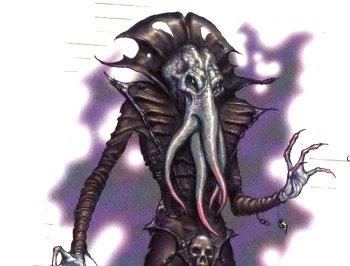 Cthulu-kin
 Though people with knowledge of 20th century role-playing games are quick to label these as Illithids, the more lovecraftian fan base has referred to these as the Cthulukin and the name has stuck.
Easily identified as a human with an octopus for a head, the eight tentacles are capable of object manipulation, though aren't themselves particularly strong. Unlike illithids, they don't eat brains, though they can do a mind-meld technique which emulates the memory probe spell. Being amongst the uglier races they tend to suffer the same racism as Trolls, and their illithid and cthulu appearance does nothing to speak for thier innocense, though they are probably just the result of goblinization (though most of the studied cases come from single mothers making it difficult to determine patronage).
Mechanics:
+2 intelligence, +2 willpower, -2 charisma
Innate Spell: Mind Reading. (they must grip a character's head with their tentacles to use this)
Tentacles: While they can grip things, tehy can't weild weapons or fire guns, though they can hold small objects (flashlights, tools) and some can learn to type with them. Distinctive features, stigma.
Build Points: 15
Fairy 

No one is quite sure where the fairys came from- perhaps they are just critters who have awakened to full sentience, perhaps they have been here all along and have "Come out of the Forests". In any case, fairies began entering into society sometime after Haley's Comet's second coming, and they've been met with all kinds of distrust, not because they're necessarily mischevious, but because they're small and often hard to take seriously. They are still afforded critter status and do not have rights, which may be justified since there is no documented case of a fairy being born to a human or metahuman (though plenty have made the claim!).
Mechanics:
Fairies are about 1' tall (the size of a barbie doll) and have wings like a butterfly, insect, or moth. They can fly at their quickness speed, but cannot run very quickly at all (they "run" at 1/4 quickness on foot). Their small size gives them a +2 bonus to stealth checks (except disguise) and a +2 TN bonus to being hit (essentially you have to make a called shot to hit them- so you cannot further "called shot" them for extra damage).
-2 Body, +3 quickness, +3 charisma, -3 strength.
A fairy cannot start with points spent towards resources (0 points- $5000). A fairy does not suffer bio-rejection, but cannot take most cyberware or bioware due primarily to the size- it's nigh impossible to find a skilled enough surgeon to implant things, much less cyberware parts of the correct size. Their size also gives them problems with equipment, armor, and anything else that requires carrying thigs. They make great mages, however. A fairy mage gets -.05 to their initiation costs, and when they initiate they may treat their own body as magic foci, using half their magic score as foci, with no need to bond or purchase the foci. These foci are reassinged during initiation only. They may share this ability with any mage they touch, either willingly or unwillingly, making them a target for mages looking for free foci. On top of this, a fairy starts with essence of 8 instead of 6, though this does nothing to their magic. Fairys have weak immune systems and suffer -1 body to tests to resist poisons, disease, and toxic effects. Fairy mages are always shamans and are never insect, blood, or toxic shamans.
Build Points: 25
Sidekicks and Cohorts
Perhaps you have a low number of players and they need sidekicks, perhaps your player needs a cohort, perhaps the team needs someone to do jobs best left for NPCs. Enter the sidekick/cohort system.
Definitions:
Sidekick: A less powerful runner who accompanies the PC on missions and is generally controlled by a PC.
Example Sidekicks: Any less powerful character, like in D&D's leadership system.
Cohort: The ultimate contact, another runner who is happy to accomplish the "NPC tasks", and while they may be "controlled" by the PC sometimes, their rolls and stats are left more up to the GM.
Example Cohorts: A rigger who drives the getaway vehicle, a decker/info gatherer who does the background work on a mission, a face who introduces you to Johnsons.
Both sidekicks and cohorts are generally considered part of the shadowrunning team and probably will want some income for their work. Cohorts are basically NPC teammates who expect full shares, while sidekicks may split part of the controlling PC's shares.
Sidekick Rules
A sidekick should generally be made with 10-20 less build points than the PC, should not be allowed more than 2-3 edges/flaws, and gains only 2 points of good karma for every 3 the PC gains. He does not gain karma pool, he must share the PC's karma pool reserve.
To gain a sidekick, you should pay 10 points of good karma for the "sidekick" benefit, and use negotiation or etiquette to find them. (Maybe they find you). They are people you've taken under your wing as a mentor, family member, or for some other reason want to help train. The GM may want to limit the sidekick's active skills to be no higher than the PC's ranks in leadership.
Once the sidekick is gained they stick around like a lesser PC. If he dies it costs another 10 karma points to replace him, and any rolls suffer a cumulative +1 penalty to locate replacement sidekicks for each one that died (as you gain a rep for killing your help!).
Cohorts:
Cohorts are easier- they're built with the same BP as the PCs and have the same karma. They are considered an official part of the shadowrunning team. As such they will expect an equal cut of mission pay, for this mission and for future missions. (Which makes it not cost effective to hire them for just that one mission). Generally they're run by the GM as party support.
Parties that frequently "hire" then "fire" cohorts may soon find themselves unable to hire long term support.
Definitions:
Sidekick: A less powerful runner who accompanies the PC on missions and is generally controlled by a PC.
Example Sidekicks: Any less powerful character, like in D&D's leadership system.
Cohort: The ultimate contact, another runner who is happy to accomplish the "NPC tasks", and while they may be "controlled" by the PC sometimes, their rolls and stats are left more up to the GM.
Example Cohorts: A rigger who drives the getaway vehicle, a decker/info gatherer who does the background work on a mission, a face who introduces you to Johnsons.
Both sidekicks and cohorts are generally considered part of the shadowrunning team and probably will want some income for their work. Cohorts are basically NPC teammates who expect full shares, while sidekicks may split part of the controlling PC's shares.
Sidekick Rules
A sidekick should generally be made with 10-20 less build points than the PC, should not be allowed more than 2-3 edges/flaws, and gains only 2 points of good karma for every 3 the PC gains. He does not gain karma pool, he must share the PC's karma pool reserve.
To gain a sidekick, you should pay 10 points of good karma for the "sidekick" benefit, and use negotiation or etiquette to find them. (Maybe they find you). They are people you've taken under your wing as a mentor, family member, or for some other reason want to help train. The GM may want to limit the sidekick's active skills to be no higher than the PC's ranks in leadership.
Once the sidekick is gained they stick around like a lesser PC. If he dies it costs another 10 karma points to replace him, and any rolls suffer a cumulative +1 penalty to locate replacement sidekicks for each one that died (as you gain a rep for killing your help!).
Cohorts:
Cohorts are easier- they're built with the same BP as the PCs and have the same karma. They are considered an official part of the shadowrunning team. As such they will expect an equal cut of mission pay, for this mission and for future missions. (Which makes it not cost effective to hire them for just that one mission). Generally they're run by the GM as party support.
Parties that frequently "hire" then "fire" cohorts may soon find themselves unable to hire long term support.
Thursday, December 16, 2010
Instruction
What a worthless skill. What GM makes people roll learning checks from an instructor to learn new skills.
So I'm modifying it.
The Instructor and the Student.
The Instructor must have as many ranks in the skill as the student wants to learn or more, and must have more than 3.
The instructor rolls an instruction test, with the TN being the new number in the skill the student wants to learn.
For every success, the skill costs 1 less point of good karma to learn, minimum of 1. As long as the instructor generated at least 1 success, the student can learn the skill using the greater of his or the instructions attribute to decide cost also, making skills much cheaper to learn by an instructor.
Example: Todd wants to learn etiquette from Bob. Todd has 6 ranks, so Bob must have at least 7 ranks of etiquette. Bob rolls an instruction test TN 7. He has 4 ranks in instruction so rolls 4 dice. 1, 4, 7, 9. This is 2 successes, so when Bob learns the next point of etiquette it costs him 2 points less of good karma. What's more, Bob can use the higher of Todd or Bob's charisma to determine whether the skill costs more (for going over the charisma score) than normal, allowing characters with low stats to learn skills from instructors at a much cheaper rate!
Now the kicker, unless the DM wants to give away discounted skills, this is a PC only skill, meaning the players must spend their own karma learning instruction so that they can give each other discounts on upgraded skills. Player A can learn etiquette, while B learns stealth, and C learns pistols. As long as they all also have instruction they can teach each other the 2 skills they didn't learn at a karma discount! Everybody wins!
(As long as there's at least 2 people with instruction. Ah, the prisoner's dilemmah!)
Another use for Instruction
Perhaps you want to use a skill and aren't there. You can give someone step by step instructions on how to do something as if you were there (over the radio, phone, etc). Make an instruction (4) test. For every success, the "student" can act as if he has 1 rank in the skill you're trying to teach him to do, with a maximum of your ranks in that skill. If the character already has the skill, this overlaps, does not stack.
Great for helping someone land a plane, disarm a bomb, etc while you are not present. Not good for teaching them how to swing a sword or shoot a gun, since the test only applies to the one roll, they don't "hold" the skill.
So I'm modifying it.
The Instructor and the Student.
The Instructor must have as many ranks in the skill as the student wants to learn or more, and must have more than 3.
The instructor rolls an instruction test, with the TN being the new number in the skill the student wants to learn.
For every success, the skill costs 1 less point of good karma to learn, minimum of 1. As long as the instructor generated at least 1 success, the student can learn the skill using the greater of his or the instructions attribute to decide cost also, making skills much cheaper to learn by an instructor.
Example: Todd wants to learn etiquette from Bob. Todd has 6 ranks, so Bob must have at least 7 ranks of etiquette. Bob rolls an instruction test TN 7. He has 4 ranks in instruction so rolls 4 dice. 1, 4, 7, 9. This is 2 successes, so when Bob learns the next point of etiquette it costs him 2 points less of good karma. What's more, Bob can use the higher of Todd or Bob's charisma to determine whether the skill costs more (for going over the charisma score) than normal, allowing characters with low stats to learn skills from instructors at a much cheaper rate!
Now the kicker, unless the DM wants to give away discounted skills, this is a PC only skill, meaning the players must spend their own karma learning instruction so that they can give each other discounts on upgraded skills. Player A can learn etiquette, while B learns stealth, and C learns pistols. As long as they all also have instruction they can teach each other the 2 skills they didn't learn at a karma discount! Everybody wins!
(As long as there's at least 2 people with instruction. Ah, the prisoner's dilemmah!)
Another use for Instruction
Perhaps you want to use a skill and aren't there. You can give someone step by step instructions on how to do something as if you were there (over the radio, phone, etc). Make an instruction (4) test. For every success, the "student" can act as if he has 1 rank in the skill you're trying to teach him to do, with a maximum of your ranks in that skill. If the character already has the skill, this overlaps, does not stack.
Great for helping someone land a plane, disarm a bomb, etc while you are not present. Not good for teaching them how to swing a sword or shoot a gun, since the test only applies to the one roll, they don't "hold" the skill.
The Worst Flaws
Sure, all flaws are bad, but some... well, they just might be worse than their point value would suggest...
Blind (-6, -2 for mages): You can't see. Bad enough when it comes to everyday life, but add in your inability to read computer screens (and spellbooks!) and the fact that there isn't much of a way to suppliment this in the system (mages needs to see to cast spells!) and you've got a recipe for disaster! Maybe if you're a rigger/decker and you can still "percieve" in the matrix/car it's not so bad, but damn!
Borrowed Time (-6): Well, you're going to die soon, whenever the DM decides. Maybe you're old, maybe you're sick (FOXDIEEEEE!), but either way, the GM can pull out his magic button and say "And then you die." Now granted, he can do that anyway, but nothing says "I'm only going to play this one session" like Borrowed Time!
Para/Quadraplegic (-3/-6): Okay, okay, so you're a rigger/decker and never leave the house. You've raped the flaw. Otherwise you're wheeling around in your wheelchair (or rigging a wheelchair) just to get from A to B. Forget disguises (Look, another guy in a wheel chair who can't apply his own makeup!), forget B&E, your shadowruns better be all about running guys down with a chair that has spikes on it or something, because if you took this and you're not a decker, you're an idiot.
Total Pacifist (-5): It's not bad enough that you can't kill people, but you go into anguish when your teammates kill people? Jinx! Your player can't control them! Sure, that's the flaw, but what group doesn't have a kill-happy maniac?
Hung out to Dry (-4): Almost always taken by people who also don't have the social skills (or a million social penalties) to maintain contacts anyway. What better way to say "You're going to have to kick mimesis' ass to get me into the game" than hung out to dry, especially for a replacement character who doesn't already at least know the group. You can't have an NPC introduce them- they have no contacts! Almost ban-worthy!
Cranial Bomb (-6): Nice. You've got a guy with a bomb in his head and it could go off whenever. This is basically borrowed time except that NPCs can use it to manipulate you! Good luck getting it removed!
Mysterious Cyberware (-3): Half the value of Cranial Bomb- and it's almost always a cranial bomb anyway. If you're not a mage you're usually cybered out, and in either case you need every last piece of essence. Even if the GM makes it something that could be beneficial (against the purpose of making it a flaw) it's certainly something that's just a kick in the balls mission's invitation.
Police Record (-6): You have a criminal SIN, must live in a halfway house, and have a parole officer checking in on you all the time? I thought Day Job was rough! What? He also knows your contacts and how to reach you at all times? Why not travel with a cop and be done with it! At least the cop has something to lose! If you get through 3 missions with this guy then he must be a shadowrider setting you up because there's no way the police are that stupid!
Amnesia (-5): Yeah, right, like I'm going to make your character for you, and like you're going to play a random character without knowing his skills. Who the hell takes this?
Large (+4): What? An edge on this list? Of course! Why? Because the only people who take this edge are trolls (or meta-trolls) and those things are big enough! When you can't fit in a car, you can never blend in anywhere, and there's no reason why people aren't always suspicious of you (and thus your team), you've paid points to be a pain in the ass. But then, you're large...
Blind (-6, -2 for mages): You can't see. Bad enough when it comes to everyday life, but add in your inability to read computer screens (and spellbooks!) and the fact that there isn't much of a way to suppliment this in the system (mages needs to see to cast spells!) and you've got a recipe for disaster! Maybe if you're a rigger/decker and you can still "percieve" in the matrix/car it's not so bad, but damn!
Borrowed Time (-6): Well, you're going to die soon, whenever the DM decides. Maybe you're old, maybe you're sick (FOXDIEEEEE!), but either way, the GM can pull out his magic button and say "And then you die." Now granted, he can do that anyway, but nothing says "I'm only going to play this one session" like Borrowed Time!
Para/Quadraplegic (-3/-6): Okay, okay, so you're a rigger/decker and never leave the house. You've raped the flaw. Otherwise you're wheeling around in your wheelchair (or rigging a wheelchair) just to get from A to B. Forget disguises (Look, another guy in a wheel chair who can't apply his own makeup!), forget B&E, your shadowruns better be all about running guys down with a chair that has spikes on it or something, because if you took this and you're not a decker, you're an idiot.
Total Pacifist (-5): It's not bad enough that you can't kill people, but you go into anguish when your teammates kill people? Jinx! Your player can't control them! Sure, that's the flaw, but what group doesn't have a kill-happy maniac?
Hung out to Dry (-4): Almost always taken by people who also don't have the social skills (or a million social penalties) to maintain contacts anyway. What better way to say "You're going to have to kick mimesis' ass to get me into the game" than hung out to dry, especially for a replacement character who doesn't already at least know the group. You can't have an NPC introduce them- they have no contacts! Almost ban-worthy!
Cranial Bomb (-6): Nice. You've got a guy with a bomb in his head and it could go off whenever. This is basically borrowed time except that NPCs can use it to manipulate you! Good luck getting it removed!
Mysterious Cyberware (-3): Half the value of Cranial Bomb- and it's almost always a cranial bomb anyway. If you're not a mage you're usually cybered out, and in either case you need every last piece of essence. Even if the GM makes it something that could be beneficial (against the purpose of making it a flaw) it's certainly something that's just a kick in the balls mission's invitation.
Police Record (-6): You have a criminal SIN, must live in a halfway house, and have a parole officer checking in on you all the time? I thought Day Job was rough! What? He also knows your contacts and how to reach you at all times? Why not travel with a cop and be done with it! At least the cop has something to lose! If you get through 3 missions with this guy then he must be a shadowrider setting you up because there's no way the police are that stupid!
Amnesia (-5): Yeah, right, like I'm going to make your character for you, and like you're going to play a random character without knowing his skills. Who the hell takes this?
Large (+4): What? An edge on this list? Of course! Why? Because the only people who take this edge are trolls (or meta-trolls) and those things are big enough! When you can't fit in a car, you can never blend in anywhere, and there's no reason why people aren't always suspicious of you (and thus your team), you've paid points to be a pain in the ass. But then, you're large...
Clone Characters
With further development in biological research came the first animal and cellular clones. This made possible the field of bioware, and advanced cyberware (such as deltaware). When Kamino Corp cloned the first humans, it revolutionized bioware and cyberware development, but also opened the door to much debate as to the ethics of cloning people.
That didn't quite stop the research however...
Clone (+10 build points)
You are a clone of another type of race (besides robot). You may be made to look exactly like someone specific, or having been created as an entirely new person.
A clone, like any other race, has essence, edges/flaws, and can accept bioware and cyberware.
A clone differs in his cellular biology at some key levels.
Bio Index: A clone ignores bio-index. Basically, his entire body is bio index. As such, he can accept any amount of bioware without any stress concerns. He still must purchase the bioware, of course.
Racial Max: A clone is made with the best of the best: his racial max for all stats is considered 1 higher than base. These must still be bought with build points but are higher. They may also take the exceptional attribute and bonus attribtue edges for each attribute if they wish.
Mutations: Clones may be mutants, but their essence is considered 0 (thanks to bio index) for any ability which uses essence. Even the enhanced essence can't overcome this, and they cannot emulate magical skills or mimic. They can have immunity or thick skin. Mutant clones are of limited use. Clones die from HMVV and cannot be Otaku.
Cyberware: A clone is still limited with cyberware, but cyberware costs 90% of the essence it normally does (which can be further affected by certained edges and flaws, cyberware upgrades, and better surgical procedures).
Magic: A clone may not become a mage. Basically he has too much bio index and it overlaps any magical ability he might possess.
Age: A clone has the borrowed time flaw at no benefit. The cloning process is not completely perfected, and no one is sure how long the clone will last before his biological processes begin to break down. This may be years, this may be days. Also, a clone's body need not reflect his true age. He may age more slowly, appearing to be 12 when 30. Or he may age more quickly, appearing to be 40 when only being 10. He may also have varying aging, growing quickly to maturity, then slowing down or speeding back up again. Many clones are only 5-10 years old in practice, since that's how long the process has been developed.
Backgrounds: A clone, being young, usually has limited backgrounds, probably has no SIN (though might be identified as someone else if created as a copy), and many of their memories may have been magically or biologically implanted. Perhaps they only remember 5 years, perhaps it's all fake memories. Amnesia is common in clones.
That didn't quite stop the research however...
Clone (+10 build points)
You are a clone of another type of race (besides robot). You may be made to look exactly like someone specific, or having been created as an entirely new person.
A clone, like any other race, has essence, edges/flaws, and can accept bioware and cyberware.
A clone differs in his cellular biology at some key levels.
Bio Index: A clone ignores bio-index. Basically, his entire body is bio index. As such, he can accept any amount of bioware without any stress concerns. He still must purchase the bioware, of course.
Racial Max: A clone is made with the best of the best: his racial max for all stats is considered 1 higher than base. These must still be bought with build points but are higher. They may also take the exceptional attribute and bonus attribtue edges for each attribute if they wish.
Mutations: Clones may be mutants, but their essence is considered 0 (thanks to bio index) for any ability which uses essence. Even the enhanced essence can't overcome this, and they cannot emulate magical skills or mimic. They can have immunity or thick skin. Mutant clones are of limited use. Clones die from HMVV and cannot be Otaku.
Cyberware: A clone is still limited with cyberware, but cyberware costs 90% of the essence it normally does (which can be further affected by certained edges and flaws, cyberware upgrades, and better surgical procedures).
Magic: A clone may not become a mage. Basically he has too much bio index and it overlaps any magical ability he might possess.
Age: A clone has the borrowed time flaw at no benefit. The cloning process is not completely perfected, and no one is sure how long the clone will last before his biological processes begin to break down. This may be years, this may be days. Also, a clone's body need not reflect his true age. He may age more slowly, appearing to be 12 when 30. Or he may age more quickly, appearing to be 40 when only being 10. He may also have varying aging, growing quickly to maturity, then slowing down or speeding back up again. Many clones are only 5-10 years old in practice, since that's how long the process has been developed.
Backgrounds: A clone, being young, usually has limited backgrounds, probably has no SIN (though might be identified as someone else if created as a copy), and many of their memories may have been magically or biologically implanted. Perhaps they only remember 5 years, perhaps it's all fake memories. Amnesia is common in clones.
Robot Characters
A robot character is a special form of artifical intelligence which has become self aware. It's a race to be chosen at character creation.
Robot (20 build points)
A robot generally has a humanoid structure, though this need not be the case. A robot is "upgraded" and "outfitted" with a variety of capabilities through spending money or build points on the robot's structure. Robots have several advantages and disadvantages.
No Essence: For good or ill, they're not alive. They have no essence score. As such they cannot be mages. They can, however, have all the cyberware they want, limited only by what may not realistically fit within their frame.
Non-Living: Not being alive, they need not eat, breathe, or drink. They do need to sleep, which represents going into a hybernation mode while their internal battery recharges. If destroyed they can be repaired, though this requires their body to be recovered and repairs to be made (see repairing, below). If repaired from a deadly physical wound, they must roll 1d6. On a roll of 1, their memory was damaged and they lose all AI (being effectively dead). If the head was especially damaged (or removed), a 1 or 2 on the 1d6 roll leaves them permanently dead.
Not being alive, the have no aura, no thoughts, and are immune to most non-physical spells. Their virtual intelligence allows them to make attempts to overcome physical spells (like illusions) like a normal character. They cannot have bioware.
Being non-living, they are also immune to stun damage, taking damage the same as objects or vehicles. They are also immune to poisons, gasses, disease (HMVV), etc. Likewise, they cannot benefit from stim patches, or healing spells. They do not recover from damage normally, they must be repaired.
SINless: They are not alive, and do not have any rights. Robots may be viewed as property when it comes to the law, and sometimes another shadowrunner might end up being blamed for the actions of his "property". Not having rights, they are just as likely to be shut down or destroyed if captured (or reprogrammed!).
Vulnerability to Rigging/Decking: A rigger may attempt to take control of a robot's body the same way as a mind control spell, using the robots intelligence to resist and using the rigger's ranks in pilot drone as the force. The threshold is half the robot's intelligence.
A decker may attempt to modifiy or read the memory of a robot like the modify/read memory spell in the same way, using computers ranks in place of the force of the spell. This requires being physically plugged into the robot, which usually means disabling it.
Repairing:Repairing a robot requires B/R mechanical skill. The base time is 1 hour per box to be repaired. (So if there are 10 boxes of damage, this takes 10 hours, even if only 3 end up being repaired) Roll a B/R mechanical test, TN = 1 + number of damage boxes (including overflow). Each success repairs 1 box of damage. This can be re-attempted for further time and healing.
Edges/Flaws: Certain edges and flaws cannot apply to robots at GM discresion.
Construction:
Robots build skill points and attributes the same as any other character. Their race is "robot" and they cannot be magicians. They may gain wealth resources normally which represents the amount of extra equipment that went into the robot. They cannot be mutant.
A robot can also purchase "robo-perks" with build points, described below:
Armor: A robot can spend 1 build points to gain 1 point of ballistic OR impact armor. Each is capped at the robot's body. He can spend 3 build points/point to instead have "hardened" versions of the armor.
Limbs: A robot is assumed to be bipedial, with 2 arms and 2 legs. He may also have:
Treads: Replaces feet, cannot be tripped, goes very slowly via stairs.
Propellors: Head propellors allow helicopter-like flight. Costs 10 BP.
Jet Pack: Allows very fast jet pack flight and hovering. Costs 20 BP. Very, very loud.
Additional Limbs: Each extra arm costs 5 BP, each extra leg costs 10 BP.
Wheels: Replaces feet, allows robot to move at car speeds on roads and other flat surfaces. Does not negotiate stairs. 10 BP.
Appearance: Base robots have a CHA of 1 and are obvious robots. Robots without extra limbs may appear as a human (male or female). 1 BP allows the appearance of a person and the ability to buy CHA. 5 BP allows the robot to "fully function" as a human would be expected to, and may be difficult to tell apart from humans (except via astral perception). Without appearance, robots have difficulty disguising themselves as humans (but as equipment...).
Skills: Robots purchase skills normally using build points.
Attributes: Robots buy attributes normally using build points. They have no racial maximum.
Size: Robots are assumed to be the same size as humans. They can be smaller, or larger. Each size category away from medium (use D&D terms) costs 1 point per category away, so:
Small/Large : 1 BP
Tiny/Huge: 3 BP (1 to go to small, 2 to go to tiny)
Robot PCs cannot be above huge or smaller than tiny. Large robots suffer penalties to stealth and disguise rolls as other characters do.
Improving Robots: Robots use karma to improve themselves like ordinary characters, with the following exceptions.
Attributes: Robots have no racial max or max attributes- they can always gain more intelligence or strength. They can benefit from Improved Cybernetic Attribute spells also, though the force of the spell must be at least 10 to affect them. (Also the essence of 0 makes the target number very high).
Skills: Robots can purchase skills normally with karma, but their attribute is irrelevant to skill cost- their skill always costs an amount of karma as if they had the lower initiative rating. Robots can use B/R mechanical to repair themselves, but the wound penalties apply to this roll, and it assumes they're "conscious".
Equipment: Robots can use weapons, armor, cyberware, and other equipment normally. They are not assumed to have "internal memory" for storing digital information (including recorded video) unless this is specially installed- all internal memory is used to run their systems and record "memories" for themselves in data format, which is not easily translated back into video. They perceive things normally and are not assumed to have photographic memory (though they can take that edge). They also may learn most skill tricks normally.
Karma Pool: Robots gain karma pool at 1 point every 25 points of good karma, lower than anyone else. Of course, it's hard for equipment to catch a break from the divine!
Jobs and Contacts: It's difficult for robots to maintain contacts and jobs, having no SIN and being regarded as property. Their contacts are generally assumed to be "forward thinking", though it is difficult for a robot to be taken seriously. Treat them as if they have stigma.
Electricity: Electricity attacks have +1 power against robots, and any which deals stun damage does physical damage to robots without a power reduction.
Lifestyles: A robot needs much less to survive- a power source and a place to "sleep". Lifestyle costs for robots are reduced by 20%. They cannot have better than a low lifestyle without GM approval (as robots don't buy houses and have no SIN). If lifestyle edges/flaws are used, feel free to remove living space and/or food from the cost association of lifestyles, but assume they need to live somewhere with reliable energy.
Karma Sharing: Robots earn karma as normal, but cannot share karma with spirits, mages, etc. (Perhaps it should be spelled Car-ma).
Hazards: Robots are generally water-proof, and can exist in most hot and cold temperatures without problems, however, any temperature that can cause actual damage to a human can also damage the robot's circuits and cause damage. A robot suffers wound modifiers as normal due to "malfunctioing" rather than pain. They are generally immune to mind effecting effects and fear (though they can express emotions, they don't necessarily "feel" them. Emotion for them is a logical process).
Robot (20 build points)
A robot generally has a humanoid structure, though this need not be the case. A robot is "upgraded" and "outfitted" with a variety of capabilities through spending money or build points on the robot's structure. Robots have several advantages and disadvantages.
No Essence: For good or ill, they're not alive. They have no essence score. As such they cannot be mages. They can, however, have all the cyberware they want, limited only by what may not realistically fit within their frame.
Non-Living: Not being alive, they need not eat, breathe, or drink. They do need to sleep, which represents going into a hybernation mode while their internal battery recharges. If destroyed they can be repaired, though this requires their body to be recovered and repairs to be made (see repairing, below). If repaired from a deadly physical wound, they must roll 1d6. On a roll of 1, their memory was damaged and they lose all AI (being effectively dead). If the head was especially damaged (or removed), a 1 or 2 on the 1d6 roll leaves them permanently dead.
Not being alive, the have no aura, no thoughts, and are immune to most non-physical spells. Their virtual intelligence allows them to make attempts to overcome physical spells (like illusions) like a normal character. They cannot have bioware.
Being non-living, they are also immune to stun damage, taking damage the same as objects or vehicles. They are also immune to poisons, gasses, disease (HMVV), etc. Likewise, they cannot benefit from stim patches, or healing spells. They do not recover from damage normally, they must be repaired.
SINless: They are not alive, and do not have any rights. Robots may be viewed as property when it comes to the law, and sometimes another shadowrunner might end up being blamed for the actions of his "property". Not having rights, they are just as likely to be shut down or destroyed if captured (or reprogrammed!).
Vulnerability to Rigging/Decking: A rigger may attempt to take control of a robot's body the same way as a mind control spell, using the robots intelligence to resist and using the rigger's ranks in pilot drone as the force. The threshold is half the robot's intelligence.
A decker may attempt to modifiy or read the memory of a robot like the modify/read memory spell in the same way, using computers ranks in place of the force of the spell. This requires being physically plugged into the robot, which usually means disabling it.
Repairing:Repairing a robot requires B/R mechanical skill. The base time is 1 hour per box to be repaired. (So if there are 10 boxes of damage, this takes 10 hours, even if only 3 end up being repaired) Roll a B/R mechanical test, TN = 1 + number of damage boxes (including overflow). Each success repairs 1 box of damage. This can be re-attempted for further time and healing.
Edges/Flaws: Certain edges and flaws cannot apply to robots at GM discresion.
Construction:
Robots build skill points and attributes the same as any other character. Their race is "robot" and they cannot be magicians. They may gain wealth resources normally which represents the amount of extra equipment that went into the robot. They cannot be mutant.
A robot can also purchase "robo-perks" with build points, described below:
Armor: A robot can spend 1 build points to gain 1 point of ballistic OR impact armor. Each is capped at the robot's body. He can spend 3 build points/point to instead have "hardened" versions of the armor.
Limbs: A robot is assumed to be bipedial, with 2 arms and 2 legs. He may also have:
Treads: Replaces feet, cannot be tripped, goes very slowly via stairs.
Propellors: Head propellors allow helicopter-like flight. Costs 10 BP.
Jet Pack: Allows very fast jet pack flight and hovering. Costs 20 BP. Very, very loud.
Additional Limbs: Each extra arm costs 5 BP, each extra leg costs 10 BP.
Wheels: Replaces feet, allows robot to move at car speeds on roads and other flat surfaces. Does not negotiate stairs. 10 BP.
Appearance: Base robots have a CHA of 1 and are obvious robots. Robots without extra limbs may appear as a human (male or female). 1 BP allows the appearance of a person and the ability to buy CHA. 5 BP allows the robot to "fully function" as a human would be expected to, and may be difficult to tell apart from humans (except via astral perception). Without appearance, robots have difficulty disguising themselves as humans (but as equipment...).
Skills: Robots purchase skills normally using build points.
Attributes: Robots buy attributes normally using build points. They have no racial maximum.
Size: Robots are assumed to be the same size as humans. They can be smaller, or larger. Each size category away from medium (use D&D terms) costs 1 point per category away, so:
Small/Large : 1 BP
Tiny/Huge: 3 BP (1 to go to small, 2 to go to tiny)
Robot PCs cannot be above huge or smaller than tiny. Large robots suffer penalties to stealth and disguise rolls as other characters do.
Improving Robots: Robots use karma to improve themselves like ordinary characters, with the following exceptions.
Attributes: Robots have no racial max or max attributes- they can always gain more intelligence or strength. They can benefit from Improved Cybernetic Attribute spells also, though the force of the spell must be at least 10 to affect them. (Also the essence of 0 makes the target number very high).
Skills: Robots can purchase skills normally with karma, but their attribute is irrelevant to skill cost- their skill always costs an amount of karma as if they had the lower initiative rating. Robots can use B/R mechanical to repair themselves, but the wound penalties apply to this roll, and it assumes they're "conscious".
Equipment: Robots can use weapons, armor, cyberware, and other equipment normally. They are not assumed to have "internal memory" for storing digital information (including recorded video) unless this is specially installed- all internal memory is used to run their systems and record "memories" for themselves in data format, which is not easily translated back into video. They perceive things normally and are not assumed to have photographic memory (though they can take that edge). They also may learn most skill tricks normally.
Karma Pool: Robots gain karma pool at 1 point every 25 points of good karma, lower than anyone else. Of course, it's hard for equipment to catch a break from the divine!
Jobs and Contacts: It's difficult for robots to maintain contacts and jobs, having no SIN and being regarded as property. Their contacts are generally assumed to be "forward thinking", though it is difficult for a robot to be taken seriously. Treat them as if they have stigma.
Electricity: Electricity attacks have +1 power against robots, and any which deals stun damage does physical damage to robots without a power reduction.
Lifestyles: A robot needs much less to survive- a power source and a place to "sleep". Lifestyle costs for robots are reduced by 20%. They cannot have better than a low lifestyle without GM approval (as robots don't buy houses and have no SIN). If lifestyle edges/flaws are used, feel free to remove living space and/or food from the cost association of lifestyles, but assume they need to live somewhere with reliable energy.
Karma Sharing: Robots earn karma as normal, but cannot share karma with spirits, mages, etc. (Perhaps it should be spelled Car-ma).
Hazards: Robots are generally water-proof, and can exist in most hot and cold temperatures without problems, however, any temperature that can cause actual damage to a human can also damage the robot's circuits and cause damage. A robot suffers wound modifiers as normal due to "malfunctioing" rather than pain. They are generally immune to mind effecting effects and fear (though they can express emotions, they don't necessarily "feel" them. Emotion for them is a logical process).
Wednesday, December 15, 2010
Spell Points
Spell points are given at character creation to buy spells and such. Here is a breakdown of some uses for spell points.
Full Magicians gain 25 spell points.
Aspected Magicians gain 35 spell points.
(Adepts gain power points instead).
Already, spell points can be used for the following:
- Bond to Foci (up to rank 6) which you purchase with starting gold.
- Learn spells (up to rank 6) which you don't pay for.
- Have elementals/watchers on hand (up to rank 6) which you don't pay for.
- Sell (you can sell unused spell points for build points: 5 spell points = 1 build point)
- Buy (you can purchase SP for 25k apiece, maximum starting SP is 50).
Here are a few other suggested uses for spell points and an associated cost:
Non-Gaesa (15): This allows you up to 1 point of essence to be used up (due to cyberware or a lower essence character, etc) with no penalty to magic. This does not affect bioware. Basically you take a gaesa for that point which has no real restriction.
Augumented Biology (15): This allows you to ignore 1 point of bio index for the purposes of magic only (not for max bio index or anything like that). This allows you to start with 1 point of bio index in bioware without having a lower starting magic rating.
Initiate (20/50): Spell points can be used to start at initiate level 1. (With higher magic and a metamagic feat). Spending all 50 (which means you bought more at character creation) will let you start at level 2 instead. (However, you have no foci or spells...)
Note: The above could be taken multiple times, though the cost may be too high for most mages.
Bonus Spirit (10): This allows a mage with access to conjuring dice 1 extra specific spirit type that they don't already have access to, even across traditions (like a shaman gaining fire elemental). Hermetic elementals are still summoned in the same way, and shamanistic elementals still last only a day or a night.
Extended Spirit (15): This allows a mage to choose one shamanistic spirit he can summon. (Hearth spirit, city spirit, etc). That spirit now lasts one day and one night instead of just one or the other. It still cannot leave its domain unless greater form. This can be taken multiple times for multiple spirit types.
Summon Ally Spirit (X): Spell points can be used in place of good karma to summon an ally spirit. (This still costs a magic point!).
Magical Edges (Cost*2): These can be used to buy magical edges (such as aptitude: magical skills, or focused concentration, etc.) Double the cost when using spell points (which is still cheaper than using build points).
Full Magicians gain 25 spell points.
Aspected Magicians gain 35 spell points.
(Adepts gain power points instead).
Already, spell points can be used for the following:
- Bond to Foci (up to rank 6) which you purchase with starting gold.
- Learn spells (up to rank 6) which you don't pay for.
- Have elementals/watchers on hand (up to rank 6) which you don't pay for.
- Sell (you can sell unused spell points for build points: 5 spell points = 1 build point)
- Buy (you can purchase SP for 25k apiece, maximum starting SP is 50).
Here are a few other suggested uses for spell points and an associated cost:
Non-Gaesa (15): This allows you up to 1 point of essence to be used up (due to cyberware or a lower essence character, etc) with no penalty to magic. This does not affect bioware. Basically you take a gaesa for that point which has no real restriction.
Augumented Biology (15): This allows you to ignore 1 point of bio index for the purposes of magic only (not for max bio index or anything like that). This allows you to start with 1 point of bio index in bioware without having a lower starting magic rating.
Initiate (20/50): Spell points can be used to start at initiate level 1. (With higher magic and a metamagic feat). Spending all 50 (which means you bought more at character creation) will let you start at level 2 instead. (However, you have no foci or spells...)
Note: The above could be taken multiple times, though the cost may be too high for most mages.
Bonus Spirit (10): This allows a mage with access to conjuring dice 1 extra specific spirit type that they don't already have access to, even across traditions (like a shaman gaining fire elemental). Hermetic elementals are still summoned in the same way, and shamanistic elementals still last only a day or a night.
Extended Spirit (15): This allows a mage to choose one shamanistic spirit he can summon. (Hearth spirit, city spirit, etc). That spirit now lasts one day and one night instead of just one or the other. It still cannot leave its domain unless greater form. This can be taken multiple times for multiple spirit types.
Summon Ally Spirit (X): Spell points can be used in place of good karma to summon an ally spirit. (This still costs a magic point!).
Magical Edges (Cost*2): These can be used to buy magical edges (such as aptitude: magical skills, or focused concentration, etc.) Double the cost when using spell points (which is still cheaper than using build points).
Tuesday, December 14, 2010
Mutant Characters
Supernatural Ability (Su): A spell that a character has innately. Such spells do not use sorcery dice, instead they use an ability score as the casting dice with no spell pool. They have no force, use essence in place of force for targets to resist (or if force limits successes, successes are not limited). Cannot be quickened, enhanced with foci, etc. They resist drain with willpower.
Body is used for healing spells. Intelligence is used for detection spells. Strength is used for combat spells. Willpower is used for manipulations. Charisma is used for illusions.
Mutant (25 build point cost)
Mutant is an archtype for characters to take. Mutants have some form of supernatural ability, critter power, or other mutation as described below. Mutants gain 25 Mutation points at character creation, which can be spent on mutant powers. Mutants don't initiate or gain new powers.
Aura: Mutants have a strange aura that looks almost awakened, but not quite. Similar to critters. Unless they are also an initiate mage with masking, they cannot hide this aura from the astral. Even if they have no "active" or useful powers, this aura is visible.
Cyberware/Bio Index: Mutants are able to gain cyberware and bioware, though the bio index and decreased essence decreases the usefulness of some powers. Bio index counts against essence for mutant powers the same as with magic. (So a mutant with 4 essence thanks to cyberware and 2 bio index with regeneration only regains 1 box pur turn instead of 2.)
Magic: Many mutant powers are considered magical in nature and are resisted as such. Likewise, mutant bonuses are magic- quickened spells overlap (do not stack) with them. So a mutant with increased body cannot benefit (as much) from an improved body spell.
Mutant powers are described below.
Supernatual Ability(20): Choose a spell, that spell is now a supernatural ability the mutant can cast at will. (See supernatural abilities, above)
Pure (5): The mutant has 1 more essence rating. This allows more cyberware or more powerful abilities.
Regeneration (15): The mutant can regenerate. Each round he regains 1 box of physical (not stun) for every 2 points of essence he has (round down). He does not regenerate from death.
Dual Natured (15): The mutant is dual natured, and percieves both the astral and physical planes at once. He cannot turn off this ability.
Magic Skill (10): The mutant can use a magic skill (not summoning or spellcasting), using his essence. This can be assensing (which requires astral perception or dual natured, or being a mage), banishing, dispelling, or any other magical skill. He chooses the skill when this is chosen. This can also be cleansing, centering, or other ones granted by metamagic techniques, though skills only available through metamagic cost an additional 5 mutant points. (Obviously invoking and conjuring are not available, as summoning is not. However, spell shielding is.)
Thick Skin (5): Every point of thick skin grants either 1 point of ballistic or impact armor. This stacks with itself.
Astral Perception (10): The mutant can astrally percieve, turning it on or off like a mage.
Magic Resistance (10): The mutant can use his essence as bonus dice to resist hostile magic spells targeting him.
Damage Resistance (10): The mutant can use his essence as bonus dice to resist normal weapons used against him. (But not magic weapons, spells, or spirit attacks, etc).
Technopath (20): The mutant can use his essence to oppose a computer or maglock or other tehnological device (not guns or bolt locks). He rolls dice to oppose the rating of the machine. If successful he can turn it on, turn it off, unlock it, etc. He cannot actively control it.
Improved Attribute (5): Every point boosts a physical or mental attribute, even above the starting max.
Skillful (5): Choose 1 skill the mutant is a savant at. The mutant always gains this skill as if it were below the relevant attribute.
Savant (10): Choose 1 skill. The mutant levels up the base skill at the cost of leveling it up as a specialization. He cannot specalize in aspects of it.
Quick (5): This can be taken up to 3 times, each time granting +1d6 initiative dice. This does not stack with magic.
Mimic (15): The mutant can attempt to use his essence to cast a spell or use a magical ability he has just witnessed. He can "store" the magical ability by "sustaining" it as if it were a sustained ability. The TN he gains from sustaining does not affect a check to use the ability, and does not apply while the ability is being used (such as if he mimiced astral projection, he does not take the sustained penalty while astrally projecting). He may not use foci to sustain the ability, nore may he sustain more than one ability. To copy an ability, he rolls essence opposed by the force of the ability (or magic of the user if the ability has no force, such as astral projection). The original owner need not resist this if he decides not to.
Immunity (5/20): The mutant is immune to one drug, poison, disease, or similar effect. For 20 points he's immune to all drugs, poisons, and diseases.
Water Breathig (10): The mutant can breathe water as well as air. (This does not protect from deep water pressure).
Otaku (20): The mutant can connect to the matrix as if his head was a cyberdeck with a rating equal to his essence.
Telepathy (15): The mutant can send messages to other people telepathically. Such messages sound like speech in the mutant's voice (coming from no particular direction). It requires line of sight and has a max range of 5 meters * essence.
Telepathic Reciever (5): The mutant with telepathy can understand replies (making telepathy 2 way) and can make perception tests to overhear telepathic communication when either the sender or reciever is within 5 meters * essence. He need not take telepathy to take this, though it is of very limited use.
Senses (5): Each rank grants 1 sense: high frequency hearing, low frequency hearing, thermographic vision, ultarsound vision, improved scent, ultraviolet vision. These are similar to cyberware equivelants but they are natural.
Detection (10): Choose one material (guns, explosives, etc). You may make a perception test to notice if the given material is within Essence*5 meters. This pereption test does not reveal the location, distance, direction, etc, only whether or not the given material is within range, and the number of such materials (allowing you to discount you and your team's equipment).
Mutant Power Increase:
A mutant can attempt a process similar to initiation to increase his power. He spends a number of good karma equal to his (total essence+1)*2. He then makes an effective essence check against his new total essence. (Total essence = essence without counting penalties for cyberware or bioware, effective essence= current essence - bio index.). If successful the points are spent and he gains 1 point of essence, which improves his exisiting powers based on essence.
Supernatural abilities are increased by boosting stats. That can be done normally.
Mutant Mages:
While a mutant can be a mage, the increased essence and increased magic (from initiating) are totally seperate issues. A mutant must spend karma seperately to increase both.
Some mutant powers emulate mage abilities. Mages may use these mutant powers to gain metamagic they aren't otherwise capable of. (Such as an adept using mutant astral perception to gain psychomancy).
Techno Mutants:
While certainly it makes sense for mutants to preserve their essence for power levels, some mutants just have very high essence and use that to afford extra cyberware or bioware, beyond what any normal character can have. This is fine. If the mutant wishes to advance, however, it can be very difficult if he has only 1 die left of essence to try to hit a 13 or something.
HMVV:
Mutants react as their base race does to HMVV, so mutants with HMVV (thanks to their higher essence possibility) can be very powerful. (Of course, paying 50+ build points for a starting character before stats, and more for a mage leaves a very weak starting character).
Body is used for healing spells. Intelligence is used for detection spells. Strength is used for combat spells. Willpower is used for manipulations. Charisma is used for illusions.
Mutant (25 build point cost)
Mutant is an archtype for characters to take. Mutants have some form of supernatural ability, critter power, or other mutation as described below. Mutants gain 25 Mutation points at character creation, which can be spent on mutant powers. Mutants don't initiate or gain new powers.
Aura: Mutants have a strange aura that looks almost awakened, but not quite. Similar to critters. Unless they are also an initiate mage with masking, they cannot hide this aura from the astral. Even if they have no "active" or useful powers, this aura is visible.
Cyberware/Bio Index: Mutants are able to gain cyberware and bioware, though the bio index and decreased essence decreases the usefulness of some powers. Bio index counts against essence for mutant powers the same as with magic. (So a mutant with 4 essence thanks to cyberware and 2 bio index with regeneration only regains 1 box pur turn instead of 2.)
Magic: Many mutant powers are considered magical in nature and are resisted as such. Likewise, mutant bonuses are magic- quickened spells overlap (do not stack) with them. So a mutant with increased body cannot benefit (as much) from an improved body spell.
Mutant powers are described below.
Supernatual Ability(20): Choose a spell, that spell is now a supernatural ability the mutant can cast at will. (See supernatural abilities, above)
Pure (5): The mutant has 1 more essence rating. This allows more cyberware or more powerful abilities.
Regeneration (15): The mutant can regenerate. Each round he regains 1 box of physical (not stun) for every 2 points of essence he has (round down). He does not regenerate from death.
Dual Natured (15): The mutant is dual natured, and percieves both the astral and physical planes at once. He cannot turn off this ability.
Magic Skill (10): The mutant can use a magic skill (not summoning or spellcasting), using his essence. This can be assensing (which requires astral perception or dual natured, or being a mage), banishing, dispelling, or any other magical skill. He chooses the skill when this is chosen. This can also be cleansing, centering, or other ones granted by metamagic techniques, though skills only available through metamagic cost an additional 5 mutant points. (Obviously invoking and conjuring are not available, as summoning is not. However, spell shielding is.)
Thick Skin (5): Every point of thick skin grants either 1 point of ballistic or impact armor. This stacks with itself.
Astral Perception (10): The mutant can astrally percieve, turning it on or off like a mage.
Magic Resistance (10): The mutant can use his essence as bonus dice to resist hostile magic spells targeting him.
Damage Resistance (10): The mutant can use his essence as bonus dice to resist normal weapons used against him. (But not magic weapons, spells, or spirit attacks, etc).
Technopath (20): The mutant can use his essence to oppose a computer or maglock or other tehnological device (not guns or bolt locks). He rolls dice to oppose the rating of the machine. If successful he can turn it on, turn it off, unlock it, etc. He cannot actively control it.
Improved Attribute (5): Every point boosts a physical or mental attribute, even above the starting max.
Skillful (5): Choose 1 skill the mutant is a savant at. The mutant always gains this skill as if it were below the relevant attribute.
Savant (10): Choose 1 skill. The mutant levels up the base skill at the cost of leveling it up as a specialization. He cannot specalize in aspects of it.
Quick (5): This can be taken up to 3 times, each time granting +1d6 initiative dice. This does not stack with magic.
Mimic (15): The mutant can attempt to use his essence to cast a spell or use a magical ability he has just witnessed. He can "store" the magical ability by "sustaining" it as if it were a sustained ability. The TN he gains from sustaining does not affect a check to use the ability, and does not apply while the ability is being used (such as if he mimiced astral projection, he does not take the sustained penalty while astrally projecting). He may not use foci to sustain the ability, nore may he sustain more than one ability. To copy an ability, he rolls essence opposed by the force of the ability (or magic of the user if the ability has no force, such as astral projection). The original owner need not resist this if he decides not to.
Immunity (5/20): The mutant is immune to one drug, poison, disease, or similar effect. For 20 points he's immune to all drugs, poisons, and diseases.
Water Breathig (10): The mutant can breathe water as well as air. (This does not protect from deep water pressure).
Otaku (20): The mutant can connect to the matrix as if his head was a cyberdeck with a rating equal to his essence.
Telepathy (15): The mutant can send messages to other people telepathically. Such messages sound like speech in the mutant's voice (coming from no particular direction). It requires line of sight and has a max range of 5 meters * essence.
Telepathic Reciever (5): The mutant with telepathy can understand replies (making telepathy 2 way) and can make perception tests to overhear telepathic communication when either the sender or reciever is within 5 meters * essence. He need not take telepathy to take this, though it is of very limited use.
Senses (5): Each rank grants 1 sense: high frequency hearing, low frequency hearing, thermographic vision, ultarsound vision, improved scent, ultraviolet vision. These are similar to cyberware equivelants but they are natural.
Detection (10): Choose one material (guns, explosives, etc). You may make a perception test to notice if the given material is within Essence*5 meters. This pereption test does not reveal the location, distance, direction, etc, only whether or not the given material is within range, and the number of such materials (allowing you to discount you and your team's equipment).
Mutant Power Increase:
A mutant can attempt a process similar to initiation to increase his power. He spends a number of good karma equal to his (total essence+1)*2. He then makes an effective essence check against his new total essence. (Total essence = essence without counting penalties for cyberware or bioware, effective essence= current essence - bio index.). If successful the points are spent and he gains 1 point of essence, which improves his exisiting powers based on essence.
Supernatural abilities are increased by boosting stats. That can be done normally.
Mutant Mages:
While a mutant can be a mage, the increased essence and increased magic (from initiating) are totally seperate issues. A mutant must spend karma seperately to increase both.
Some mutant powers emulate mage abilities. Mages may use these mutant powers to gain metamagic they aren't otherwise capable of. (Such as an adept using mutant astral perception to gain psychomancy).
Techno Mutants:
While certainly it makes sense for mutants to preserve their essence for power levels, some mutants just have very high essence and use that to afford extra cyberware or bioware, beyond what any normal character can have. This is fine. If the mutant wishes to advance, however, it can be very difficult if he has only 1 die left of essence to try to hit a 13 or something.
HMVV:
Mutants react as their base race does to HMVV, so mutants with HMVV (thanks to their higher essence possibility) can be very powerful. (Of course, paying 50+ build points for a starting character before stats, and more for a mage leaves a very weak starting character).
Monday, December 13, 2010
SIN?
SIN is shadowrun's equivelant to a social security number. A social id number (or whatever it stands for) it seperates the people born in hospitals from the people who weren't (and were never "officialized" to the government).
People were able to choose when they created the runner whether he has a SIN or not. (No SIN should probably be a flaw). There are advantages and disadvantages each way.
Advantages to no SIN
- You don't have fingerprints, DNA, blood type, or photos on file with the police, making it harder to track you down.
- You don't have a social security number, so the IRS won't come looking for you at tax time to explain your shadowrunning income.
Disadvantage to no SIN
- You can't hold a decent job, since you have no way to prove eligibility to work
- If arrested, you have limited rights, as an illegal immigrant.
- It may be hard to get medical treatment at a hospital
- It may be difficult to get a medium or higher lifestyle- how can you rent a house or buy a mansion with no identity?
- No bank account either- hope you're fine with cash!
- Terrorist. When the police do start to trace you, by evidence left at crime scenes, they're not looking for a citizen, they're looking for a foreign terrorist. Depending on where you are, this may not afford you certain legal protections. (Hopefully the UCAS has no patriot act!)
- You can get pulled over for a minor thing and put in major trouble
- Anyone who doesn't like you can report you and get you arrested or deported.
People were able to choose when they created the runner whether he has a SIN or not. (No SIN should probably be a flaw). There are advantages and disadvantages each way.
Advantages to no SIN
- You don't have fingerprints, DNA, blood type, or photos on file with the police, making it harder to track you down.
- You don't have a social security number, so the IRS won't come looking for you at tax time to explain your shadowrunning income.
Disadvantage to no SIN
- You can't hold a decent job, since you have no way to prove eligibility to work
- If arrested, you have limited rights, as an illegal immigrant.
- It may be hard to get medical treatment at a hospital
- It may be difficult to get a medium or higher lifestyle- how can you rent a house or buy a mansion with no identity?
- No bank account either- hope you're fine with cash!
- Terrorist. When the police do start to trace you, by evidence left at crime scenes, they're not looking for a citizen, they're looking for a foreign terrorist. Depending on where you are, this may not afford you certain legal protections. (Hopefully the UCAS has no patriot act!)
- You can get pulled over for a minor thing and put in major trouble
- Anyone who doesn't like you can report you and get you arrested or deported.
Languages
Languages are a big pain in the butt. How many ranks should you have to be considered fluent? How often should you make an "understanding" check?
Here's a "better" way to handle language skill ranks.
Each rank of a language gives you 1 language ability. Some language abilities are ranked and must be taken in order.
Speaking
1- gist of it- you can make a language roll to understand the gist of what is being said to you.
2- hear it- you are fluent in understanding a language, make a roll to communicate things to other people using the language.
3- got it- you are fluent in speaking the language and understanding the spoken form.
This means with 3 ranks you can fluently understand and speak a language without being literate in it.
Writing
1- kind of- you can roll a language (or decipher script) check to understand something written in the language
2- gist of it- you can pretty much understand the gist of something written down
3- fluent- you can understand the written form just fine, might need a roll to write complex things
4- got it- you need no roll to read/write in this language
With 4 ranks you can be literate in a language without being able to speak it.
Extras
Sign Language- you can communicate in this language using sign language if someone else has it. Dialect- each point can represent a special dialect of this language, such as yooper or southern terms "y'all, and 'eh!'" This can mean cants also (Like shizzle and l33t)
Read Lips- you can read lips to see what people are saying when you can't hear them by rolling a language check (requires full speaking).
Note: While read lips is a phonetic thing, there's little difference between "fuck him" and "looks grim". Only by understanding the language can you get any meaning out of the conversation, otherwise you can get major errors that make your final "transcript" make no sense.
Non-Specific Language Perks (Take as language skills)
Read Braille- you can read braille transcripts in any language you can read(and write)
Morse- you can communicate in morse code in any language you can read (requires full writing)
So If you took Spanish 2, assuming 1 rank read and 1 rank write, you can roll 2 dice whenever trying to read or write spanish. Further dice ensure less need to roll. More expensive, but closer to what was intended.
For your primary language, you are assumed to have 3 ranks spoken, 4 ranks written, with no extras at no cost.
Some edges or cyber/bioware may give you bonus language dice- these are not ranks, just dice to assist you at lower ranks.
Here's a "better" way to handle language skill ranks.
Each rank of a language gives you 1 language ability. Some language abilities are ranked and must be taken in order.
Speaking
1- gist of it- you can make a language roll to understand the gist of what is being said to you.
2- hear it- you are fluent in understanding a language, make a roll to communicate things to other people using the language.
3- got it- you are fluent in speaking the language and understanding the spoken form.
This means with 3 ranks you can fluently understand and speak a language without being literate in it.
Writing
1- kind of- you can roll a language (or decipher script) check to understand something written in the language
2- gist of it- you can pretty much understand the gist of something written down
3- fluent- you can understand the written form just fine, might need a roll to write complex things
4- got it- you need no roll to read/write in this language
With 4 ranks you can be literate in a language without being able to speak it.
Extras
Sign Language- you can communicate in this language using sign language if someone else has it. Dialect- each point can represent a special dialect of this language, such as yooper or southern terms "y'all, and 'eh!'" This can mean cants also (Like shizzle and l33t)
Read Lips- you can read lips to see what people are saying when you can't hear them by rolling a language check (requires full speaking).
Note: While read lips is a phonetic thing, there's little difference between "fuck him" and "looks grim". Only by understanding the language can you get any meaning out of the conversation, otherwise you can get major errors that make your final "transcript" make no sense.
Non-Specific Language Perks (Take as language skills)
Read Braille- you can read braille transcripts in any language you can read(and write)
Morse- you can communicate in morse code in any language you can read (requires full writing)
So If you took Spanish 2, assuming 1 rank read and 1 rank write, you can roll 2 dice whenever trying to read or write spanish. Further dice ensure less need to roll. More expensive, but closer to what was intended.
For your primary language, you are assumed to have 3 ranks spoken, 4 ranks written, with no extras at no cost.
Some edges or cyber/bioware may give you bonus language dice- these are not ranks, just dice to assist you at lower ranks.
Amnesia
Ha ha! I don't have to make a backstory for you, GM, because my character has Amnesia!
What a great way for the player to avoid a backstory. What a great way for the GM to get even with him for it!
When making up a backstory for a player who has amnesia, you must consider the source of the amnesia.
Repressed Memories: Something horrible happened to the character and was repressed by the subconscious. Less likely with eiditic memory.
Head Injury: Some head injury happened and removed a bunch of the character's life.
Magic Involvement: Somone has erased the character's memory.
Drug Addiction: The character has lost large parts of his memory of the course of alcoholism or extreme drug use.
Cyberware/Bioware: Certain cyber and bioware inhibits the brain's abilities to make memories, and this could be the cause of amnesia.
Disease: The character could be old or have dementia or some other disease that may cause amnesia.
Each of these carries a certain implication: A head injury implies a terrible accident (or combat), while repressed memories indicate a horrible past. Magic means that someone wanted to keep that past a secret, and Drug addiction means the character was/is an addict. Cyberware would have to be intentional or impanted by a company, and may still be there! And diseases, well, they're trouble on their own!
If the player isn't going to choose a source, you can choose one for him. And therein you've provided your own backstory hook.
Some character's aren't happy with their amnesia backstory. Of course, you can remind them that they were free to create their own backstory (even having chosen amnesia!), and their failure to do that was an invitation for you to make your own. Plus, many sources of amnesia represent a troubled past (memory wipe, repressed memory, drug addiction, implanted cyberware) or a troubled present (disease, drug addiction).
Also, eiditic memory might inhibit disease or drug addiction from being a source, forcing you to go with another (maybe worse) option. Eiditic memory might also prevent repressed memories, forcing memories to be wiped via magic or "accident".
Keep in mind PC's day jobs and other details when making backstories. Police and many other corporate jobs to background checks on characters, so the player would be aware of his past if it was something that would show up on a background check, and if they have the same identity, and accident would show up in medical history, as would existing cyberware (hello mind wipe!).
Sometimes you can be a little too cruel, GM, but this should be an encouragement for a PC to write his own backstory, even if the character has amnesia!
What a great way for the player to avoid a backstory. What a great way for the GM to get even with him for it!
When making up a backstory for a player who has amnesia, you must consider the source of the amnesia.
Repressed Memories: Something horrible happened to the character and was repressed by the subconscious. Less likely with eiditic memory.
Head Injury: Some head injury happened and removed a bunch of the character's life.
Magic Involvement: Somone has erased the character's memory.
Drug Addiction: The character has lost large parts of his memory of the course of alcoholism or extreme drug use.
Cyberware/Bioware: Certain cyber and bioware inhibits the brain's abilities to make memories, and this could be the cause of amnesia.
Disease: The character could be old or have dementia or some other disease that may cause amnesia.
Each of these carries a certain implication: A head injury implies a terrible accident (or combat), while repressed memories indicate a horrible past. Magic means that someone wanted to keep that past a secret, and Drug addiction means the character was/is an addict. Cyberware would have to be intentional or impanted by a company, and may still be there! And diseases, well, they're trouble on their own!
If the player isn't going to choose a source, you can choose one for him. And therein you've provided your own backstory hook.
Some character's aren't happy with their amnesia backstory. Of course, you can remind them that they were free to create their own backstory (even having chosen amnesia!), and their failure to do that was an invitation for you to make your own. Plus, many sources of amnesia represent a troubled past (memory wipe, repressed memory, drug addiction, implanted cyberware) or a troubled present (disease, drug addiction).
Also, eiditic memory might inhibit disease or drug addiction from being a source, forcing you to go with another (maybe worse) option. Eiditic memory might also prevent repressed memories, forcing memories to be wiped via magic or "accident".
Keep in mind PC's day jobs and other details when making backstories. Police and many other corporate jobs to background checks on characters, so the player would be aware of his past if it was something that would show up on a background check, and if they have the same identity, and accident would show up in medical history, as would existing cyberware (hello mind wipe!).
Sometimes you can be a little too cruel, GM, but this should be an encouragement for a PC to write his own backstory, even if the character has amnesia!
Subscribe to:
Posts (Atom)