The concept was stolen from Paul's Health and Wellness page, but the overall treatments are mine.
There are certain spas, mechanics, doctors, and other professionals who can provide people temporary boosts or optimizations.
Renraku Rigger Realignment:
Renraku can update the latest software, provide special programming, and "tune-up" a rigger's VCR. This process involves the sedation of the rigger, opening the headware, and tinkering with it. Once completed, the rigger gains a bonus to his control pool equal to 2x his VCR's rating (from 1-3). This effect lasts until the rigger suffers a deadly stun or physical wound, or until 28 days have elapsed. Such a treatment costs $5000 per level of the VCR.
Decker Update:
This involves turning in your cyberware to a local "geek squad" to have it updated with the latest software, and protections against the latest malware. Each level of the treatment gives you +1 die to each of your hacking, digital perception, and digital stealth checks when splitting dice between them. The treatment is available in 3 levels. The cost is $5000, $10,000, or $20,000 respectively, and the treatment only lasts for 7 days (when the new programs are developed and the old ones are obsolete again).
Crash Study:
This involves finding a private tutor to instruct you in a specific skill. This is available in 8 levels, representing the skill level of the instructor, and takes 2 days of study. This is useless if you have the skill at rank 8+. Afterwards, make an intelligence check, TN 4+level. If you have the skill to be taught already, roll it as a suppliment. If successful, you gain the skill at the level (overlapping the skill if you already have it). However, the information doesn't stick in your mind as it is not formal training, and you only keep the skill for a number of days equal to your successes. Successful or not, the training costs $1000 per level. If you decide to learn the skill with good karma during this time, it costs you 1 less point of good karma per success you got, but you cannot use this benefit to improve the skill beyond 8.
Spa Treatment:
Avalon has perfected a spa treatment based on purifying the body and soul. It's a one day appointment that involves a special laxative and colonoscopy, meals of organically grown foods and specially purified water, and involves exercise routines, deep tissue massage, special grooming, and sleeping in a special container where you breathe purified air and absorb slight sunlight beams. This gives you a boost to your essence equal to 1/6 your current essence score(use no rounding just like when calculating cyberware loss)- which does not improve magic, but can provide better TNs for health spells, allow for a higher "safe" bio index, or improved mutant powers. It also provides a 1 point boost to all attributes (S,Q,B,I,W,Ch). This effect lasts for a number of days equal to your increased essence. The one-day treatment costs $20,000. Some wealthy people do this once or twice a week to keep the benefits at all times.
Cyberware Nanite Optomization
Developed independantly by Ares and by Nova Robotics, the Nanite Optomization involves the injection of special nanites that head for the cyberware and miniaturize it while it is already in the body. The user makes a test using the rating of the service against double the total essence lost from cyberware in the user(round up). (So if you have 3.5 cyberware loss the TN is 8). Each success on this test decreases the essence cost of your existing cyberware by 5%, with a maximum decrease of 50%. This does not decrease essence lost, but allows for the difference to be used on new cyberware, or for the user to benfit from some kind of essence restoration treatment. This has no effect on bioware. The cost for this is Level^2*$5000, so for a Level 10 treatment (which is the max), it will cost $500,000. Of course, it could potential cut your cyberware essence cost in half.
Cyberware cannot benefit from further treatments (once decreased it is decreased), but cyberware already optomized still affects the TN the nanites use to repair your system. Unused essence lost (such as the difference between the essence lost and the new cyberware cost) does not contribute to the TN. This effect does not fade.
So you have 3 points of essence taken by cyberware and get a R5 treatment. You roll 5 dice against a TN of 6. You get 4 successes, so you decrease the essence lost by 20%. You're still down 3 points of essence, but only 2.4 is taken up by cyberware. You can add .6 worth of cyberware without further essence loss. If you only add .4, you're at 2.8 lost from cyberware (still TN 6) even though you are still down 3 essence, and can only decrease the cost of that extra .4.
Brainwave Stimulation
By going into Aztechnology, you can get special experimental shocks done to your brain, altering your brainwaves. Each level boosts your intelligence score by 1 point and provides you a task pool of 1 die, as well as giving you +1 die to knowledge and language checks (but not when defaulting). It is available in 3 levels. This effect lasts for 1d6+4 days (the d6 can explode). The treatment costs $15000 per level.
Mental Training
Avalon corp (as well as Shinra) offers this magical service to people who are worried about pesky mages stealing their secrets. They bombard the user with mind reading and control spells, while trying to train the user to defeat them. Each level of the treatment adds +2 to your effective willpower score, which only affects the number of dice you have and the target number for resisting spells and other willpower targeting effects. It does not help you resist drug addiction or nonmagical acts of will. This is available in 3 ratings. Your willpower can not be increased to more than double it's beginning rating and this does not stack with magical enhancements (such as a quickend improve willpower spell). When this is complete, roll a willpower check against a TN of 4 using your increased willpower. Each success increases the duration of this treatment by 1 day, with a base time of 2 days. This takes 1 day to perform the treatment, and costs $5000 per level. Some runners are hesitant to use this service as the person performing the service gains access to their memories and actions during this time, though the people performing the service are usually quite professional. As such, it has a street index of 2 for those who also need to hide special secrets that might come out.
Patches O'Houllihan's Quickness Exercises
Developed by Patches O'Houllihan as training for the sport of dodgeball, this 1 week training program involves having wrenches thrown at you, dodging cars on the street, being shot at, and is an overall dangerous and reckless means for improving reflexes and reaction time. When the 1 week session is complete the person gains +1 iniative dice, +4 to reaction, +1 to quickness, and lowers his TN on dodge tests by 1, and can make dodge tests for attacks he is not aware of. If he has the combat paralysis flaw, he ignores it for the duration. However, he takes a penalty of (1d6/2, round up) to strength, body, and willpower due to the stress (and injuries) he suffers during the training. (Roll once and use the same number against all) The effect lasts for one month and costs $15000. It stacks with any magical, cyberware, bioware, perk, or edge boost to these stats. Strength, Body, or Willpower brought below 1 involves failure and injury, and the person must spend the month "healing up".
Mental Tune-Up
This use of brainwave altering chemicals and electroshock helps to "tune up" the brain and combat the mental effects of aging, including Alzhimer's disease and dementia. Any mental stat bonuses due to age are doubled. This process costs $30,o00 and lasts 1 year.
Showing posts with label equipment. Show all posts
Showing posts with label equipment. Show all posts
Friday, January 7, 2011

Friday, December 31, 2010
Cameras
Everything digital nowadays. But sometimes- just sometimes, the old way is better.
Just like when sometimes bows are better than guns, sometimes old school film cameras (including movie cameras) are better than their digital equivelants? And why is that? Because they're optical!
A film camera makes a flash of light and an image is burned into the photographic negative, which must then be manually developed in a lab (or via polaroid). What this means is that the image is as optical as a mirror. While this doesn't help most video cameras (especially as far as displaying things on a monitor), it means that film based cameras record things as people do, and are not auto-tricked by trid phantasm.
They have no intelligence or willpower, so any illusion will affect them, unless it's specifically designated to hit machines and not people. (Most spells like that are used as counter-rutheneum measures). In any case, this may be something to keep in mind when dealing with the invisible to machines.
Granted- a mage can't target through the picture (though he could target through the optical zoom on a regular video camera), and cyberware recorders perform the same function. But just sometimes it might help to have some optical pics.
Just like when sometimes bows are better than guns, sometimes old school film cameras (including movie cameras) are better than their digital equivelants? And why is that? Because they're optical!
A film camera makes a flash of light and an image is burned into the photographic negative, which must then be manually developed in a lab (or via polaroid). What this means is that the image is as optical as a mirror. While this doesn't help most video cameras (especially as far as displaying things on a monitor), it means that film based cameras record things as people do, and are not auto-tricked by trid phantasm.
They have no intelligence or willpower, so any illusion will affect them, unless it's specifically designated to hit machines and not people. (Most spells like that are used as counter-rutheneum measures). In any case, this may be something to keep in mind when dealing with the invisible to machines.
Granted- a mage can't target through the picture (though he could target through the optical zoom on a regular video camera), and cyberware recorders perform the same function. But just sometimes it might help to have some optical pics.
B&E Equipment
Glass Cutter:
A suction cup with an extendable claw that can circle around and create a small circular opening in most glass windows, usually very quietly. Often times you need only create a hole small enough for your arm to reach in and unlock the window before climbing in normally. Highly concealable (8). Does not work on bullet proof glass.
Suction Climbers:
These devices attach to your hands, feet, and knees to aid in climbing. Using these a person gains a +2 bonus to any dice to climb, and by making an athletics (12) test, they can even climb across a completely horizontal surface (like a ceiling). (The bonus does not apply to the ceiling climbing). Some walls and ceilings may be treated to prevent this, but outdoor ones never are because weather effects remove all treatments.
Lockpicks:
The lockpick gun is known, but regular lockpicks are small and easily concealed (10). They can be used to pick mechanical locks with a B/R mechanical test, base time 5 minutes with every success (use rating of the lock) reducing by 1/2. Basically a B/R locks kit.
Stethoscope:
Used to "pick" combination locks and dials. Certain cyberware may grant similar bonuses, but allows you to roll a perception test against the lock's rating to pick the lock, base time 10 minutes with extra successes decreasing time. With digital methods of locking doors, these are not quite as common anymore.
Bolt Cutters:
Already in SR3- but these are great for getting past padlocks or chain link fences.
Bag of Dust / Aerosol Spray
Useful for finding laser beams and (to a lesser extent) trip wires, as well as secret doors (provided they're not air-tight) and wind currents. Somewhat obsolete with thermographic vision and special cyber vision.
Grapple Gun/Stealth Rope
Already in SR3- great for climbing to rooftops.
Polaroid
With digital cameras being all the rage and all sorts of electrical setups to avoid tampering, sometimes you can just put a polaroid picture of a hallway in front of a (immobile) camera and trick the person watching it. Of course, a polaroid is needed for instant printing.
A suction cup with an extendable claw that can circle around and create a small circular opening in most glass windows, usually very quietly. Often times you need only create a hole small enough for your arm to reach in and unlock the window before climbing in normally. Highly concealable (8). Does not work on bullet proof glass.
Suction Climbers:
These devices attach to your hands, feet, and knees to aid in climbing. Using these a person gains a +2 bonus to any dice to climb, and by making an athletics (12) test, they can even climb across a completely horizontal surface (like a ceiling). (The bonus does not apply to the ceiling climbing). Some walls and ceilings may be treated to prevent this, but outdoor ones never are because weather effects remove all treatments.
Lockpicks:
The lockpick gun is known, but regular lockpicks are small and easily concealed (10). They can be used to pick mechanical locks with a B/R mechanical test, base time 5 minutes with every success (use rating of the lock) reducing by 1/2. Basically a B/R locks kit.
Stethoscope:
Used to "pick" combination locks and dials. Certain cyberware may grant similar bonuses, but allows you to roll a perception test against the lock's rating to pick the lock, base time 10 minutes with extra successes decreasing time. With digital methods of locking doors, these are not quite as common anymore.
Bolt Cutters:
Already in SR3- but these are great for getting past padlocks or chain link fences.
Bag of Dust / Aerosol Spray
Useful for finding laser beams and (to a lesser extent) trip wires, as well as secret doors (provided they're not air-tight) and wind currents. Somewhat obsolete with thermographic vision and special cyber vision.
Grapple Gun/Stealth Rope
Already in SR3- great for climbing to rooftops.
Polaroid
With digital cameras being all the rage and all sorts of electrical setups to avoid tampering, sometimes you can just put a polaroid picture of a hallway in front of a (immobile) camera and trick the person watching it. Of course, a polaroid is needed for instant printing.
Personal Vehicles
Roller Skates (Ice Skates)
The basic model that fits on your feet- available in regular or inline varieties. (Ice skates are all the same of course). This allows you to travel at 2x your quickenss normally or 5x when running. This is "driven" usnig the athletics skill, and you may have to make athletics checks involving handling these at high speeds or during hazards, jumps, etc.
Scooters/Skateboards
A skateboard requires an athletics test to use, but allows you to go at 3x your quickness normally or 6x when "running". You must make an athletics (4) test to use regularly, (6) to "run" and may have to make extra checks to avoid hazards. The scooter works the same way except that you need not make athletics checks to keep your balance like you do on the skateboard.
Bicycle
Bicycle includes unicycles, tricicyles, two-person bicycles, etc. They are all used with the athletics (biking) skill. At normal usage "walking" it allows you to go 3x quickness, at full speed you can go at 10x your quickness (athletics tests may be used to increase this just as when running). Unicycles and tandem bikes mayhave more specalized tests. Nice in that they have no fuel, are usually able to be carried, are silent, and easily stowed, and don't require licensing (so its hard to trace to an owner).
Wheelchair
These allow "walking" movement at 1/2 quickness and running at 2x quickness (though hills can increase this). Athletics tests can compensate. Most buildings by law must accomodate these chairs.
Pogo-Stick
Requires athletics (6) tests to use, but these allow a walking speed of 2x quickness, are very light and easy to use. The test must be made every round or you fall off it.
Motorized Personal Vehicles (Requires the new skill Pilot: Personal Vehicles)
Motorized Scooters: Usually go between 20-30 MPH and have handlings of 6. Sometimes can fold down for easy stowing and has excellent gas milage.
Go-Kart: Small vehicle not allowed on most city roads and certainly not on expressways, but can hit speeds up to 40-50mph, usually fairly loud due to 2 cylendar engine, but can fit in the trunk of most full size vehicles. Defaulting to drive is only a +1 Modifier.
Segway: A small vehicle you stand on and lean on to pilot- requires both hands and has no storage space of any kind, and allows for speed up to 15 mph. Fairly manuverable (handling 3). It's easily stowed and hidden and fairly quiet. Some areas ban these on the streets.
Motorized Wheelchair: With top speeds of 10mph and some slight storage capacity, these are the way for the paraplegic to travel in style. Thanks to rigger upgrades some can even go as fast as cars (though the handling sucks) and even quadrapalegics can operate them with datalinks.
Rocket Skates: Able to hit speeds of 20mph, though piloting checks must be made for every turn (handling 6). Very difficult to stop in a hurry (without crashing), but very easy to take off and put on and very small.
The basic model that fits on your feet- available in regular or inline varieties. (Ice skates are all the same of course). This allows you to travel at 2x your quickenss normally or 5x when running. This is "driven" usnig the athletics skill, and you may have to make athletics checks involving handling these at high speeds or during hazards, jumps, etc.
Scooters/Skateboards
A skateboard requires an athletics test to use, but allows you to go at 3x your quickness normally or 6x when "running". You must make an athletics (4) test to use regularly, (6) to "run" and may have to make extra checks to avoid hazards. The scooter works the same way except that you need not make athletics checks to keep your balance like you do on the skateboard.
Bicycle
Bicycle includes unicycles, tricicyles, two-person bicycles, etc. They are all used with the athletics (biking) skill. At normal usage "walking" it allows you to go 3x quickness, at full speed you can go at 10x your quickness (athletics tests may be used to increase this just as when running). Unicycles and tandem bikes mayhave more specalized tests. Nice in that they have no fuel, are usually able to be carried, are silent, and easily stowed, and don't require licensing (so its hard to trace to an owner).
Wheelchair
These allow "walking" movement at 1/2 quickness and running at 2x quickness (though hills can increase this). Athletics tests can compensate. Most buildings by law must accomodate these chairs.
Pogo-Stick
Requires athletics (6) tests to use, but these allow a walking speed of 2x quickness, are very light and easy to use. The test must be made every round or you fall off it.
Motorized Personal Vehicles (Requires the new skill Pilot: Personal Vehicles)
Motorized Scooters: Usually go between 20-30 MPH and have handlings of 6. Sometimes can fold down for easy stowing and has excellent gas milage.
Go-Kart: Small vehicle not allowed on most city roads and certainly not on expressways, but can hit speeds up to 40-50mph, usually fairly loud due to 2 cylendar engine, but can fit in the trunk of most full size vehicles. Defaulting to drive is only a +1 Modifier.
Segway: A small vehicle you stand on and lean on to pilot- requires both hands and has no storage space of any kind, and allows for speed up to 15 mph. Fairly manuverable (handling 3). It's easily stowed and hidden and fairly quiet. Some areas ban these on the streets.
Motorized Wheelchair: With top speeds of 10mph and some slight storage capacity, these are the way for the paraplegic to travel in style. Thanks to rigger upgrades some can even go as fast as cars (though the handling sucks) and even quadrapalegics can operate them with datalinks.
Rocket Skates: Able to hit speeds of 20mph, though piloting checks must be made for every turn (handling 6). Very difficult to stop in a hurry (without crashing), but very easy to take off and put on and very small.
Thursday, December 30, 2010
Powered Armors
 Power Armor
The lighest and most useful of the ridable mechs, powered armor links to your own muscles and does the moving for you, replacing your strength score with it's and providing heavy armor bonuses to you.
The rating of a power armor determines it's STR and QUICK scores (but it still uses your own natural reaction). It can hold cyberware-like weapon mounts and jet packs, optical systems, and similar designs at extra cost.
Your typical power armor is like hardened heavy secuirty armor, takes 20 minutes to take off or put on, and has a battery that lasts 6 hours before recharging. They usually have strength and quickness scores of 10. They are bulky and not-concealable, though they carry their own weight, and can use their strength score for tasks (like carrying thins or wielding melee weapons). They are mostly smartlink 2 equipped when using weapons. Some are rutheneum covered.
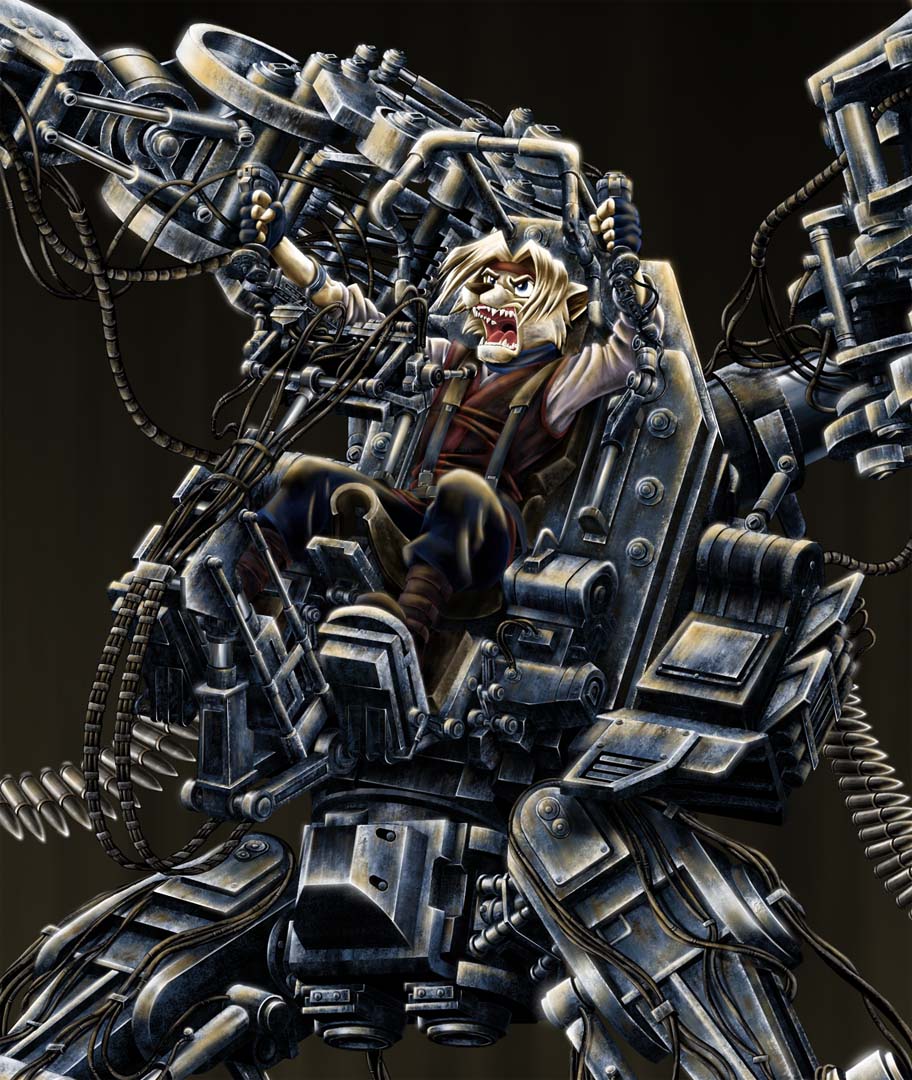 Power Mechs
Mainly used by military, these mechs act as powered armors but provide no actual bonus to ballistic ratings (though provide 8 impact and alleviate all falling damage).
Such devices are typically used to wield heavy weapons like rail guns or miniguns by one person, and often have effective strength ratings of 14 or more. These mechs can lift most cars (but not outrun them).
The availability of these are extremely high, and the user suffers perception modifiers from the front and side (though included huds usually show movement in 360 degrees).
These things way 2-3 tons and can fit in the back of a semi truck (by laying or folding) but not in most moving trucks. They make reduclous noise. Certainly not for your average shadowrunner. This is used with the Pilot: Mech skill.
 Bot Suit
 These limited power suits are used for heavy lifting and mechanical work. They are not combat-specific, and generally have a strength score equal to their rating (normally from 6-12) and are self powered, but use the user's quickness (giving -2 to the quickness score). They are not fast, but instead strong, used to pull cars (in neutral) or lift heavy boxes.
Some provide ballisting and impact armor ratings, usually between 2 and 4.
Magical Technology
Mana-Masker
A new development by Avalon corp, the Mana-Masker is a device about the size of Darth Vader's chest plate, which contains microscopic bacterial organisms which are nurtured inside and given various electrical impusles that allow them to simulate emotions.
In game terms, this helps mask an astral signature of an individual or his foci. This device can fool any mechanical way of detecting astral signatures (such as the Shinra PKE but not mages using astral vision). The rating of the device rolls against the rating of the one looking for signatures, and if successful it hides the auras of foci and individuals (but not sustained or quickened spells) on the person. The mana masker must be worn on the outside of the body, and may be apparant to others.
Aura-Bomb
A special kind of grenade by Avalon corp, this sends out sprays of microorganisms into the air in the form of smoke or mist when it detonates. While this does nothing to normal people, anyone astrally perciving (or any machine doing so) will be overloaded with the auras, and be unable to distinguish one aura from another (being effectively blind). What's more, astrally projecting creatures and unmanifested spirits will be unable to move through the effective area due to the life forms everywhere. This is sometimes used to set false alarms with PKE readers, or to hide mages (amongst the mess).
M-Death
This is a special drug which, when injected, temporarily removes all magic from the subject. The subject becomes unable to summon spirits or use magic (though ones already in the field still owe their survices). Their aura is completely surpressed during this time. It takes 6 successes on an assenssing test to realize that the aura viewed is being concealed by drugs, but they cannot tell the true aura or essence/magic scores. This prevents critters from using regeneration and other abilities, but helps them sneak past any form of astral viewing, mechanical or otherwise.
This drug is in very high demand due to its possible weapon use, but Avalon has been very protective in its production, specifically using a method which requires awakened plants so that the drug cannot be easily replicated. It is not really addictive (2, day). This even conceales magical auras on the target (such as active spells and foci).
Ranged Weapon Foci
Avalon finally "perfected" the ranged weapon foci. A projectile weapon (such as a slingshot or bow, but not a firearm or laser weapon) can be imbued as a ranged weapon focus. (Treat it as a weapon with reach +3!). Whenever the weapon is to be fired as a focus, the user's magic is reduced by 1 (meaning that your standard starting mage has 6 shots at best, including misses). When the magic reaches 0, the mage must check for magic loss and all sustained spells and abilities (like astral projection) are lost. The lost magic points restore at 1 per hour. When using this in astral combat, the weapon need not fire "actual" projectiles. The mage may choose to use the weapon without expending magic but it does not act as a weapon focus (for damaging creatures or overcoming regeneration from death) when this is done.
Metamagic: Ranged Focus Expert
With the creation of the Ranged Weapon Focus, Avalon mages developed a metamagic technique which would allow magic only to be lost on a successful hit, not when the shot misses.
Metamagic Ranged Focus Master (requires ranged focus expert)
The most advanced mages have learned how to channel their magic so that only enemies who suffer a wound from the ranged weapon foci cause magic loss to the mage, those who resist the damage completely cause no ill effects to the mage.
Avanlon Emancipator
This taser weapon fires a ray of electrical discharge at a target, doing 5L stun damage. It can hold 20 shots before needing a recharge and is the size of Han's Blaster. Spirits and astrally active creatures take no damage from this specially charged beam. This is not the main use of the device, however. When fired at a device which houses a trapped spirit (such as a mako battery or a spirit trap) the device must make an rating test TN 8. If it has more successes then the person firing the weapon got, it is fine. Otherwise it explodes, causing everyone within 10 meters to resist 10S damage, and the spirt(s) within are freed instantly, who usually flee, but sometimes may attack their prior captors.
Large reactor devices (such as Mako reactors or giant Spirit Trap containment units) usually have special shielding devices rendering them immune or resistant to such handheld devices.
A new development by Avalon corp, the Mana-Masker is a device about the size of Darth Vader's chest plate, which contains microscopic bacterial organisms which are nurtured inside and given various electrical impusles that allow them to simulate emotions.
In game terms, this helps mask an astral signature of an individual or his foci. This device can fool any mechanical way of detecting astral signatures (such as the Shinra PKE but not mages using astral vision). The rating of the device rolls against the rating of the one looking for signatures, and if successful it hides the auras of foci and individuals (but not sustained or quickened spells) on the person. The mana masker must be worn on the outside of the body, and may be apparant to others.
Aura-Bomb
A special kind of grenade by Avalon corp, this sends out sprays of microorganisms into the air in the form of smoke or mist when it detonates. While this does nothing to normal people, anyone astrally perciving (or any machine doing so) will be overloaded with the auras, and be unable to distinguish one aura from another (being effectively blind). What's more, astrally projecting creatures and unmanifested spirits will be unable to move through the effective area due to the life forms everywhere. This is sometimes used to set false alarms with PKE readers, or to hide mages (amongst the mess).
M-Death
This is a special drug which, when injected, temporarily removes all magic from the subject. The subject becomes unable to summon spirits or use magic (though ones already in the field still owe their survices). Their aura is completely surpressed during this time. It takes 6 successes on an assenssing test to realize that the aura viewed is being concealed by drugs, but they cannot tell the true aura or essence/magic scores. This prevents critters from using regeneration and other abilities, but helps them sneak past any form of astral viewing, mechanical or otherwise.
This drug is in very high demand due to its possible weapon use, but Avalon has been very protective in its production, specifically using a method which requires awakened plants so that the drug cannot be easily replicated. It is not really addictive (2, day). This even conceales magical auras on the target (such as active spells and foci).
Ranged Weapon Foci
Avalon finally "perfected" the ranged weapon foci. A projectile weapon (such as a slingshot or bow, but not a firearm or laser weapon) can be imbued as a ranged weapon focus. (Treat it as a weapon with reach +3!). Whenever the weapon is to be fired as a focus, the user's magic is reduced by 1 (meaning that your standard starting mage has 6 shots at best, including misses). When the magic reaches 0, the mage must check for magic loss and all sustained spells and abilities (like astral projection) are lost. The lost magic points restore at 1 per hour. When using this in astral combat, the weapon need not fire "actual" projectiles. The mage may choose to use the weapon without expending magic but it does not act as a weapon focus (for damaging creatures or overcoming regeneration from death) when this is done.
Metamagic: Ranged Focus Expert
With the creation of the Ranged Weapon Focus, Avalon mages developed a metamagic technique which would allow magic only to be lost on a successful hit, not when the shot misses.
Metamagic Ranged Focus Master (requires ranged focus expert)
The most advanced mages have learned how to channel their magic so that only enemies who suffer a wound from the ranged weapon foci cause magic loss to the mage, those who resist the damage completely cause no ill effects to the mage.
Avanlon Emancipator
This taser weapon fires a ray of electrical discharge at a target, doing 5L stun damage. It can hold 20 shots before needing a recharge and is the size of Han's Blaster. Spirits and astrally active creatures take no damage from this specially charged beam. This is not the main use of the device, however. When fired at a device which houses a trapped spirit (such as a mako battery or a spirit trap) the device must make an rating test TN 8. If it has more successes then the person firing the weapon got, it is fine. Otherwise it explodes, causing everyone within 10 meters to resist 10S damage, and the spirt(s) within are freed instantly, who usually flee, but sometimes may attack their prior captors.
Large reactor devices (such as Mako reactors or giant Spirit Trap containment units) usually have special shielding devices rendering them immune or resistant to such handheld devices.
Wednesday, December 29, 2010
Mako Energy
Energy from spiritual sources or "souls", Mako energy has been quite contraversial since its discovery by Shinra Corp. It provides energy which is clean, reliable, portable, and long-lasting, but it is powered by "souls" (and it's status as renewable energy is debateable).
Many Mako battery reactors are powered by captured free spirits, ghosts and spectres, or even live critters (who die during the process).
In game terms, Mako batteries usually cost double or triple what normal batteries do, with an extremely high availability. They generate a small aura (as if a sustained spell), and the batteries will last 10-20 times as long, making them ideal for rutheneum suites or energy weapons. Once the batteries drain, they can only be recharged by replacing the spirit trapped within, either by catching one and using a spirit trap, or by going to a designated Shinra facility and purchasing one. Some free spirits have been known to be powerful enough to have charged batteries which still have not run out!
A few small mako reactors have been created, usually on site to help power Shinra's own corporate buildings. Rumors about them using the "earth's soul" abound, though their spirit fighting equipment and reputation implies that they could easily be powered by strong captured spirits. The effect of draining the earth's soul (if it exists) leads to debates as heated and varied as the global warming debates of the late 20th century. So far, no ill effects have been observed (or at least reported).
Anyone seen with a mako battery seems to be treated as if they had the spirit bane flaw for all spirit types. There has been some debate as to whether this is an evil practice or not, particularly in relation to blood spirits, toxic spirits, and insect spirits.
Many Mako battery reactors are powered by captured free spirits, ghosts and spectres, or even live critters (who die during the process).
In game terms, Mako batteries usually cost double or triple what normal batteries do, with an extremely high availability. They generate a small aura (as if a sustained spell), and the batteries will last 10-20 times as long, making them ideal for rutheneum suites or energy weapons. Once the batteries drain, they can only be recharged by replacing the spirit trapped within, either by catching one and using a spirit trap, or by going to a designated Shinra facility and purchasing one. Some free spirits have been known to be powerful enough to have charged batteries which still have not run out!
A few small mako reactors have been created, usually on site to help power Shinra's own corporate buildings. Rumors about them using the "earth's soul" abound, though their spirit fighting equipment and reputation implies that they could easily be powered by strong captured spirits. The effect of draining the earth's soul (if it exists) leads to debates as heated and varied as the global warming debates of the late 20th century. So far, no ill effects have been observed (or at least reported).
Anyone seen with a mako battery seems to be treated as if they had the spirit bane flaw for all spirit types. There has been some debate as to whether this is an evil practice or not, particularly in relation to blood spirits, toxic spirits, and insect spirits.
Improvised Weapons
Sometimes you don't have a weapon. Sometimes you need to deal with the crap you find. Enter the improvised weapons!
Improvised weapons generally deal damage using either unarmed combat skill or whatever is closest to the weapon. Weapons that fit in the palm of the hand (large rocks or broken bottles) used for melee should be unarmed combat. Larger items (pool cues, chairs, etc) should go towards other items (polearms for pool cues). Thrown weapons tend to use the thrown weapon skill.
An improvised item generally uses ballistic armor to resist it. If sharp (broken bottle) it does physical damage, if blunt (big rock) it does stun damage. Going from stun>physical is fine, but it reduces the power of the attack by 1/2.
Most improvised weapons do 1 or 2 points less power than normal (so a chair leg might do [Str-2]L stun). Partiuclarly bulky items (like a whole chair) should take a +1 or +2 TN penalty to their use.
Some basic improvised weapons:
(Str-2)L Stun: Big rock, fire extinquisher, char leg, pool cue (+1 reach), chair (+2 TN), railroad spike.
(Str-1)L Stun: Bike chain (+1 reach), ladder (+2 reach), baseball bat
(Str)L Stun: Tire iron, crowbar
(Str-1)L : Broken bottle, railroad spike, straight razor, sawblade, saw, board with a nail in it
At GMs option, some improvised weapons may have special characteristics (a chair might be held as a shield, dirt might be thrown to blind, etc).
Improvised weapons generally deal damage using either unarmed combat skill or whatever is closest to the weapon. Weapons that fit in the palm of the hand (large rocks or broken bottles) used for melee should be unarmed combat. Larger items (pool cues, chairs, etc) should go towards other items (polearms for pool cues). Thrown weapons tend to use the thrown weapon skill.
An improvised item generally uses ballistic armor to resist it. If sharp (broken bottle) it does physical damage, if blunt (big rock) it does stun damage. Going from stun>physical is fine, but it reduces the power of the attack by 1/2.
Most improvised weapons do 1 or 2 points less power than normal (so a chair leg might do [Str-2]L stun). Partiuclarly bulky items (like a whole chair) should take a +1 or +2 TN penalty to their use.
Some basic improvised weapons:
(Str-2)L Stun: Big rock, fire extinquisher, char leg, pool cue (+1 reach), chair (+2 TN), railroad spike.
(Str-1)L Stun: Bike chain (+1 reach), ladder (+2 reach), baseball bat
(Str)L Stun: Tire iron, crowbar
(Str-1)L : Broken bottle, railroad spike, straight razor, sawblade, saw, board with a nail in it
At GMs option, some improvised weapons may have special characteristics (a chair might be held as a shield, dirt might be thrown to blind, etc).
Archaic Projectile Weapons
Anyone can fire a gun, and it's easy to be a sniper when you're shooting someone from over a kilometer away with a silenced rifle. Archaic weapons help add some flavor (and some advantage) to a typical mission.
Bows: Bows have a distinct advantage over guns: they are silent. In many cases they can be built out of non-metallic materials (not always) and thus be hidden from metallic anomaly scanners. However, their bulk can often compensate for this. Bows cannot benefit from lasers, scopes, or smartlinks.
Firing a bow is a complex action that includes drawing the arrow, and pulling the string. It uses impact armor instead of ballistic armor to determine damage.
Bows do (S+2)M damage base, though some specially designed bows or arrows may increase this (EX ammo is avail for arrows, but it does eliminate the silence benefit). Bows have pistol range.
Crossbows: Crossbows are the fine line between bows and guns. They take a complex action to load, a simple action to shoot, and do flat damage. (Usually 6M, but can be modified by specially made crossbows or bolts). Like bows they can be easily made of non-metallic materials and unlike bows they can be folded up to make the more concealable. They are also silent. Crossbows can benefit from sights and scopes but not smartlinks. Crossbows have pistol range. They also use impact armor instead of ballistic.
While the range is more limited, the ability to work in complete silence can grant a huge advantage to the users of bows and crossbows, and such items are more easily considered "hunting" gear and are thus more available and less likely to draw questions from athority figures, even if you're walking down the street with them (but not drawn and strung of course).
Slingshots: Slingshots are small, easily concealable (8), and can pack a whollop. They do (Str)M damage, and special ammo models can increase this. They are very often made of non-metallic materials, rarely are people questioned for having this (except in termos of curiousity- why does an adult have a kid's toy?) and they are silent. They are also cheap. Their range is as a holdout pistol, and it's a complex action to fire. These cannot benefit from attachments (smartlink, etc)
Blowgun: A small dart is inserted into the blowgun and administered by blowing into the tube very quickly. They are extermely concealable (10), and the darts are often coated with poisons or drugs. The blowgun deals 6L(stun) damage, and this is never scaled up from successes, the extra successes only negate the ability to scale it down. Armor generally blocks these if it has impact ratings above 1, but a called shot can avoid armor rating with these. A wound generally must be taken to administer the poison, but not always if the poison is contact. These cannot benefit from attachments.
Launcher: Takes three people to use, this is a bit of rubber or elastic, each end held by two people while the third pulls back on the string and launches a missile (such as a grenade, molotov cocktail, water balloon, etc) a long distance with complete silence. Each "holder" must make a strength check TN 4 to keep steady while the launcher can fire at grenade launcher ranges. The impact does no damage, but typically the explosive detonates on impact (cooking during flight). If fired directly at a target at point blank range it is resisted with impact armor and does (Str+4)L(stun) damage. These are cheap and ultra-concealable (12).
Weapons above use the Projectile Weapon (quickness) active skill, which is grouped with thrown weapons.
Bows: Bows have a distinct advantage over guns: they are silent. In many cases they can be built out of non-metallic materials (not always) and thus be hidden from metallic anomaly scanners. However, their bulk can often compensate for this. Bows cannot benefit from lasers, scopes, or smartlinks.
Firing a bow is a complex action that includes drawing the arrow, and pulling the string. It uses impact armor instead of ballistic armor to determine damage.
Bows do (S+2)M damage base, though some specially designed bows or arrows may increase this (EX ammo is avail for arrows, but it does eliminate the silence benefit). Bows have pistol range.
Crossbows: Crossbows are the fine line between bows and guns. They take a complex action to load, a simple action to shoot, and do flat damage. (Usually 6M, but can be modified by specially made crossbows or bolts). Like bows they can be easily made of non-metallic materials and unlike bows they can be folded up to make the more concealable. They are also silent. Crossbows can benefit from sights and scopes but not smartlinks. Crossbows have pistol range. They also use impact armor instead of ballistic.
While the range is more limited, the ability to work in complete silence can grant a huge advantage to the users of bows and crossbows, and such items are more easily considered "hunting" gear and are thus more available and less likely to draw questions from athority figures, even if you're walking down the street with them (but not drawn and strung of course).
Slingshots: Slingshots are small, easily concealable (8), and can pack a whollop. They do (Str)M damage, and special ammo models can increase this. They are very often made of non-metallic materials, rarely are people questioned for having this (except in termos of curiousity- why does an adult have a kid's toy?) and they are silent. They are also cheap. Their range is as a holdout pistol, and it's a complex action to fire. These cannot benefit from attachments (smartlink, etc)
Blowgun: A small dart is inserted into the blowgun and administered by blowing into the tube very quickly. They are extermely concealable (10), and the darts are often coated with poisons or drugs. The blowgun deals 6L(stun) damage, and this is never scaled up from successes, the extra successes only negate the ability to scale it down. Armor generally blocks these if it has impact ratings above 1, but a called shot can avoid armor rating with these. A wound generally must be taken to administer the poison, but not always if the poison is contact. These cannot benefit from attachments.
Launcher: Takes three people to use, this is a bit of rubber or elastic, each end held by two people while the third pulls back on the string and launches a missile (such as a grenade, molotov cocktail, water balloon, etc) a long distance with complete silence. Each "holder" must make a strength check TN 4 to keep steady while the launcher can fire at grenade launcher ranges. The impact does no damage, but typically the explosive detonates on impact (cooking during flight). If fired directly at a target at point blank range it is resisted with impact armor and does (Str+4)L(stun) damage. These are cheap and ultra-concealable (12).
Weapons above use the Projectile Weapon (quickness) active skill, which is grouped with thrown weapons.
Tuesday, December 28, 2010
The Optical Mage
Magic is targed through optics, meaning that one can use mirrors to help target spells. This lead to a lot of experimentation with fiberoptics and mirrors, and this is some of what the mage came up with.
Fiberoptic Goggles: Goggles with bendable, posable wires that extend up to 3' from the user's face, allowing them to look under doors, around corners, into cars, etc. Great for shooting around corners, however it provides complete blindness to all other things other than what the mage is looking at as the fiber optic lens takes up the full field of vision (like binoculars). It requires a complex action to aim such devices, and they have +5 to their stealth to avoid being seen by others. A mage cannot target you by seeing your goggles cord.
The Dental Mirror:
A dental mirror allows reflection, but it takes a complex action to aim and provides a +2 visibility modifier. The mirrors have +5 stealth to avoid being seen. A mage takes a +5 visibility modifier to target you back through your dental mirror.
Hand Mirror:
The hand mirror can be aimed as a simple action, and provides only a +1 visibility modifer to spells targed within. They have a +3 stealth to avoid being seen. A mage takes a +3 visibility modifier to target you back using your own mirror.
Periscope Goggles:
These are nice in that they can be aimed with a non-action as part of the looking around. Like fiberoptic goggles they provide blindness to all other directions (damn my lack of periphial vision!), and they have a very limited field of view. They have +2 to stealth to avoid being seen. A mage takes a +8 visibility modifier to target you back through your own persicope goggles.
Split Vision Method:
This involves one of the above methods with another eye either closed, or open, splitting your vision amidst 2 different directions. This allows you the benefits of the special vision (periscope, fiber optics), but provides a +3 TN modifier to all perception tests since you're trying to focus on 2 things at once. At least you aren't otherwise blinded.
Double Vision Method:
This involves using your actual vision to taget and supplimental vision to see other dangers. For example, you might use your fiber optic cables to view what's going on behind you (by wrapping them around your head) and then use ultrasound vision to be aware of other dangers. You may only target spells via your optical vision, but may use your alternate vision to do other tests, with only a +1 TN modifier due to the split vision. The difficulty here comes in getting multiple forms of vision that doesn't involve your eyes, though it may be possible.
Fiberoptic Goggles: Goggles with bendable, posable wires that extend up to 3' from the user's face, allowing them to look under doors, around corners, into cars, etc. Great for shooting around corners, however it provides complete blindness to all other things other than what the mage is looking at as the fiber optic lens takes up the full field of vision (like binoculars). It requires a complex action to aim such devices, and they have +5 to their stealth to avoid being seen by others. A mage cannot target you by seeing your goggles cord.
The Dental Mirror:
A dental mirror allows reflection, but it takes a complex action to aim and provides a +2 visibility modifier. The mirrors have +5 stealth to avoid being seen. A mage takes a +5 visibility modifier to target you back through your dental mirror.
Hand Mirror:
The hand mirror can be aimed as a simple action, and provides only a +1 visibility modifer to spells targed within. They have a +3 stealth to avoid being seen. A mage takes a +3 visibility modifier to target you back using your own mirror.
Periscope Goggles:
These are nice in that they can be aimed with a non-action as part of the looking around. Like fiberoptic goggles they provide blindness to all other directions (damn my lack of periphial vision!), and they have a very limited field of view. They have +2 to stealth to avoid being seen. A mage takes a +8 visibility modifier to target you back through your own persicope goggles.
Split Vision Method:
This involves one of the above methods with another eye either closed, or open, splitting your vision amidst 2 different directions. This allows you the benefits of the special vision (periscope, fiber optics), but provides a +3 TN modifier to all perception tests since you're trying to focus on 2 things at once. At least you aren't otherwise blinded.
Double Vision Method:
This involves using your actual vision to taget and supplimental vision to see other dangers. For example, you might use your fiber optic cables to view what's going on behind you (by wrapping them around your head) and then use ultrasound vision to be aware of other dangers. You may only target spells via your optical vision, but may use your alternate vision to do other tests, with only a +1 TN modifier due to the split vision. The difficulty here comes in getting multiple forms of vision that doesn't involve your eyes, though it may be possible.
Grenades!
Porcupine Grenade-
This grenade blasts forth with long quills in all directions when it explodes. Anyone cought in the area taks 11S ranged damage, though ballistic armor applies.
Instaboom-
This grenade doesn't cook- it reacts to impact, so it explodes immediately upon landing. However, the thrower must succeed at a thrown weapons (6) test just to make sure it doesn't explode during the throw. Cost: 2x standard grenade.
Latcher-
This grenade has a sticky substance that causes it to never scatter- it sticks on people, walls, ceilings, cars, etc and explodes normally. It cannot be quick-drawn however, since it must be taken out of it's protective coating for the sticky surface to be apparant. A str (4) check can pick up the grenade, but it can't be thrown, but you can run out with it (or something it's stuck to) if you're quick enough. Cost: 2x standard grenade.
EMP-
This grenade explodes with an electromagnetic pulse that attempts to disable electronic devices in the area. When it explodes, all electronic devices within 10 meters must make an opposed test using their rating against the rating of the EMP grenade. Each net success on the part of the grenade disables the device for 1 minute. Cyberware is unaffected.
Shrieker-
This grenade detonated with a large shriek. Glass objects must make a body (6) test or shatter, and the sound can be heard from far away. Smoke grenades thrown in this way continue to shriek as the smoke comes out, obscuring hearing tests.
Inker-
This grenade explodes with ink, paint, or some other colored fluid. This can be done to vandalize (as it renders computer screens mostly illegible) but it can also foil rutheneum and other stealthy colored outfits, or aid in chase scenes (Target is purple, repeat purple!). The ink is almost always a day long procedure to completely rub off, and might be ultraviolet, so it's viewable only to special visions.
This grenade blasts forth with long quills in all directions when it explodes. Anyone cought in the area taks 11S ranged damage, though ballistic armor applies.
Instaboom-
This grenade doesn't cook- it reacts to impact, so it explodes immediately upon landing. However, the thrower must succeed at a thrown weapons (6) test just to make sure it doesn't explode during the throw. Cost: 2x standard grenade.
Latcher-
This grenade has a sticky substance that causes it to never scatter- it sticks on people, walls, ceilings, cars, etc and explodes normally. It cannot be quick-drawn however, since it must be taken out of it's protective coating for the sticky surface to be apparant. A str (4) check can pick up the grenade, but it can't be thrown, but you can run out with it (or something it's stuck to) if you're quick enough. Cost: 2x standard grenade.
EMP-
This grenade explodes with an electromagnetic pulse that attempts to disable electronic devices in the area. When it explodes, all electronic devices within 10 meters must make an opposed test using their rating against the rating of the EMP grenade. Each net success on the part of the grenade disables the device for 1 minute. Cyberware is unaffected.
Shrieker-
This grenade detonated with a large shriek. Glass objects must make a body (6) test or shatter, and the sound can be heard from far away. Smoke grenades thrown in this way continue to shriek as the smoke comes out, obscuring hearing tests.
Inker-
This grenade explodes with ink, paint, or some other colored fluid. This can be done to vandalize (as it renders computer screens mostly illegible) but it can also foil rutheneum and other stealthy colored outfits, or aid in chase scenes (Target is purple, repeat purple!). The ink is almost always a day long procedure to completely rub off, and might be ultraviolet, so it's viewable only to special visions.
Poisons
Note: Some of these may be just like existing poisons in the shadowrun books (wherever they are listed- those books are horrible!).
Poisons in General-A poison has a rating (R), which designates the target number need to avoid its harmful effects (using a body test). Generally, the number of successes will lower the effect of the poison, so if you lower the penalty down to 0 you eliminate the poison.
A poison can be (I)nhaled, (In)jected, or (C)ontact. Injected poisons must inflict at least a light wound (phys or stun) to take effect. Injected poisons may also be swallowed.
The poisons will be stated in NAME(R,Type). So Slag(4,In) means Slag is the name of the poison, 4 is the TN, and it is Injected. Ability score damage restores at 1 per day.
Slag (4,In): This poison is made to slow down opponants, and is frequently used by police to catch criminals on the run. It does a base damage of 6 to quickness, with each success reducing this. This change in quickness results in lower max speed and reaction.
Dammitol(4,C): This poison causes seratonin levels to drop horribly, dealing damage to charisma. It does a base damage of 4 to charisma, with one less for each success.
Screamer (6,I): This gas, while not actually making any noise, interferes with the inner ear, causing the user to hear intense screaming for 5 minutes after inhaling, with each success reducing this time by one minute. During that time they are effectively deaf, and take +1 TN on other skills due to the loud noise. People with cyberear replacements are not affected, since they have no inner ear.
Lunesta (4,I): This black gas is used frequently in grenades (sometimes with screamer) to affect the cornea of eyes. The user goes blind for 5 minutes after inhaling, with each success reducing this by 1 minute. During that time they fail all visual checks and take firing blind modifiers on any rolls. Cyber eye replacements are immune to this, not having a cornea.
P&P (6,C): This poison, called Pleasure and Pain, (sometimes used by dominatrixes at the club scene) causes alternating feelings of intense pleasure and intense pain on the subject. In a mechanical sense, they take a +8 TN penalty to all rolls while this is in effect, due to the severe sensations, with body success reducing the penalty by 1. People with Orthoskin get a +1 die per orthoskin level to resit this, and people with sensitive skin bioware take a +2 TN penalty to this resistance roll.
Sheep (4,In): This poison was named either for the practice of counting sheep or for the way sheep collapse when scared, but it causes the target to fall unconscious for 40 minutes, with each success reducing this time by 10 minutes.
Truth Syrum (8,In): This powerful drug aids in interrogation. Each time the person is posed a question, they must make a willpower(10) test to avoid answering truthfully and completely. Each success on the body test reduces the TN on the willpower test by 1. Unlike other drugs, this drug takes about 10 minutes to take effect.
Poisons in General-A poison has a rating (R), which designates the target number need to avoid its harmful effects (using a body test). Generally, the number of successes will lower the effect of the poison, so if you lower the penalty down to 0 you eliminate the poison.
A poison can be (I)nhaled, (In)jected, or (C)ontact. Injected poisons must inflict at least a light wound (phys or stun) to take effect. Injected poisons may also be swallowed.
The poisons will be stated in NAME(R,Type). So Slag(4,In) means Slag is the name of the poison, 4 is the TN, and it is Injected. Ability score damage restores at 1 per day.
Slag (4,In): This poison is made to slow down opponants, and is frequently used by police to catch criminals on the run. It does a base damage of 6 to quickness, with each success reducing this. This change in quickness results in lower max speed and reaction.
Dammitol(4,C): This poison causes seratonin levels to drop horribly, dealing damage to charisma. It does a base damage of 4 to charisma, with one less for each success.
Screamer (6,I): This gas, while not actually making any noise, interferes with the inner ear, causing the user to hear intense screaming for 5 minutes after inhaling, with each success reducing this time by one minute. During that time they are effectively deaf, and take +1 TN on other skills due to the loud noise. People with cyberear replacements are not affected, since they have no inner ear.
Lunesta (4,I): This black gas is used frequently in grenades (sometimes with screamer) to affect the cornea of eyes. The user goes blind for 5 minutes after inhaling, with each success reducing this by 1 minute. During that time they fail all visual checks and take firing blind modifiers on any rolls. Cyber eye replacements are immune to this, not having a cornea.
P&P (6,C): This poison, called Pleasure and Pain, (sometimes used by dominatrixes at the club scene) causes alternating feelings of intense pleasure and intense pain on the subject. In a mechanical sense, they take a +8 TN penalty to all rolls while this is in effect, due to the severe sensations, with body success reducing the penalty by 1. People with Orthoskin get a +1 die per orthoskin level to resit this, and people with sensitive skin bioware take a +2 TN penalty to this resistance roll.
Sheep (4,In): This poison was named either for the practice of counting sheep or for the way sheep collapse when scared, but it causes the target to fall unconscious for 40 minutes, with each success reducing this time by 10 minutes.
Truth Syrum (8,In): This powerful drug aids in interrogation. Each time the person is posed a question, they must make a willpower(10) test to avoid answering truthfully and completely. Each success on the body test reduces the TN on the willpower test by 1. Unlike other drugs, this drug takes about 10 minutes to take effect.
Friday, December 24, 2010
Runner Outfits
Sometimes you want to look sleek and sexy, but also hide your identity and perform tasks. So enters the Avaline "Costume" series, costumes designed to make you look like a sexy superhero, but also being functional in the extremely "rediculous" case that you actually use it to be a superhero shadowrunner. All of these provide cover for your face to hide your features.
Ninjawear-
Coming in a dark black or "dirty city gray" color, these full body suits cover the entire face and even have sunglass technology built into the typical eye hole, so that you just appear as a shilouhette, while not obscuring your own vision. The color grants a +1 bonus on stealth (sneaking and hiding) checks in dark areas (including outdoor night), which does not stack with ruthenum, but still...
The hands have a special plastic-clay polimer that aids in gripping, as do the feet, which grants a +1 bonus on any check to climb or avoid being disarmed. As an added feature (which is advertised as a sexual role play scenario), various pieces, or all of the costume can tear-away and be removed as a simple action, making this a "sexy ninja" costume, or just allowing you to quickly remove the costume to show other clothes underneath. The ninja costume is specially built with strong fibers which provide 1 ballistic and 2 impact armor rating.
Avengerwear-
Themed after superheroes, the Avengerwear series provides a thick black chestplate and legwear which provides 2 ballistic and 3 impact armor, and a black cape which can open up to concealed gliders. It also provides a belt which can proives +2 to any attempt to conceal small items like pistols, grapple guns, a few small grenades, or some simple surveillance equipment (like shotgun mics). The arms have spiked steel plates allowing the user to grip into buildings while climbing, granting +1 to climbing checks, or checks to avoid falling off a ledge or something by grabbing on to the side. The mask itself is designed to be difficult to remove, taking several complex actions, even if the wearer is unconscious.
Haremwear-
This loose, semi-transparant material is worn by women as an attractive harem costume, with a small veil to cover the facial features. The fact that the legs and arms have thin material tends to draw the target's eyes to the form rather than the face. While this does provide a -2 penalty to any attempts to conceal objects on the person, it does grant +2 dice to any athletic tests based on how loose it is, as if you were wearing nothing at all. It often comes equipped with steel razor fans, which fits with the costume, but acts as actual edged weapons, and are easily concealable as harmelss accessories.
Gothiwear-
With gothic culture still alive and well, the Avoline Gothiwear provided strong attire for the descriminating gothic shadowrunner. Using white and black makeup to disguise the face and either a wig or hair dye to mask their true features, the wearer gets a +2 bonus on disguise checks when wearing the gothiwear- but the benefits don't stop there. The heavy cloak can be opened into a pesonal glider, and that long spring-loaded gothic dress works as a personal cannon, allowing them to fire themselves up to tall buldings (in a single bound!). The make coat or female corset provides a 2 impact and 1 ballistic rating, and the entire ensamble grants +2 to concealment rating of objects hidden within. Many come with a sword-cane accessory as well, some with a sword-cane disguised grapple gun instead.
Ninjawear-
Coming in a dark black or "dirty city gray" color, these full body suits cover the entire face and even have sunglass technology built into the typical eye hole, so that you just appear as a shilouhette, while not obscuring your own vision. The color grants a +1 bonus on stealth (sneaking and hiding) checks in dark areas (including outdoor night), which does not stack with ruthenum, but still...
The hands have a special plastic-clay polimer that aids in gripping, as do the feet, which grants a +1 bonus on any check to climb or avoid being disarmed. As an added feature (which is advertised as a sexual role play scenario), various pieces, or all of the costume can tear-away and be removed as a simple action, making this a "sexy ninja" costume, or just allowing you to quickly remove the costume to show other clothes underneath. The ninja costume is specially built with strong fibers which provide 1 ballistic and 2 impact armor rating.
Avengerwear-
Themed after superheroes, the Avengerwear series provides a thick black chestplate and legwear which provides 2 ballistic and 3 impact armor, and a black cape which can open up to concealed gliders. It also provides a belt which can proives +2 to any attempt to conceal small items like pistols, grapple guns, a few small grenades, or some simple surveillance equipment (like shotgun mics). The arms have spiked steel plates allowing the user to grip into buildings while climbing, granting +1 to climbing checks, or checks to avoid falling off a ledge or something by grabbing on to the side. The mask itself is designed to be difficult to remove, taking several complex actions, even if the wearer is unconscious.
Haremwear-
This loose, semi-transparant material is worn by women as an attractive harem costume, with a small veil to cover the facial features. The fact that the legs and arms have thin material tends to draw the target's eyes to the form rather than the face. While this does provide a -2 penalty to any attempts to conceal objects on the person, it does grant +2 dice to any athletic tests based on how loose it is, as if you were wearing nothing at all. It often comes equipped with steel razor fans, which fits with the costume, but acts as actual edged weapons, and are easily concealable as harmelss accessories.
Gothiwear-
With gothic culture still alive and well, the Avoline Gothiwear provided strong attire for the descriminating gothic shadowrunner. Using white and black makeup to disguise the face and either a wig or hair dye to mask their true features, the wearer gets a +2 bonus on disguise checks when wearing the gothiwear- but the benefits don't stop there. The heavy cloak can be opened into a pesonal glider, and that long spring-loaded gothic dress works as a personal cannon, allowing them to fire themselves up to tall buldings (in a single bound!). The make coat or female corset provides a 2 impact and 1 ballistic rating, and the entire ensamble grants +2 to concealment rating of objects hidden within. Many come with a sword-cane accessory as well, some with a sword-cane disguised grapple gun instead.
Thursday, December 23, 2010
New Weapons
 Gunblade:
 The combination of a pistol and a sword, a gunblade allows a skilled user to fire the weapon just as it's cutting into a person for more severe damage capability.
The gunblade uses the edged weapons skill. On a successful hit, the user can make a heavy pistols (4) test. Each success increases the power of the attack by 1.
While this takes some skill to use properly, in the hands of the right user it can inflict serious damage, as the blade itself does (Str+1)M damage as it is.
 Lightsabre:
An interesting bit of magical technology which came out of Avalon Corp. It's basically a small handle generator, from which comes a fairly weak plasma laser which deals of a successful hit (S-1)L damage... nothing to be impressed with. This uses the laser weapons skill. The beam can cut things as if it were an edged weapon.
However, as a weapon focus these items truly awaken. As a weapon focus it does (S+2F) damage, and the damage is L for force 1, M for force 2-3, S for force 4-5, and D for force 6+. So a force 6 weapon focus lightsabre does S+12D damage. Of course, only an awakened character can use it to it's full potential, and its great cost makes sure only the best adepts can operate a powerful one. Still- in the proper hands it is definately a force to be reckoned with. (The damage of the lightsabre in astral combat uses Cha instead of force, but this supersedes the normal weapon foci astral damage codes.)
The lightsabre is easily concealed when turned off, but when activated emits a low hum, making it difficult to use stealthily.

Phasers
A small easily concealed energy weapon that can provide quite the sting. While it doesn't have the energy capacity that bullets can, the ability to switch between Stun damage and Physical damage with a push of a button makes this a great ranged weapon.
It uses the energy weapons skill, and has variable power settings, allowing you to increase the damage code of the attack. Base damage is 2L. You can increase the damage code by taking a +2 TN to hit per code above L, or increase the power by taking +1 TN to hit per 2 power increase. Unfortunately they are not smartlink compatable and they have pistol range. Changing settings (power, damage code, or stun/physical) is a complex action, though you can make any adjustments you want with that same action.
The weakness in phasers comes from the fact that the energy wave generated by the beam can be blocked by most energy shielding technology. Some people can get 1-2 shots in before the shields compensate, though people with B/R energy weapons can attempt to get the phasers to randomly modulate frequencies to get a few more shots in, though at best this gets you 10-20 shots before the shields just catch up.
This suffers no recoil.
Freeze Ray
The ares corp recently came out with the freeze ray as part of a technology to cool superconductors that leaked into the weapons development field. This uses the energy weapons skill.
The weapon is fired at the target, who resists using quickness instead of body. Each net success for the attacker reduces the target's quickness by 1 due to freezing icy temperatures- quickness reduced to 0 freezes the target in a block of ice where they are conscious but immobile. The quickness returns (with warmth) at the rate of 1 point per 5 minutes, once quickness goes back up to 1 the target can move (at lower quickness). This can be dodged normally using combat pool. As far as damage, the targets need only resist 2L stun regardless of successes any time they take any quickness damage.
Wednesday, December 22, 2010
Electronic/Mechanical Equipment
RI Coordinator
The RI coodinator is a large radio unit with signal boosters. It can be keyed to either special helmets work by a team or by simple transmitters. The home piece of equipment, which is the size of a desktop computer, calculates on a hud the locations of each team member. If they wear the specalized helmets, it can also transmit this hud to the plastic of each helmet, and can also display what's in the field of view of each agent to another agent or to the main unit. It also keeps the team in contact with each other via radio frequency. The home unit uses a random number generator to manage the changing of frequencies to help overcome anyone else listening in.
More advanced version contain ultrasound mappers on the helmets so it can construct a kind of auto-map in the HUD. If the building plans can be recieved and downloaded in digital form it can also overlay such maps for the team to use. If the headware can be equipped to detect other life forms (like some cyberware has), they can be displayed on the HUD also as a warning to the runners. Each of these "upgrades" can be quite costly.
This equipment is suseptable to signal jamming, so signal boosters may be needed.
De-Magnitizer:
A large block which goes onto a mag-lock door and forces it open. Unlike the sequencer or the scramblers, this attacks the magnetic locking mechanism, which either disables the magnatism or reverses it- forcing the door to swing open. On the plus side, it's very quick- it takes 1 full combat round for it to work. Make a rating test of the unit vs the door, one net success and it works. The downside is that it almost always triggers an alarm, since it doesn't bypass- it overpowers, as if you had ripped the door off yourself. The unit takes 3 complex actions to attach to a lock and 1 to remove once it is activated. Great for getting out in a hurry, not great for getting in secretly. The technical equivelant of breaking a window.
Key-Blaster:
One of the reasons they made maglocks is because of the keyblaster. It's a small device that shoots pressurized air into a mechanical lock, pushing the bolts up so that the lock can be turned. Roll the rating of the blaster against the rating of the lock, if successful (with one success) it allows you to unlock the door. Most mechanical locks are of low rating. In any case, it takes only a complex action to use.

Tricorder
A tricorder is a small device, about the size of a cell phone. When opened it can scan an area about 3 meters around itself, and apply relevant knowledge skills, which it displays on the screen. The rating of the tricorder determines the ranks in a knowledge skill that it has. Many knowledge skills include knowledge:biotech (for scanning for diseases, cyberware, etc- common in medical models), knowledge: metahumanity (for scanning people to determine racial origins or mutations, etc), knowledge structural (for determining building weak points, etc) or knowledge weapons (for identifying weapons, explosives) or knowledge electronics (for identifying maglocks and providing instructions for disarming).
The tricorder rolls its rating against the rating of any machine it scans, (or against the disguise of any person it's identifying), and if successful it identifies the creature/device and rolls its knowledge checks. A tricorder can hold up to 2x its ratings in knowledge skills, to be divvyed up in any way amongst knowledge skill ranks. It also provides 6 ranks in instruction for giving directions on how to construct (or destroy/override, etc) a given device it identifies.
Camera Loop
This piece of equipment searches the camera for images of non-movement, and attempts to loop that image to the camera's vision, providing the illusion that no one is ever in the hall, despite what the camera actually sees. Installing this requires that the person get under the camera, and attach it with a B/R electronics check, TN = rating of the camera, base time 15 minutes with extra successes decreasing time.
Afterwards the loop seraches for an empty image and plays it repeatedly. It makes an opposed test against the camera. If the camera wins, it records what's actually there, but displays the fake image. If the loop wins, the camera records the blank hallway too.
While this is not fool-proof (if the hall SHOULD be full, it will still show as empty, and any image of a clock or shadows might be a giveaway), this is an effective way of disabling a camera so that the guards watching don't know what's going on. (Of course, if the immage SUDDENLY goes blank that could be a problem too!)
The RI coodinator is a large radio unit with signal boosters. It can be keyed to either special helmets work by a team or by simple transmitters. The home piece of equipment, which is the size of a desktop computer, calculates on a hud the locations of each team member. If they wear the specalized helmets, it can also transmit this hud to the plastic of each helmet, and can also display what's in the field of view of each agent to another agent or to the main unit. It also keeps the team in contact with each other via radio frequency. The home unit uses a random number generator to manage the changing of frequencies to help overcome anyone else listening in.
More advanced version contain ultrasound mappers on the helmets so it can construct a kind of auto-map in the HUD. If the building plans can be recieved and downloaded in digital form it can also overlay such maps for the team to use. If the headware can be equipped to detect other life forms (like some cyberware has), they can be displayed on the HUD also as a warning to the runners. Each of these "upgrades" can be quite costly.
This equipment is suseptable to signal jamming, so signal boosters may be needed.
De-Magnitizer:
A large block which goes onto a mag-lock door and forces it open. Unlike the sequencer or the scramblers, this attacks the magnetic locking mechanism, which either disables the magnatism or reverses it- forcing the door to swing open. On the plus side, it's very quick- it takes 1 full combat round for it to work. Make a rating test of the unit vs the door, one net success and it works. The downside is that it almost always triggers an alarm, since it doesn't bypass- it overpowers, as if you had ripped the door off yourself. The unit takes 3 complex actions to attach to a lock and 1 to remove once it is activated. Great for getting out in a hurry, not great for getting in secretly. The technical equivelant of breaking a window.
Key-Blaster:
One of the reasons they made maglocks is because of the keyblaster. It's a small device that shoots pressurized air into a mechanical lock, pushing the bolts up so that the lock can be turned. Roll the rating of the blaster against the rating of the lock, if successful (with one success) it allows you to unlock the door. Most mechanical locks are of low rating. In any case, it takes only a complex action to use.
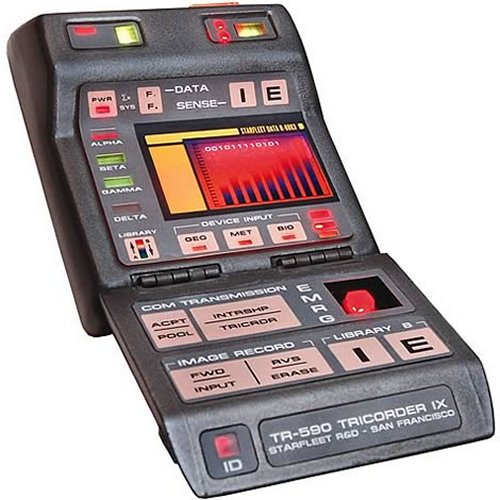
Tricorder
A tricorder is a small device, about the size of a cell phone. When opened it can scan an area about 3 meters around itself, and apply relevant knowledge skills, which it displays on the screen. The rating of the tricorder determines the ranks in a knowledge skill that it has. Many knowledge skills include knowledge:biotech (for scanning for diseases, cyberware, etc- common in medical models), knowledge: metahumanity (for scanning people to determine racial origins or mutations, etc), knowledge structural (for determining building weak points, etc) or knowledge weapons (for identifying weapons, explosives) or knowledge electronics (for identifying maglocks and providing instructions for disarming).
The tricorder rolls its rating against the rating of any machine it scans, (or against the disguise of any person it's identifying), and if successful it identifies the creature/device and rolls its knowledge checks. A tricorder can hold up to 2x its ratings in knowledge skills, to be divvyed up in any way amongst knowledge skill ranks. It also provides 6 ranks in instruction for giving directions on how to construct (or destroy/override, etc) a given device it identifies.
Camera Loop
This piece of equipment searches the camera for images of non-movement, and attempts to loop that image to the camera's vision, providing the illusion that no one is ever in the hall, despite what the camera actually sees. Installing this requires that the person get under the camera, and attach it with a B/R electronics check, TN = rating of the camera, base time 15 minutes with extra successes decreasing time.
Afterwards the loop seraches for an empty image and plays it repeatedly. It makes an opposed test against the camera. If the camera wins, it records what's actually there, but displays the fake image. If the loop wins, the camera records the blank hallway too.
While this is not fool-proof (if the hall SHOULD be full, it will still show as empty, and any image of a clock or shadows might be a giveaway), this is an effective way of disabling a camera so that the guards watching don't know what's going on. (Of course, if the immage SUDDENLY goes blank that could be a problem too!)
Gun Mounts and Accessories
Corner-Shot (Scope and Stock accessory)
The Corner-Shot allows for a bendable rifle (or assault rifle, etc) with fiber-optics or electrical targeting systems so that the user can stand by a corner and aim at targets on the other side of the corner without revealing himself.
This provides a +1 to the TN modifier to fire, and requires a simple action to aim up the shot (meaning it takes 2 simple actions each round to fire), but allows the attacker full cover. While many companies and armies utilize corner-shot, the ability to quickly peek out and fire twice makes it not all-encompasing.
Remote Lock (trigger accessory)
Basically a safety switch that can be turned on or off remotely. While this has little practical use on the gun itself, it has been effective during training and safety classes to ensure no accidents happen. The operator uses a remote control (or even cyberware remotes) to enable or disable guns. This has proven effective in small security patrols where building maintenance can disable guns to prevent them from being stolen from security officers. While more specific models already exist, it might be helpful for shadowrunning teams when one PC has a very itchy trigger finger, to prevent him from going gun-wild.
More to Come
The Corner-Shot allows for a bendable rifle (or assault rifle, etc) with fiber-optics or electrical targeting systems so that the user can stand by a corner and aim at targets on the other side of the corner without revealing himself.
This provides a +1 to the TN modifier to fire, and requires a simple action to aim up the shot (meaning it takes 2 simple actions each round to fire), but allows the attacker full cover. While many companies and armies utilize corner-shot, the ability to quickly peek out and fire twice makes it not all-encompasing.
Remote Lock (trigger accessory)
Basically a safety switch that can be turned on or off remotely. While this has little practical use on the gun itself, it has been effective during training and safety classes to ensure no accidents happen. The operator uses a remote control (or even cyberware remotes) to enable or disable guns. This has proven effective in small security patrols where building maintenance can disable guns to prevent them from being stolen from security officers. While more specific models already exist, it might be helpful for shadowrunning teams when one PC has a very itchy trigger finger, to prevent him from going gun-wild.
More to Come
Personal Flight Suits (PFSs)
Technology that has been experimented with for many years, PFSs were designed to be a replacement for cars world over.
Of course, it didn't turn out that way. Between trying to regulate air traffic, licensing and training of people using the suits, concerns about mid-air collisions and running out of gas, most personal flight suits were deemed unrealistic for your average citizen. Of course, research continues, and it's possible that some prototypes or even government issued suits were created, which could have gotten into the hands of individuals.
Powered Parachutes:
This device (which exists today!) is basically a framed chair with a variety of fans, some of which blow up against a parachute, providing lift. While the speeds on this are not great, and it takes time to lift off (so it's not good for a quick escape), it does allow for limited flight. While generally flown "for sport", it can also be used for surveillance or to land on the roof of a building, though it isn't particularly stealthy. Still, it avoids radar, is fairly quiet (people inside a building might not be aware one is being operated), and can be colored to be slightly concealed against the night sky. This may be considered more of a vehicle than a personal flight suit, though some models exist which can be carried around like a large backpack, they are very heavy and bulky and completely non-concealable.
Personal Gliders:
While not technically flight, glider equipment can be built into capes or backpacks allowing the user to lock "wings" out from his back, and gliding down. Not useful for going ascending, though it can facilitate a jump off a skyscraper easily enough. Somewhat concealable, thought it will appear as a cape or backpack- best case scenario. Cyberware versions may exist which can fold into the body of a person.
Personal Cannons:
Not exactly a cannon, but a spring loaded funnel that fits around a person, who can lock it into place, bend down against the ground, and launch themselves up into the air. The descent proves to be its own obstacle, but this device can be concealed into large gowns or dresses. The device can launch someone up to 10*Rating in meters (with a R1 launching you 10M) up into the air, and some aiming can allow for landing on a building (though risky). While it takes skill to use, such things are concealable, very quiet, and amongst the stealthiest ways to "jump" onto a building's roof.
Jet Packs:
The ultimate in personal flight suits, the jetpack is considered the holy grail of personal flight. Able to achieve high altitudes and speeds faster than most cars, the jetpack's flaws are in its high fuel consumption and poor manuverability. Your speed (and small size) would allow you to bypass most radars, and quickly escape pursuit (though it will probably be clear where you land). The jetpack is loud and requires special piloting skill to avoid splatting yourself on buildings at high speed, though low speed and hover options are available. Some are even quite concealable as cyberware or as a backpack, though specalized helmets are required to operate at high speeds.
Note: Costs and cyberware equivelants are intentionally left out for GMs to decide as campaign world warrants.
Of course, it didn't turn out that way. Between trying to regulate air traffic, licensing and training of people using the suits, concerns about mid-air collisions and running out of gas, most personal flight suits were deemed unrealistic for your average citizen. Of course, research continues, and it's possible that some prototypes or even government issued suits were created, which could have gotten into the hands of individuals.
Powered Parachutes:
This device (which exists today!) is basically a framed chair with a variety of fans, some of which blow up against a parachute, providing lift. While the speeds on this are not great, and it takes time to lift off (so it's not good for a quick escape), it does allow for limited flight. While generally flown "for sport", it can also be used for surveillance or to land on the roof of a building, though it isn't particularly stealthy. Still, it avoids radar, is fairly quiet (people inside a building might not be aware one is being operated), and can be colored to be slightly concealed against the night sky. This may be considered more of a vehicle than a personal flight suit, though some models exist which can be carried around like a large backpack, they are very heavy and bulky and completely non-concealable.
Personal Gliders:
While not technically flight, glider equipment can be built into capes or backpacks allowing the user to lock "wings" out from his back, and gliding down. Not useful for going ascending, though it can facilitate a jump off a skyscraper easily enough. Somewhat concealable, thought it will appear as a cape or backpack- best case scenario. Cyberware versions may exist which can fold into the body of a person.
Personal Cannons:
Not exactly a cannon, but a spring loaded funnel that fits around a person, who can lock it into place, bend down against the ground, and launch themselves up into the air. The descent proves to be its own obstacle, but this device can be concealed into large gowns or dresses. The device can launch someone up to 10*Rating in meters (with a R1 launching you 10M) up into the air, and some aiming can allow for landing on a building (though risky). While it takes skill to use, such things are concealable, very quiet, and amongst the stealthiest ways to "jump" onto a building's roof.
Jet Packs:
The ultimate in personal flight suits, the jetpack is considered the holy grail of personal flight. Able to achieve high altitudes and speeds faster than most cars, the jetpack's flaws are in its high fuel consumption and poor manuverability. Your speed (and small size) would allow you to bypass most radars, and quickly escape pursuit (though it will probably be clear where you land). The jetpack is loud and requires special piloting skill to avoid splatting yourself on buildings at high speed, though low speed and hover options are available. Some are even quite concealable as cyberware or as a backpack, though specalized helmets are required to operate at high speeds.
Note: Costs and cyberware equivelants are intentionally left out for GMs to decide as campaign world warrants.
Tuesday, December 21, 2010
Magic Services
While your character may not be a mage, he has plenty of reason to hire mages. Here are some of the services mages have been known to supply:
Spell Teaching, Talismongering, Etc: Ah yes, the basic services mages provide to each other- glossed over here.
Entertainment: The entertainment spell can provide lifelike illusions even better than simsense programs, with the only downside is that some mage is controlling them (and thus watching you interact).
Spellcasting Services: Whether it's magical healing, or even quickening spells, mages are right up there wanting to cash in (though karma intensive spells are very expensive).
Astral Scrubbing: Grab a mage with cleansing and help clean up the psycic images so no one can come in and psychomancy or astrally track you. Great for cleaning up crime scenes, horrible for cleaning up your house.
Psychic Detective: Maybe you need to bring someone with psychomancy to a location to read the past or astrally track someone else. Hopefully he didn't hire a scrubber
Spirit Summoning: For a fee a mage might be able to summon a spirit to follow you around and assist you for a while. The problem with this is you almost always need a greater form (not always, but almost always) to be able to bring him from the summon spot to where you're going. But having a spirit on hand to conceal you can be very useful.
Aura Reading: Maybe you need a guy with astral perception to read your own aura (or thoughts!) to find out some secret about your past (or to discover what that mysterious piece of cyberware is!).
Spy: A mage can astrally project and check an area out- though this can get very dangerous and is closer to hiring your own shadowrunner than purchasing a magic service.
Sustainer: Maybe you need someone to take over sustaining a spell for you. Usually you're paying this guy a high hourly rate, but he requires a special metamagic feat for this.
Healing: Restoring essence or magic can get very expensive as this experimental metamagic feat is used to heal you up. Almost always at GM call.
Magic Surgery: Get a mage with biotech and the right metamagic and cyberware/bioware essence reduction can be greatly reduced! Even better if you can get magical cyberware to begin with!
Sometimes it doesn't hurt just to look up a mage- as long as he can keep a secret!
Spell Teaching, Talismongering, Etc: Ah yes, the basic services mages provide to each other- glossed over here.
Entertainment: The entertainment spell can provide lifelike illusions even better than simsense programs, with the only downside is that some mage is controlling them (and thus watching you interact).
Spellcasting Services: Whether it's magical healing, or even quickening spells, mages are right up there wanting to cash in (though karma intensive spells are very expensive).
Astral Scrubbing: Grab a mage with cleansing and help clean up the psycic images so no one can come in and psychomancy or astrally track you. Great for cleaning up crime scenes, horrible for cleaning up your house.
Psychic Detective: Maybe you need to bring someone with psychomancy to a location to read the past or astrally track someone else. Hopefully he didn't hire a scrubber
Spirit Summoning: For a fee a mage might be able to summon a spirit to follow you around and assist you for a while. The problem with this is you almost always need a greater form (not always, but almost always) to be able to bring him from the summon spot to where you're going. But having a spirit on hand to conceal you can be very useful.
Aura Reading: Maybe you need a guy with astral perception to read your own aura (or thoughts!) to find out some secret about your past (or to discover what that mysterious piece of cyberware is!).
Spy: A mage can astrally project and check an area out- though this can get very dangerous and is closer to hiring your own shadowrunner than purchasing a magic service.
Sustainer: Maybe you need someone to take over sustaining a spell for you. Usually you're paying this guy a high hourly rate, but he requires a special metamagic feat for this.
Healing: Restoring essence or magic can get very expensive as this experimental metamagic feat is used to heal you up. Almost always at GM call.
Magic Surgery: Get a mage with biotech and the right metamagic and cyberware/bioware essence reduction can be greatly reduced! Even better if you can get magical cyberware to begin with!
Sometimes it doesn't hurt just to look up a mage- as long as he can keep a secret!
Friday, December 17, 2010
Surrogate
Ares revolutionized the secuirty buisness when it came out with the securo-drone, the first in what would be their Surrogate Line. A rigger (or even a layman with a specially designed VCR pod) could control a security drone as if it were themselves, a bipedial robot under their complete control, allowing them to be patrolling, fighting in wars, patrolling the streets, without any physical harm coming to themselves.
With the advent of cloning and AI, riggers have been able to build realistic molds on these Surrogates, and some of them may be completely indistinguishable from normal people (except on the astral, of course). Some more advanced riggers can even connect to more than one unit at a time for maximum security with minimum human necessity.
Of course, the system is not perfect- while the rigger can experience sight and sound (and some are equipped with a detector that mimics scent); magic, touch, taste, and true odor are not yet within the drone's capability. Being a drone, they are more suseptable to physical illusions, though active riggers can use their own intelligence to combat illusions rather than the drone's.
The drones also require a strong signal, and are suseptable to jamming, there are generally encrypted signal boosters in facilities which use such drones.
Still, they have revolutionized warfare, replacing the need to ever send humans directly into battle (though the cost of a proper unit still makes it difficult for a replacement army to be comprised completely of them). Many megacorps make full use of these in low-security facilities (while higher ones use a combination of these, and living secuirty forces).
Ares is still doing research in their Surrogate line to attempt to replicate the sensation of touch, balance, and similar sensations. It's expected that once they figure it out, mankind may develop into a full rigging state, sending out drones for everything except copulation (though when reproduction is not the goal, perhaps even that!).
With the drones unable to use magic, there are still plenty of reasons why not to pilot such a thing, but these can be quite valuable to a shadowrunner- or a johnson, though neither they, nor their specially built VCRs, are yet available to the general public.
With the advent of cloning and AI, riggers have been able to build realistic molds on these Surrogates, and some of them may be completely indistinguishable from normal people (except on the astral, of course). Some more advanced riggers can even connect to more than one unit at a time for maximum security with minimum human necessity.
Of course, the system is not perfect- while the rigger can experience sight and sound (and some are equipped with a detector that mimics scent); magic, touch, taste, and true odor are not yet within the drone's capability. Being a drone, they are more suseptable to physical illusions, though active riggers can use their own intelligence to combat illusions rather than the drone's.
The drones also require a strong signal, and are suseptable to jamming, there are generally encrypted signal boosters in facilities which use such drones.
Still, they have revolutionized warfare, replacing the need to ever send humans directly into battle (though the cost of a proper unit still makes it difficult for a replacement army to be comprised completely of them). Many megacorps make full use of these in low-security facilities (while higher ones use a combination of these, and living secuirty forces).
Ares is still doing research in their Surrogate line to attempt to replicate the sensation of touch, balance, and similar sensations. It's expected that once they figure it out, mankind may develop into a full rigging state, sending out drones for everything except copulation (though when reproduction is not the goal, perhaps even that!).
With the drones unable to use magic, there are still plenty of reasons why not to pilot such a thing, but these can be quite valuable to a shadowrunner- or a johnson, though neither they, nor their specially built VCRs, are yet available to the general public.
Nano Machines
Nanomachines are a special form of cyberware that represents microscopic robots that perform functions within your body. Like cyberware, they have an essence cost (and thus may be available in expanded grades) though used nanomachines are impossible, since it's impossible to collect them all.
Nanomachines are implanted either surgically or using an injection method. Nanomachines are usually programmed to repair each other and construct new machines as the need arises (such as due to blood loss). Only certain nanos can accept an injection method. (Counter-nanos always can).
Vulnerability to Electricity: If you take damage from an electricity attack (or are in the blast of an emp), the nanomachines must roll their rating against the power of the attack. Every box of damage they "take" renders them inactive for 1 minute. Every box of stun damage renders them inactive for 1 round.
Essence: The essence cost of the nanomachines is based on their active rating. If the rating is decreased (due to counter nanos) or if the nanomachines are completely disabled/destroyed, the essence cost is restored as the machines eventually leave the bloodstream. In this way it is more similar to bio index than an actual essence cost. A person can still die if they have 0 essence due to nanomachines, however. Robots cannot use nanomachines.
Following are a list of nanomachines.
Destructive: Such machines are entered and await a given order (much like a cranial bomb). Once the order is given they begin destroying the host body, who must resist (Rating)M physical damage each round until they die. Such nanites take time to enter the body, the order may be given immediately, however they must wait at least 24 hours before they start attacking the cells- which should be enough time to implant counter-nanos. Must be implanted surgically. Essence: 0.1 Cost: R*$5,000.
Counter-Nano: Such machines are implanted and begin battling existing nanomachines. Each counter is designed to defeat a specific kind of nanomachine (and ignore others). They roll their rating against the rating of the other machine. Each net success lowers the rating of the machine by 1 until one is destroyed, much like a banishing contest. During this time the nanos being countered are not operational. It's possible to have counter-counter nanos already implanted. Essence: 0.15 Cost: R*$2000.
Regenerative: Such machines attempt to heal damage you incur. Every hour they can make a biotech roll using their rating as their skill ranks to repair damage in you, regardless of your wound level or activity level (as long as you are not dead). Unlike most healing, they may attempt the same wounds over and over. They also provide their dice to suppliment and recovery check you make normally. Essence: 0.1/rating. Cost: R*5000
Boosting: Nanos may attempt to boost a physical skill or intelligence, by modifying your body's makeup. This boost is considered a cybernetic boost. They basically roll as if using "improve attribute" spell with a number of dice equal to their rating. (So rating 12, best case, can improve a stat by 6). This boost is immediately lost if nanos are disabled. The successes are rolled when implanted and maintain indefinately from then on, so you may pay for a much higher rating than you actually need. You will need to disable the old machines (via counter) before you can attempt a new implantation. Essence: 0.15*R Cost: $7000*R
Repairing: Such nanos may repair malfunctioing or broken cyberware in your system. They make B/R checks every minute that cyberware is broken in an attempt to repair it, using their rating. Essence: 0.2 Cost: $4000*R
Nanomachines are implanted either surgically or using an injection method. Nanomachines are usually programmed to repair each other and construct new machines as the need arises (such as due to blood loss). Only certain nanos can accept an injection method. (Counter-nanos always can).
Vulnerability to Electricity: If you take damage from an electricity attack (or are in the blast of an emp), the nanomachines must roll their rating against the power of the attack. Every box of damage they "take" renders them inactive for 1 minute. Every box of stun damage renders them inactive for 1 round.
Essence: The essence cost of the nanomachines is based on their active rating. If the rating is decreased (due to counter nanos) or if the nanomachines are completely disabled/destroyed, the essence cost is restored as the machines eventually leave the bloodstream. In this way it is more similar to bio index than an actual essence cost. A person can still die if they have 0 essence due to nanomachines, however. Robots cannot use nanomachines.
Following are a list of nanomachines.
Destructive: Such machines are entered and await a given order (much like a cranial bomb). Once the order is given they begin destroying the host body, who must resist (Rating)M physical damage each round until they die. Such nanites take time to enter the body, the order may be given immediately, however they must wait at least 24 hours before they start attacking the cells- which should be enough time to implant counter-nanos. Must be implanted surgically. Essence: 0.1 Cost: R*$5,000.
Counter-Nano: Such machines are implanted and begin battling existing nanomachines. Each counter is designed to defeat a specific kind of nanomachine (and ignore others). They roll their rating against the rating of the other machine. Each net success lowers the rating of the machine by 1 until one is destroyed, much like a banishing contest. During this time the nanos being countered are not operational. It's possible to have counter-counter nanos already implanted. Essence: 0.15 Cost: R*$2000.
Regenerative: Such machines attempt to heal damage you incur. Every hour they can make a biotech roll using their rating as their skill ranks to repair damage in you, regardless of your wound level or activity level (as long as you are not dead). Unlike most healing, they may attempt the same wounds over and over. They also provide their dice to suppliment and recovery check you make normally. Essence: 0.1/rating. Cost: R*5000
Boosting: Nanos may attempt to boost a physical skill or intelligence, by modifying your body's makeup. This boost is considered a cybernetic boost. They basically roll as if using "improve attribute" spell with a number of dice equal to their rating. (So rating 12, best case, can improve a stat by 6). This boost is immediately lost if nanos are disabled. The successes are rolled when implanted and maintain indefinately from then on, so you may pay for a much higher rating than you actually need. You will need to disable the old machines (via counter) before you can attempt a new implantation. Essence: 0.15*R Cost: $7000*R
Repairing: Such nanos may repair malfunctioing or broken cyberware in your system. They make B/R checks every minute that cyberware is broken in an attempt to repair it, using their rating. Essence: 0.2 Cost: $4000*R
Subscribe to:
Posts (Atom)